 GENOTT LTD Editorial Team
A Livestock Business Plan in Nigeria is not a fancy document—it’s your risk-control system in a country where margins can disappear fast due to feed price swings, disease pressure, security losses, and market volatility. Many investors in Abuja, Lagos, and Enugu enter livestock with “money and excitement” but without the feasibility math—then get shocked when working capital dries up before sales, or when weak housing and poor biosecurity turn animals into recurring medical expenses.
This pillar guide gives you an investor-grade approach to writing a Livestock Business Plan and feasibility study that lenders and serious partners respect. You’ll get a practical feasibility template, CAPEX vs OPEX budgeting for ranches and feedlots, a simple livestock ROI calculator Nigeria framework (feedlot vs ranch vs hybrid), and working capital stress tests so you know exactly how much cash you need to survive slow months.
We also break down real funding pathways—BOI, BOA, NIRSAL risk-sharing and credit guarantees, plus what banks typically demand (business plan, CAC registration, taxes, asset valuation). BOI’s own checklist explicitly includes a Business Plan, CAC documentation, tax clearance, and valuation/invoices—meaning your documentation quality directly affects funding outcomes.
SUMMARY TABLE
| Topic | Key Insight | Notes |
|---|---|---|
| Feasibility | “Numbers first” beats passion | Define model, costs, market route, risks |
| CAPEX vs OPEX | Investors fail by under-budgeting CAPEX + over-optimistic OPEX | Budget water, fencing, drainage, storage |
| ROI calculator | ROI depends on cost/kg gain + mortality + selling channel | Stress test price –15% |
| Working capital | Most livestock farms fail from cashflow gaps, not lack of demand | Build monthly cashflow and buffer |
| Funding | BOI asks for CAC docs + business plan + tax + valuation | Prepare document pack early |
| Risk-sharing | NIRSAL CRG can cover up to 75% of principal + accrued interest | Use it to de-risk lending |
| Insurance | NAIC provides premium subsidy up to 50% (selected policies) | Perils include disease/accidents etc |
| Compliance | Movement/inspection controls exist under animal disease law | Plan permits + records |
What a Livestock Business Plan in Nigeria Must Prove (and Why Investors Care)
A strong Livestock Business Plan must answer one question: “Can this project survive Nigeria’s volatility and still return profit?”
To be investor-grade, your plan must prove 7 things:
-
Clear production model: feedlot finishing, ranching, breeding, poultry layers/broilers, dairy, sheep/goat, or hybrid.
-
Unit economics: cost per head/day (or bird/week), cost per kg gain, mortality assumptions, break-even selling price.
-
Infrastructure logic: water, housing, drainage, storage, access road, security—built like assets, not improvisations.
-
Market route: how you sell in Lagos/Abuja/Enugu corridors (direct buyers, butchers, restaurants, processors, bulk contracts).
-
Compliance readiness: movement documentation and animal health controls—especially for scale.
-
Cashflow realism: monthly cashflow (12–24 months), with buffers for slow months.
-
Funding readiness: a document pack that matches what financiers request (CAC, plan, tax, valuation, invoices). BOI explicitly lists these.
Why it matters: lenders and serious partners are not funding “animals.” They’re funding a system.
Step-by-Step: Livestock Farm Feasibility Study in Nigeria (Template + Real Assumptions)
Below is a practical feasibility template you can copy into your Livestock Business Plan.
Step 1: Define the investment thesis (1 page)
-
What livestock line: cattle feedlot, ranching, poultry, piggery, sheep/goat, dairy, or mixed.
-
What problem you solve: price stability, reliable supply, seasonal demand, processing.
-
Why you’ll win: integration, feed security, location advantage, buyer contracts.
Nigeria example (Abuja): A hybrid cattle model—grow animals on pasture outskirts, finish 90 days near Abuja for uniform weights, supply abattoir/wholesalers weekly.
Step 2: Market + channel map (not “market is big”)
Break your market into channels and pricing power:
| Channel | Pays more? | Requires consistency? | Best for |
|---|---|---|---|
| Direct households | High | Medium | Eid/December peaks |
| Restaurants/hotels | Medium–High | High | Weekly supply |
| Butchers/abattoirs | Medium | High | Volume movement |
| Processors/packagers | Medium | Very high | Scale + specs |
Your Livestock Business Plan should identify:
-
2–3 primary buyers + 1 backup channel
-
delivery frequency
-
payment terms (deposit vs pay-on-delivery)
Step 3: Technical model (operations you can actually run)
Write the “how it works” in plain, measurable terms:
-
Stock sourcing: where animals/birds come from (North markets, hatcheries, breeders)
-
Quarantine and biosecurity steps
-
Feeding system and storage
-
Staffing and supervision routine
-
Health plan and record templates
Step 4: Hard assumptions (state ranges and justify)
Don’t hide assumptions. Put them in a box.
Example assumption ranges (use conservative numbers):
-
Mortality/theft loss planning: 1–5% (scale and location dependent)
-
Feed price stress: +20% scenario (Nigeria reality)
-
Selling price stress: –15% scenario (market volatility)
-
Medical shocks: outbreaks/seasonal disease pressure
If you want to reference structured lending expectations: CBN’s Anchor Borrowers Programme lists eligibility basics like BVN, bank account, and farmer group/anchor linkage—useful when structuring cooperative-based models.
Step 5: Financial model (unit economics → monthly cashflow)
Your feasibility is not complete until it includes:
-
unit economics table
-
CAPEX vs OPEX
-
12–24 month monthly cashflow
-
sensitivity tests
-
break-even and payback
We’ll do those next.
Cost Analysis: CAPEX vs OPEX for Ranches & Feedlots (What Investors Miscalculate)
Most Nigerian livestock investors miscalculate in two places:
-
They underbuild CAPEX (water, drainage, storage, fencing, roads).
-
They under-budget working capital (feed + labor + vet during “no-sales” months).
CAPEX (Capital Expenditure): build the asset
Typical CAPEX line-items:
-
land access (lease premium/purchase), survey, documentation
-
pens/housing, roofing, flooring, drainage
-
fencing, gates, perimeter lighting/security
-
borehole + tanks + reticulation
-
feed store/silage/hay storage
-
handling facilities + loading ramp
-
internal roads (rainy season access)
OPEX (Operating Expenditure): run the system
Typical OPEX:
-
feed and supplements
-
labor and security
-
vet services/medications/disinfectants
-
transport/logistics
-
repairs, utilities, bedding
CAPEX vs OPEX table (feedlot/ranch logic)
| Cost Bucket | Feedlot (intensive) | Ranch (managed grazing) | Hybrid |
|---|---|---|---|
| Housing/pen CAPEX | Higher | Medium | Medium–High |
| Water CAPEX | High | High | High |
| Feed OPEX | Highest | Lower | Medium |
| Security CAPEX/OPEX | High | High | High |
| Logistics OPEX | Medium | Medium | Medium |
Practical Nigeria budgeting note (documentation and finance)
If you’re approaching BOI, their checklist expects CAC documentation, a Business Plan, tax clearance, and a valuation report (plus equipment invoices where applicable). Build your CAPEX in a BoQ format so it’s fundable.
Livestock ROI Calculator: Feedlot vs Ranch vs Hybrid (Nigeria Scenarios)
Below is a simple ROI calculator structure you can embed into your Livestock Business Plan.
1) Unit economics calculator (core)
Key formula (per cycle):
Gross Margin = Revenue – Variable Costs
Variable Costs include: purchase/stock cost + feed + meds + transport + losses.
Break-even selling price = (Variable Costs + Allocated overhead) ÷ surviving stock
2) Example ROI comparison table (illustrative)
Assume a 90–120 day finishing cycle for ruminants; use local quotes to replace numbers.
| Model | Main profit lever | Main risk | Best when |
|---|---|---|---|
| Feedlot finishing | cost/kg gain + sale timing | feed price spikes | near Lagos/Abuja demand |
| Ranch | low purchased feed | water + security | land + water stable |
| Hybrid | balanced costs + cashflow | planning complexity | most Nigerian contexts |

3) Mandatory sensitivity tests (approval gate)
Your plan must show what happens if:
-
feed cost rises +20%
-
mortality/theft increases by +3%
-
selling price falls –15%
-
transport rises (route/fuel shocks)
Why this is non-negotiable: Nigeria’s livestock market can be seasonal and highly price-dispersed; your business must survive a weak season, not only a peak season.
Working Capital Planning for Feedlots (Cashflow & Stress Tests)
Many profitable livestock models still fail due to cashflow gaps. So in your Livestock Business Plan, show monthly cashflow.
What to include in a 12-month cashflow
-
Month-by-month feed purchases
-
Salaries/security monthly
-
Vet/meds routine
-
Transport months (buying + selling)
-
Sales months (peak windows)
-
Buffer (contingency line)
Working capital rule of thumb (investor-grade)
Keep enough cash to cover:
-
2–4 months of OPEX, plus
-
one full feed cycle (for feedlots), plus
-
a contingency (10–15% of OPEX)
Stress-test discipline
A lender will look for:
-
a “base case” cashflow
-
a “downside case” where selling price drops and feed rises
-
a plan for how you respond (cheaper ration options, alternative buyers, delayed expansion)
Funding Options in Nigeria: BOI, NIRSAL, BOA, Commercial Banks, Private Equity (What They Ask For)
This section is where your Livestock Business Plan becomes fundable.
1) Bank of Industry (BOI) – what your application must contain
BOI’s published checklist (for an agri-processing capital fund) includes:
-
formal application
-
CAC registration documentation
-
Business Plan
-
tax clearance
-
valuation report by an accredited BOI valuer
-
invoices/quotes for equipment/raw materials
Investor takeaway: even when you’re “livestock-focused,” processing/storage and value chain elements can make your project more BOI-friendly (feed mill, cold chain, packaging partnerships).
2) NIRSAL – de-risking finance via Credit Risk Guarantee
NIRSAL positions its Credit Risk Guarantee as risk-sharing that can provide up to 75% coverage on principal and accrued interest (depending on product/risk tier).
How to use this in your plan: show lenders how guarantees/risk-sharing improve bankability.
3) Bank of Agriculture (BOA) – practical entry pathway for many farmers
BOA loan requirements can include account relationship history and documentation like BVN, application forms, and a lien deposit for some products—useful for smaller-scale or step-up models.
4) CBN intervention pathways (when relevant)
CBN’s ABP eligibility highlights basics like being linked to an anchor/farmer group and having BVN/bank account—useful if your model is cooperative-based or supply-chain-linked.
5) Commercial banks and private equity – what they typically demand
Expect a stronger version of BOI requirements:
-
audited/projected financials
-
collateral/security structure
-
risk controls (biosecurity, insurance, buyer contracts)
-
governance (roles, reporting, approvals)
Pro tip: show your BoQ, supplier quotes, and phased expansion. Investors fund projects that can scale without chaos.
Livestock Insurance in Nigeria: What’s Insurable, What Isn’t, and How to Reduce Risk
Insurance is not “extra cost”; it’s a finance tool.
NAIC (Nigeria Agricultural Insurance Corporation) – what it indicates
NAIC states its functions include premium subsidy up to 50% on selected crop and livestock insurance policies, and lists livestock perils including accidents/disease and related events.
NAIC’s own portal describes livestock coverage aimed at protection against disease, death, and theft (as presented on their livestock coverage descriptions).
What insurance won’t fix
Insurance is not a substitute for:
-
proper fencing/security
-
quarantine and hygiene
-
recordkeeping (claims often require evidence)
-
strong transport practices
Risk reduction that insurers and lenders love
-
tagged animals/batches + records
-
security lighting and controlled access
-
vet partnership + vaccination/deworming schedule
-
documented sourcing and movement logs
Common Mistakes Nigerians Make in Livestock Feasibility & Business Plans
-
Writing a Livestock Business Plan that is “beautiful” but has no unit economics.
-
Ignoring CAPEX realities (water, drainage, fencing, road access).
-
No monthly cashflow—only yearly totals.
-
“Optimistic” mortality and zero theft assumptions.
-
No compliance thinking—movement/inspection controls exist under animal disease law.
-
No buyer strategy—selling only to middlemen.
-
No document pack: CAC, taxes, valuation, invoices—yet BOI explicitly requests these.
-
Scaling animals before scaling feed storage and water systems.
Expert Recommendations “Bankable Livestock Project” Method
-
Feasibility + investor model
-
unit economics, monthly cashflow, stress tests
-
buyer channel map (Lagos/Abuja/Enugu routes)
-
Infrastructure masterplan
-
pens/housing specs, drainage, water grid
-
feed storage/silage/hay design
-
security architecture + perimeter design
-
loading bay/handling race (reduces losses)
-
Documentation pack for funding
-
CAC structure guidance (enterprise vs LTD)
-
BoQ + quotes + supplier list
-
tax and valuation workflow aligned with BOI expectations
-
Operations + risk control
-
SOPs, record templates, training, compliance workflow
-
insurance strategy (where applicable)
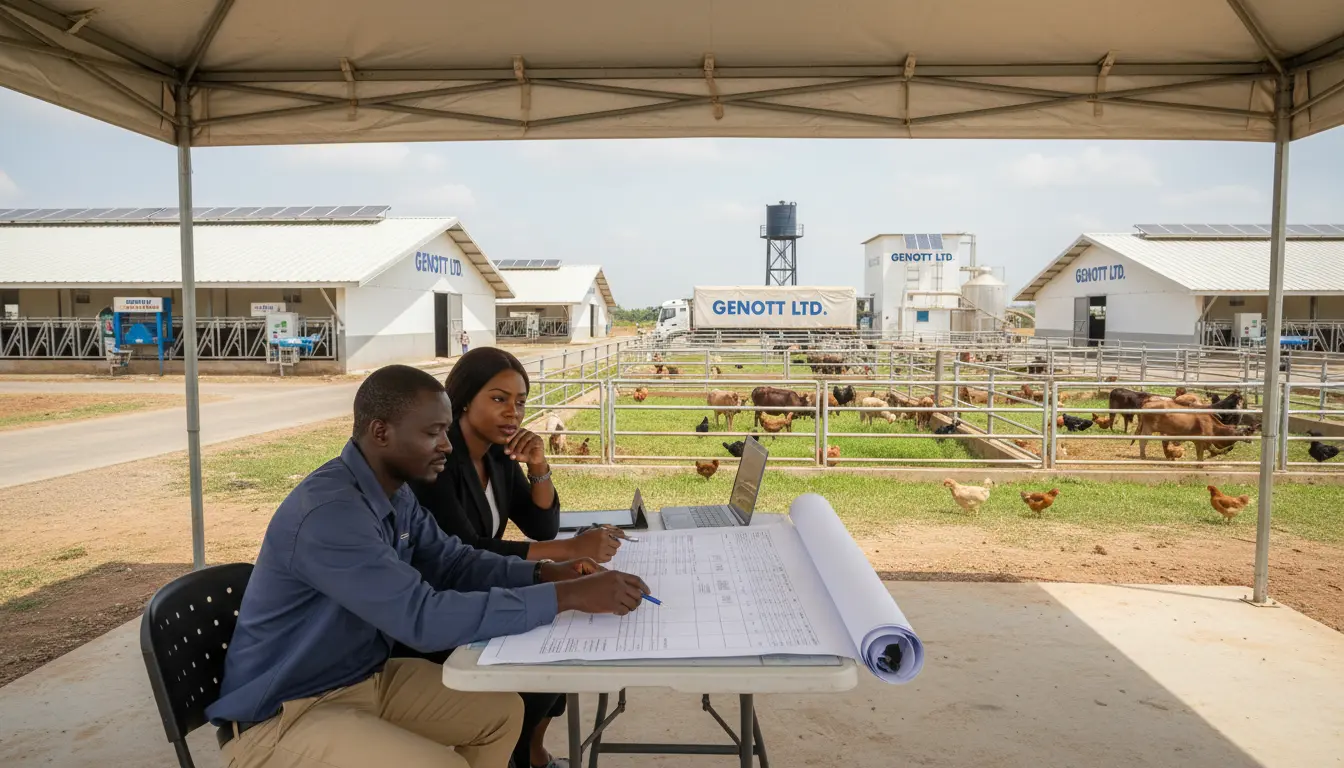
Engineer_reviewing_boq_farm_layout 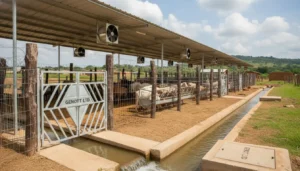
Livestock_pens_in_nigeria
Future Trends & Strategic Insights (2026+)
-
More structured finance and risk-sharing in agriculture—NIRSAL’s CRG positioning (up to 75% coverage) supports ongoing de-risking momentum.
-
Greater compliance pressure at scale (movement controls, inspection posts, permits) as livestock trade formalizes.
-
Insurance becomes more normal in funded projects, especially where lenders require risk cover.
-
Integration becomes the competitive moat: fodder + storage + logistics + contracts will separate scalable farms from hobby farms.
FAQs
1) What should a Livestock Business Plan in Nigeria contain?
Executive summary, market channels, technical model, CAPEX/OPEX budget, monthly cashflow (12–24 months), ROI/sensitivity tests, risks, and funding document pack.
2) How do I write a livestock feasibility study Nigeria investors will accept?
Use unit economics, conservative assumptions, stress tests (feed +20%, price –15%), and show infrastructure + risk controls.
3) What is the typical livestock farming startup cost Nigeria investors should budget?
It depends on species and scale, but the biggest drivers are land access, water systems, housing, fencing/security, and working capital. Always separate CAPEX from OPEX.
4) What funding options exist for livestock farming in Nigeria?
Common paths include BOI (project-style requirements), BOA (farmer-focused products), and de-risking mechanisms through NIRSAL’s CRG.
5) Does BOI require a business plan for funding?
Yes—BOI’s checklist for relevant funds includes a Business Plan and other documentation like CAC registration, tax clearance, and valuation.
6) How does NIRSAL help livestock businesses access finance?
NIRSAL offers risk-sharing tools like Credit Risk Guarantee, stating coverage can be up to 75% on principal and accrued interest depending on tiers.
7) Is livestock insurance available in Nigeria?
NAIC provides agricultural insurance functions including premium subsidy up to 50% on selected policies, and its portal describes livestock coverage against risks including disease/death/theft.
8) Do I need permits to move livestock across states?
Nigeria’s animal disease control framework includes inspection/control structures and movement controls for trade animals; large-scale operators should plan documentation and records.
CONCLUSION
A serious Livestock Business Plan in Nigeria is a decision tool, not paperwork. If your feasibility study proves unit economics, includes a monthly cashflow with buffers, separates CAPEX from OPEX, and survives downside stress tests, you can confidently approach funding and scale without “surprise losses.” The best livestock investors in Nigeria treat livestock like an integrated infrastructure-and-logistics business: water, housing, feed storage, security, compliance, and buyer contracts—then animals.
If you want long-term profitability, build the plan to survive bad seasons, not only good ones.
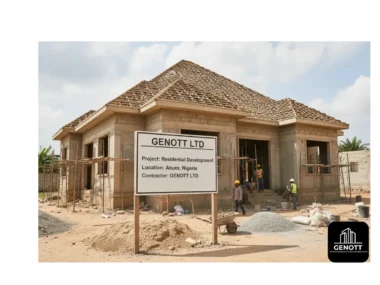
For professional support, GENOTT LTD provides expert guidance in livestock project feasibility studies, BoQ and construction planning (pens, fencing, drainage, water systems), farm access-road design, and investment-ready documentation for lenders and partners.

 GENOTT LTD Editorial Team