 GENOTT LTD Editorial Team
Integrated livestock farming in Nigeria is no longer a “big man’s hobby”—it’s becoming a serious, structured investment response to three Nigerian realities: expensive feed, climate pressure, and market volatility. If you’re building for scale (feedlot, ranch, dairy, poultry, sheep/goat, or mixed systems), your real advantage won’t just be animal numbers—it will be your integration design: how you connect feed production, water, housing, animal health, processing, logistics, and sales into one profitable system.
Nigeria’s policy direction has also shifted toward more organized livestock systems (including ranch-style solutions and value chain modernization) to improve productivity and reduce conflict risks tied to open grazing. At the same time, macro pressures—high food inflation, transport costs, and input volatility—make “buy feed and pray” a weak business strategy.
This guide is written for investors at different layers (starter to institutional). It covers feedlot investment in Nigeria, ranch development planning, crop-livestock integration for feed-cost reduction, export readiness, climate resilience, realistic cost logic in naira, and the legal/compliance workflows Nigerian operators often ignore until it becomes expensive.
SUMMARY TABLE
| Topic | Key Insight | Notes |
|---|---|---|
| Investment logic | Integration wins by reducing feed + mortality + logistics losses | “System design” beats herd size |
| Feedlot economics | Profit depends on cost/kg gain and sale timing | Feed volatility is the #1 risk |
| Ranch development | Requires water, pasture plan, fencing, and access roads | Align with NLTP direction |
| Legal/compliance | Movement permits and animal health controls exist in law | Plan documentation early |
| Export potential | Export readiness needs NAQS + veterinary cert processes | Start traceability now |
| Climate resilience | Water scarcity is rising; plan boreholes + storage + fodder | North is especially exposed |
| Best model for scale | Hybrid systems (pasture + feedlot finishing + crops) | Balances cost and growth |
Why Integrated Livestock Farming Matters in Nigeria (Now More Than Ever)
Integrated livestock farming in Nigeria is simply the practice of running livestock as part of a connected production system, not an isolated activity. Instead of buying feed at peak prices and selling animals into unpredictable markets, you build a system where:
-
Crops support animals (fodder, silage, residues, by-products)
-
Animals support crops (manure, compost, biogas slurry)
-
Infrastructure supports both (water, access roads, storage, power)
-
Markets are planned (contracts, off-take, seasonal finishing)
The Nigerian drivers pushing integration
-
Policy direction toward modernized livestock systems
Nigeria’s National Livestock Transformation Plan (NLTP) is explicitly about transforming the livestock sector—improving productivity, reducing conflict, and encouraging more organized systems. -
Input and logistics volatility
Food inflation and transport costs have put constant pressure on farm inputs and consumer demand. Integration reduces how exposed your margins are to these shocks. -
Climate pressure (especially water)
Reporting highlights growing water scarcity affecting Nigerian agriculture, particularly in northern regions—an issue that hits pasture, fodder yields, and animal hydration. -
Market opportunity + substitution
Nigeria is actively trying to grow domestic livestock productivity (e.g., dairy efforts and pasture improvements), which signals institutional interest and future ecosystem improvements (inputs, genetics, pasture species).
Investor takeaway: Integration isn’t a “nice-to-have.” It’s a risk management system that also improves profitability.
Step-by-Step Breakdown: Building a Commercial Integrated Livestock System (Feedlot + Ranch + Value Chain)
This is the practical pathway investors should follow—whether you’re building near Abuja, scaling outside Lagos, or developing a ranch corridor in the North.
Step 1: Choose your operating model (the backbone of the investment)
You’ll typically pick one of these:
A) Ranch-based production (grazing + fodder)
-
Best where land is available and security is manageable.
-
Strong long-term cost advantage if pasture and water are well designed.
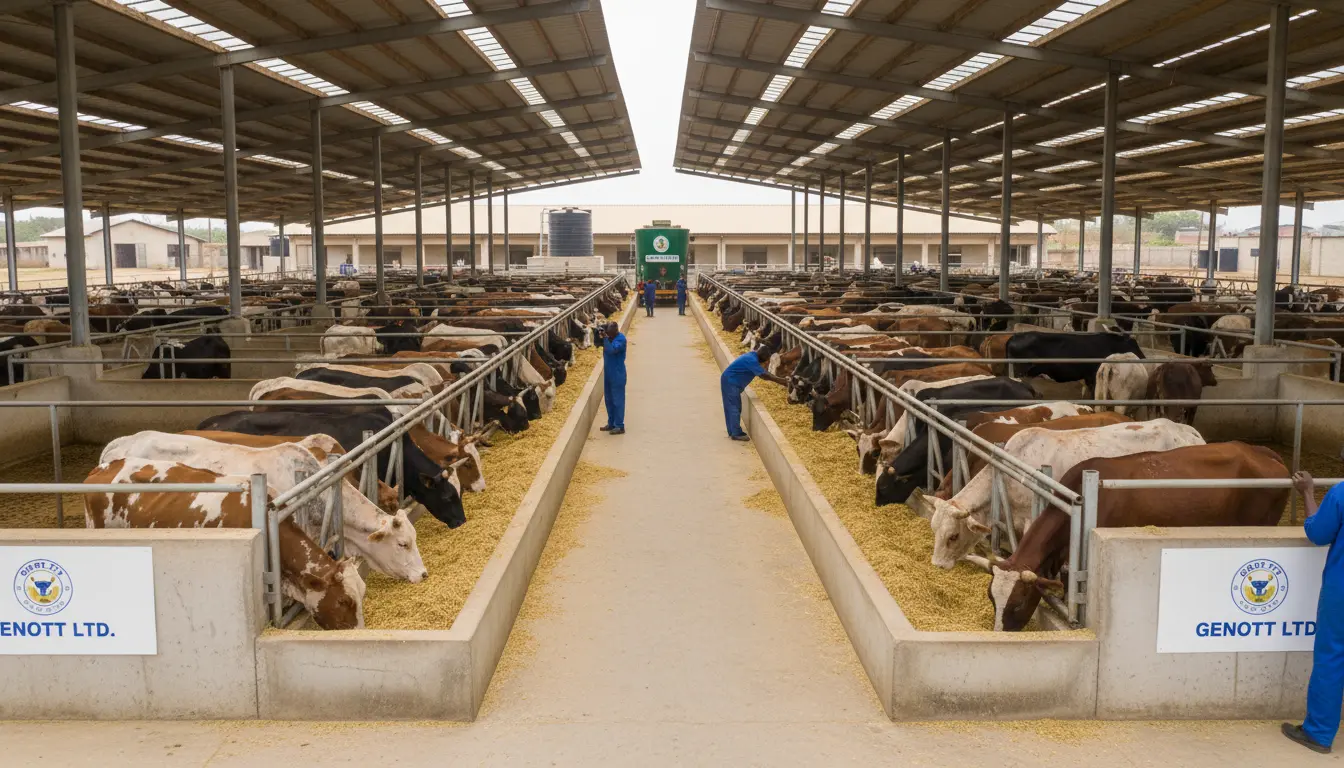
B) Feedlot finishing (intensive fattening)
-
Buy animals or grow them, then finish them on high-energy rations.
-
Works well near big markets (Lagos/Abuja/PH) where speed and uniformity matter.
C) Hybrid integrated model (most scalable in Nigeria)
-
Pasture + cut-and-carry fodder for base growth
-
Feedlot finishing for 60–120 days before peak sales
-
Crops (maize/sorghum/napier/alfalfa substitutes) to reduce purchased feed
Step 2: Site selection (Nigeria-specific investor checklist)
A good site is not just “cheap land.” It must satisfy five constraints:
-
Market access: proximity to abattoirs, wholesalers, or urban demand corridors (e.g., Lagos–Ibadan axis, Abuja–Kaduna axis, Enugu–Onitsha corridor)
-
Water security: borehole yield + storage + distribution plan (assume stress seasons)
-
Road access: trucks must enter during rainy season (civil works matter)
-
Security profile: perimeter design + local intelligence + response plan
-
Disease and control-point reality: plan movement documentation and health controls
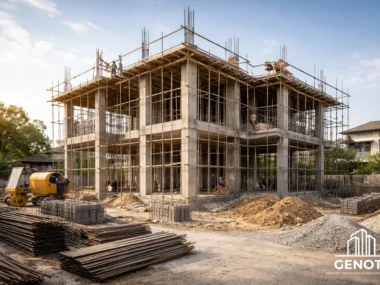
Step 3: Masterplan the farm (Architecture + Construction + Agriculture)
This is where most “livestock projects” fail—because they underbuild the system.
Minimum zones for a high-scale integrated layout
-
Receiving + quarantine pen (separate airflow, separate tools)
-
Main housing blocks (ventilation, drainage, shaded loafing)
-
Feed mill / mixing bay + dry store
-
Hay/silage storage (weather-proof)
-
Water: borehole + overhead tank(s) + trough network
-
Loading bay & animal handling race (reduces stress injuries)
-
Manure yard / composting / biogas zone
-
Staff housing + security post + perimeter lighting
Why this matters: Feedlots and large ranches are logistics businesses. If your layout causes wasted movement, wet pens, poor ventilation, or feed spoilage, your cost/kg gain jumps—quietly killing ROI.
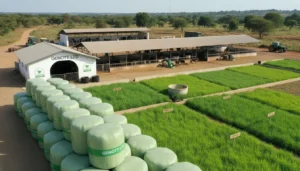
Step 4: Build the “feed system” before scaling animals
In integrated livestock farming in Nigeria, animals are the last thing you scale—not the first.
A bankable feed system includes:
-
Dry season plan (fodder bank, silage, hay)
-
Wet season plan (rapid growth + conservation)
-
By-product strategy (bran, brewers grains where available, crop residues)
-
Feed quality control (mycotoxin risk, adulteration risk)
-
Cost tracker (₦/kg DM, ₦/kg gain)
Step 5: Put compliance and traceability in place early (don’t retrofit later)
If you ever want serious off-take contracts or export-grade positioning, you need:
-
animal health records
-
movement documentation discipline
-
vaccination/deworming schedules
-
batch identification (simple tagging system)
Nigeria’s animal disease control framework includes movement permit expectations and controls for trade animals.
Cost Analysis & Investment Insights (₦): What Investors Should Budget For
Costs vary heavily by location and scope, so the correct approach is: CAPEX vs OPEX, then size-specific ranges, then stress tests.
CAPEX (Capital Expenditure): “Build the asset”
Typical CAPEX buckets:
-
Land acquisition/lease premium + surveying/approvals
-
Earthworks + drainage + internal roads
-
Housing pens + roofing + flooring
-
Fencing + gates + lighting/security
-
Water system (borehole, tanks, piping)
-
Feed store + hay/silage storage
-
Small feed mill / mixing equipment (for feedlots)
-
Handling facilities (race, crush, loading ramp)
-
Power (generator/solar hybrid depending on strategy)
OPEX (Operating Expenditure): “Run the system”
Typical OPEX:
-
Feed ingredients + supplements
-
Veterinary care + meds + disinfectants
-
Labor + security
-
Transport (animals, feed inputs, product)
-
Repairs + bedding + utilities
-
Compliance costs (inspections, documentation)
Practical CAPEX planning ranges (2026 Nigeria reality)
These are planning ranges. Final numbers must come from a Bill of Quantities (BoQ) and local quotes.
| Scale | What it looks like | Typical CAPEX Range |
|---|---|---|
| Starter-SME | 50–150 head (hybrid, basic feed mixing, strong fencing) | ₦8m – ₦35m |
| SME-Commercial | 200–500 head feedlot finishing + fodder plots | ₦40m – ₦180m |
| Institutional | 1,000+ head systems + processing + strong roads/water | ₦250m – ₦1bn+ |
Why feed cost dominates the model
Feed is often the largest variable cost in feedlot investment in Nigeria. When commodity prices rise, livestock margins compress quickly—seen across Nigerian agriculture value chains when maize/soy prices rise.
Investor rule: Do not approve a feedlot model without:
-
cost/kg gain estimate
-
feed +20% stress scenario
-
selling price –15% scenario
-
mortality/theft scenario
Feed Cost Reduction Strategies (Crop–Livestock Integration That Actually Works)
Integrated livestock farming in Nigeria becomes profitable when you reduce purchased feed dependence.
1) Fodder block model (high impact for Nigeria)
Allocate land to:
-
Napier/elephant grass (where suitable)
-
Sorghum (dual-purpose grain + stover)
-
Maize (grain + silage potential)
-
Legume for protein support (depending on zone)
-
Drought-tolerant species where water stress is severe
Climate pressures (water scarcity, shifting seasons) make fodder planning and water infrastructure non-negotiable.
2) Silage + hay = your dry-season insurance
If you run scale, your biggest risk is buying feed when everyone is buying feed. Silage/hay reduces this exposure.
3) By-product economics (Nigeria reality)
Use what is locally abundant and consistent:
-
Bran/offal from mills
-
Brewers grains near breweries
-
Crop residues (treated/processed properly)
The goal is stable, safe calories—not “cheap but risky” feed.
4) Feed mill micro-integration (even small-scale)
A small mixing bay with proper storage can reduce:
-
adulteration risk
-
spoilage losses
-
procurement chaos
Ranch Development in Nigeria: What “Real Ranching” Requires (Beyond Fencing)
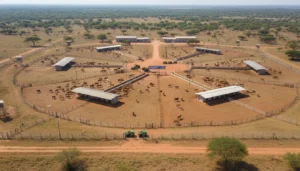
Ranch development in Nigeria is not just “buy land and fence it.” It’s a managed ecology + infrastructure system.
The non-negotiables of a bankable ranch
-
Water grid: boreholes, solar pumps, tanks, troughs, redundancy
-
Pasture plan: rotational grazing paddocks, reseeding, dry-season feed bank
-
Animal handling: race/crush/loading ramp to reduce injuries
-
Security architecture: perimeter design, lighting, controlled access
-
Conflict and governance awareness: ranching is often discussed in Nigeria as part of broader efforts to reduce farmer-herder conflict; NLTP is within that conversation.
Integrated Livestock Farming in Nigeria
Policy alignment (investor confidence)
NLTP materials and independent analysis make clear that Nigeria has tried to move toward more organized systems and reduce uncontrolled movement—important context for long-horizon ranch investments.
Livestock Value Chain Integration (Where the Real Money Is)
Many Nigerian livestock businesses fail because they only invest in animals. High-scale investors invest in the value chain.
The 6-layer livestock value chain stack
-
Inputs: feed ingredients, vet supplies, genetics
-
Production: ranch/feedlot/housing systems
-
Aggregation: collection points, weighing, grading
-
Processing: abattoir, cold chain, packaging
-
Distribution: refrigerated logistics, wholesalers, retail contracts
-
Brand + compliance: standards, traceability, certifications
Even without owning processing, you can integrate through contracts and shared facilities.
Export Potential: What Nigeria-Based Livestock Investors Must Build For
Export is not a “later” idea. Export readiness is built from day one through hygiene, records, and compliance.
What export readiness typically requires (Nigeria institutions)
Nigeria export guidance highlights relevant competent authorities and documentation—such as NAQS and veterinary certification for animals/animal products.
NAQS operating procedures also describe export permit steps, inspections, and quarantine measures.
Practical export-ready actions you can implement now
-
Batch records (inputs, treatments, growth)
-
Vaccination/deworming logs
-
Hygiene standard operating procedures
-
Identifiable lots (tags) and movement logs
-
Partner mapping: NAQS, veterinary services, credible processors
Investor note: Many livestock exports are effectively “systems exports”—buyers pay for trust (standards, traceability, consistent quality), not just volume.
Climate Resilience: Designing Livestock Systems for Nigeria’s New Weather Reality
Climate resilience is now part of ROI.
What climate pressure looks like in Nigeria
Reporting indicates increasing drought and water scarcity challenges affecting farm productivity, especially in northern regions.
Resilience measures that directly protect profits
-
Water redundancy (borehole + storage + backup pump)
-
Shade and heat-stress design (orientation, ventilation)
-
Fodder conservation (silage/hay)
-
Diversified feed sources (reduce dependence on one commodity)
-
Health management (heat stress increases disease susceptibility)
Nigeria’s push to register new pasture species in recent efforts to improve dairy/pasture systems signals growing attention to pasture productivity—relevant for ranch and hybrid systems.
Comparisons & Alternatives (Tables): Feedlot vs Ranch vs Hybrid Integrated Systems
| Model | Best use-case in Nigeria | Pros | Cons | Investor fit |
|---|---|---|---|---|
| Feedlot (intensive) | Near Lagos/Abuja big markets; finishing for peak windows | Fast turnover, uniform product | Feed price exposure; needs strong biosecurity | SME to Institutional |
| Ranch (extensive/managed grazing) | Land-advantaged regions; long-term cost advantage | Lower purchased feed cost, scalable | Water/security/pasture management heavy | SME to Institutional |
| Hybrid integrated | Most of Nigeria; balance of cost + control | Reduces feed exposure, improves cashflow | Requires planning discipline | Best overall |
Common Mistakes Nigerians Make
-
Scaling animals before scaling feed (then suffering feed cost shocks)
-
Underbuilding water infrastructure (then dry-season losses)
-
Ignoring movement documentation reality until shipments get delayed
-
No quarantine pen (new stock introduces disease into whole herd)
-
Weak housing design (wet floors, poor ventilation → slow growth, high meds)
-
No buyer strategy (selling only to middlemen, losing margin)
-
No cost/kg gain tracking (you can’t manage what you don’t measure)
-
Security treated as optional (theft wipes out months of work)
Expert Recommendations
If you want an investment-grade system, build it like infrastructure—because it is.
GENOTT LTD’s “Investment-Grade Livestock Build Framework”
1) Feasibility → concept design
-
market corridor and offtake mapping (Abuja, Lagos, Enugu routes)
-
land suitability + water yield checks
-
model choice (feedlot/ranch/hybrid)
2) Masterplan + BoQ
-
pen blocks, drainage, roads, feed stores
-
water grid and storage
-
security architecture
-
expansion-ready layout
3) Compliance + operating SOP
-
quarantine, health schedule, records
-
movement and trade documentation discipline
4) Commercial rollout
-
buyer channels + contracts
-
logistics plan + delivery standards
-
data dashboard (growth, feed, mortality, costs)
Future Trends & Strategic Insights (2026+)
-
More intensive, organized systems
National discussions and plans reflect a continued push toward more organized livestock production and value chain improvements. -
Pasture and genetics modernization
Reported initiatives around dairy and pasture improvements suggest expanding institutional attention to productivity gains. -
Stronger export discipline
Export competitiveness will increasingly reward operators with NAQS/veterinary documentation readiness and traceability systems. -
Climate-smart infrastructure becomes ROI-critical
Water infrastructure, fodder conservation, and heat-stress design will separate survivors from casualties.
FAQs
1) What is integrated livestock farming in Nigeria?
It’s a system where livestock is connected to feed production, water, housing, health, processing/logistics, and markets—so profits come from efficiency, not luck.
2) Is feedlot investment in Nigeria profitable?
It can be, but only if you track cost/kg gain, secure feed supply, manage health tightly, and stress-test against feed price rises and selling price drops.
3) What does ranch development in Nigeria typically require?
Land, pasture plan, rotational paddocks, water grid, fencing/security, and handling facilities—plus a clear market route and governance strategy.
4) What legal steps should commercial livestock operators plan for?
Animal movement controls and permits exist in Nigeria’s animal disease control framework; serious operators plan documentation and health records early.
5) How can I reduce feed costs in commercial livestock systems in Nigeria?
Use crop-livestock integration: fodder plots, silage/hay, by-products, storage, and ration discipline—so you’re less exposed to volatile commodity markets.
6) Which Nigerian locations are best for high-scale livestock projects?
It depends on your model: feedlots benefit from proximity to Lagos/Abuja markets; ranch/hybrid models benefit from land and water feasibility plus strong security and road access.
7) Can Nigerian livestock businesses export?
Export readiness is possible, but requires documentation and competent authority processes (NAQS + veterinary certification and inspections).
8) How does climate change affect livestock investment in Nigeria?
Water scarcity and shifting seasons increase feed and water risk—so resilient water systems and fodder conservation become profit protection.
CONCLUSION
Integrated livestock farming in Nigeria is fundamentally a systems investment. The biggest profits at scale come from linking feed security, water resilience, infrastructure design, disease control, logistics, and market strategy into one coordinated model. Feedlots can generate fast turnover near urban demand, ranching can unlock long-term cost advantages where land and water are feasible, and hybrid systems often deliver the best balance in Nigerian conditions.
If you treat livestock as a complete value chain—not just animals—you can build a resilient operation that survives feed inflation, climate stress, and market swings while positioning for higher-margin contracts and eventual export readiness.
For professional support, GENOTT LTD provides expert guidance in farm masterplanning, pen and feedlot construction, ranch layout, water systems, fencing/security design, access road planning, and livestock project feasibility—helping investors build scalable, compliant livestock assets in Nigeria.

 GENOTT LTD Editorial Team