 GENOTT LTD Editorial Team
On November 1, 2021, a 21-story luxury building under construction in Ikoyi, Lagos, collapsed within seconds, killing 45 people and sending shockwaves through Nigeria’s construction industry. Three months later, another building crumbled in Ebute Metta. These aren’t isolated incidents—Nigeria experiences dozens of building collapses annually, claiming nearly hundreds of lives and destroying billions of naira in property.
The tragedy? Nearly every collapse is preventable. Building collapse prevention in Nigeria doesn’t require revolutionary technology or massive budgets—it demands adherence to fundamental structural engineering principles that save lives and protect investments. Yet across Lagos, Abuja, Port Harcourt, and other Nigerian cities, developers continue making fatal mistakes: skipping ₦500,000 soil investigations to save costs, adding unauthorized floors to existing structures, using substandard materials, and bypassing qualified structural engineers entirely.
This comprehensive analysis examines the exact structural engineering mistakes that transform buildings into death traps, from foundation design failures costing lives to material quality compromises, professional negligence, and regulatory gaps. Whether you’re a property developer investing ₦50M-₦500M, a building owner, prospective buyer, or concerned citizen, understanding these critical errors and their prevention strategies could save your life, protect your investment, and prevent the next preventable tragedy.
QUICK SUMMARY
| Cause of Collapse | Common Mistake | Prevention Cost | Consequence |
|---|---|---|---|
| Foundation Failure | Skipping soil investigation | ₦300,000-₦800,000 | Total building loss (₦50M-₦500M+) |
| Design Errors | Unqualified “designers” | ₦2M-₦8M (proper engineer) | Structural collapse, deaths |
| Material Defects | Substandard cement/concrete | ₦500-₦2,000/bag difference | Progressive failure, sudden collapse |
| Supervision Gaps | No engineer oversight | ₦500,000-₦2M monitoring | Construction defects, instability |
| Load Violations | Adding unauthorized floors | ₦3M-₦15M redesign | Overloading, catastrophic failure |
Why Building Collapse Prevention in Nigeria Requires Urgent National Attention
Nigeria’s building collapse epidemic represents a public health crisis masked as construction failure. The Lagos State Building Control Agency (LASBCA) records 60-100 building collapse incidents annually across Lagos alone, with similar patterns in Abuja, Port Harcourt, Kano, and other major cities. Conservative estimates suggest 150-200 people die yearly in preventable structural failures—a death toll comparable to major disasters yet normalized through frequency.
The economic impact compounds human tragedy. Each major collapse destroys ₦50M-₦500M in direct property value, with cascading costs including:
- Emergency response and rescue operations
- Medical treatment for survivors
- Legal proceedings and compensation claims
- Neighboring property damage
- Market confidence erosion in affected areas
- Insurance premium increases industry-wide
The Nigerian Construction Regulatory Gap
Several unique factors intensify building collapse risks in Nigerian contexts:
Weak Enforcement: Building codes exist (National Building Code 2006, Lagos State Building Regulations), but enforcement remains inconsistent. Developers routinely bypass approval processes through corruption or operate in areas with minimal regulatory presence.
Professional Shortage: Nigeria has approximately 15,000 registered engineers (COREN) serving 220 million people. Demand far exceeds qualified professional supply, creating opportunity for unqualified practitioners.
Cost Pressure Culture: Extreme budget consciousness drives developers toward “cost-saving” measures that compromise safety: skipping soil tests, hiring unqualified designers, using substandard materials, eliminating professional supervision.
Limited Public Awareness: Most property buyers and building owners cannot distinguish qualified structural engineers from self-proclaimed “designers” or assess structural integrity indicators.
Informal Construction Dominance: An estimated 60-70% of Nigerian construction occurs informally without permits, approved drawings, or professional engineering involvement.
Understanding building collapse prevention in Nigeria requires confronting these systemic challenges while implementing proven technical solutions.
Fatal Foundation Design Mistakes and Soil Investigation Failures
Foundation failure represents the most catastrophic structural engineering mistake, as it typically causes total building collapse rather than localized damage. Yet it’s also the most commonly compromised element in Nigerian construction.
The ₦500,000 Shortcut That Costs ₦500 Million
Geotechnical Investigation Reality:
- Professional soil testing cost: ₦300,000-₦800,000 for typical residential plots
- Timeline: 2-3 weeks for drilling, laboratory analysis, engineering report
- Information provided: Soil bearing capacity, water table level, foundation recommendations, settlement predictions
Developer “Cost-Saving” Approach:
- Skip soil investigation entirely
- Assume soil conditions based on neighboring buildings
- Use generic foundation design regardless of actual ground conditions
- Result: Foundation inadequate for actual soil bearing capacity
Ikoyi 21-Story Collapse Analysis (2021):
Preliminary investigations revealed multiple foundation-related failures:
- Inadequate pile foundation depth for 21-story load
- Possible soil bearing capacity miscalculation
- Construction on reclaimed land without proper treatment
- Foundation design possibly based on assumptions rather than site-specific testing
Cost Comparison:
- Proper geotechnical investigation: ₦600,000
- Redesigned foundation based on actual soil data: ₦8M-₦15M additional
- Building collapse total loss: ₦5 billion+ (property + lives + legal costs)
- ROI on soil testing: 8,000%+
Foundation Type Selection Errors
Nigerian Soil Conditions Require Specific Foundation Approaches:
Laterite Soil (Common in Central Nigeria – Abuja, Jos):
- Good bearing capacity (150-300 kN/m²)
- Strip or pad foundations suitable for low-rise (1-3 stories)
- Raft foundation for 4-6 stories
- Concern: Seasonal volume changes require proper depth
Clay Soil (Lagos, Port Harcourt Coastal Areas):
- Poor bearing capacity (50-150 kN/m²)
- High water content and compression
- Raft or pile foundations mandatory for 3+ stories
- Settlement risk requires careful design
Sandy Soil (Coastal and Riverine Areas):
- Variable bearing capacity (100-250 kN/m²)
- Water table considerations critical
- Pile foundations for high-rise
- Erosion and undermining risks
Reclaimed/Swampy Land (Victoria Island, Lekki, Warri):
- Extremely poor bearing capacity (<50 kN/m²)
- Mandatory pile foundations regardless of height
- Soil improvement techniques required
- Settlement monitoring essential
Common Fatal Error: Using strip foundation (appropriate for 2-story on good soil) for 5-story building on clay soil. Foundation fails progressively, building tilts, then collapses.
Differential Settlement and Adjacent Excavation Dangers
Lagos Island/Ikoyi Pattern:
Dense urban development creates foundation interaction risks:
- Developer excavates deep basement for new building
- Excavation removes lateral soil support from neighboring foundation
- Neighbor’s building experiences differential settlement
- Cracks appear, structural distress develops
- Without intervention, collapse follows
Prevention Requirements:
- Notify neighbors before deep excavation
- Provide temporary shoring and underpinning
- Monitor adjacent structures during construction
- Legal liability for excavation-induced damage
Structural Design Calculation Errors and Load Miscalculations
Professional structural engineering distinguishes safe buildings from disaster-waiting-to-happen. Yet developers frequently bypass this critical expertise to save ₦2M-₦8M—a decision that costs hundreds of millions when structures fail.
The “Designer” vs. Structural Engineer Distinction
COREN-Registered Structural Engineer:
- Minimum: 5-year engineering degree + professional practice + registration
- Licensed to design structures, sign structural drawings
- Professional indemnity insurance (₦5M-₦50M coverage)
- Continuous professional development requirements
- Legal liability for design adequacy
Unqualified “Designer/Draftsman”:
- Often CAD operators or building technologists
- No structural engineering qualifications
- Cannot legally sign structural drawings
- No insurance coverage
- Common in informal construction sector
Reality Check: Estimated 40-60% of Nigerian residential buildings (especially 1-3 stories) built without qualified structural engineer involvement.
Adding Floors Without Structural Reassessment
Deadly Common Scenario:
- Original Design: 2-story residential building, approved structural drawings, ₦25M construction
- Year 2 Decision: Developer adds 3rd floor without consulting structural engineer
- Year 4 Decision: Adds 4th floor, still no structural assessment
- Year 6 Reality: Building now carries 2x original design load
- Failure Mechanism: Columns, beams, foundation designed for 2 stories gradually deform under 4-story load
- Collapse Trigger: Additional occupancy load (furniture, people) or minor structural shock exceeds capacity
Prevention Cost: ₦3M-₦15M structural redesign and strengthening Collapse Cost: Total loss ₦60M-₦150M + potential deaths
Critical Load Calculation Errors
Dead Load (Permanent Weight):
- Structural elements: concrete, steel, blocks
- Finishes: tiles, plaster, roofing
- Fixed services: staircases, tanks
Live Load (Occupancy/Use):
- Residential: 1.5-2.5 kN/m²
- Office: 2.5-4.0 kN/m²
- Commercial/retail: 4.0-5.0 kN/m²
- Storage/warehouse: 7.5-15.0 kN/m²
Wind Load (Lateral Forces):
- Increases exponentially with height
- Critical for buildings >3 stories
- Requires shear walls or bracing systems
Common Miscalculations:
- Ignoring wind load entirely (catastrophic for tall buildings)
- Using residential live load for commercial conversion
- Forgetting rooftop water tank weight (10,000L = 10 tons)
- Inadequate load factors of safety
Undersized Structural Members
Example: 5-Story Building in Surulere, Lagos
Inadequate Design:
- Ground floor columns: 230mm × 230mm
- Required for load: 300mm × 300mm minimum
- Steel reinforcement: 8 bars of 12mm diameter
- Required: 12 bars of 16mm diameter
Progressive Failure Pattern:
- Months 1-12: No visible issues
- Months 13-24: Minor cracks appear in columns
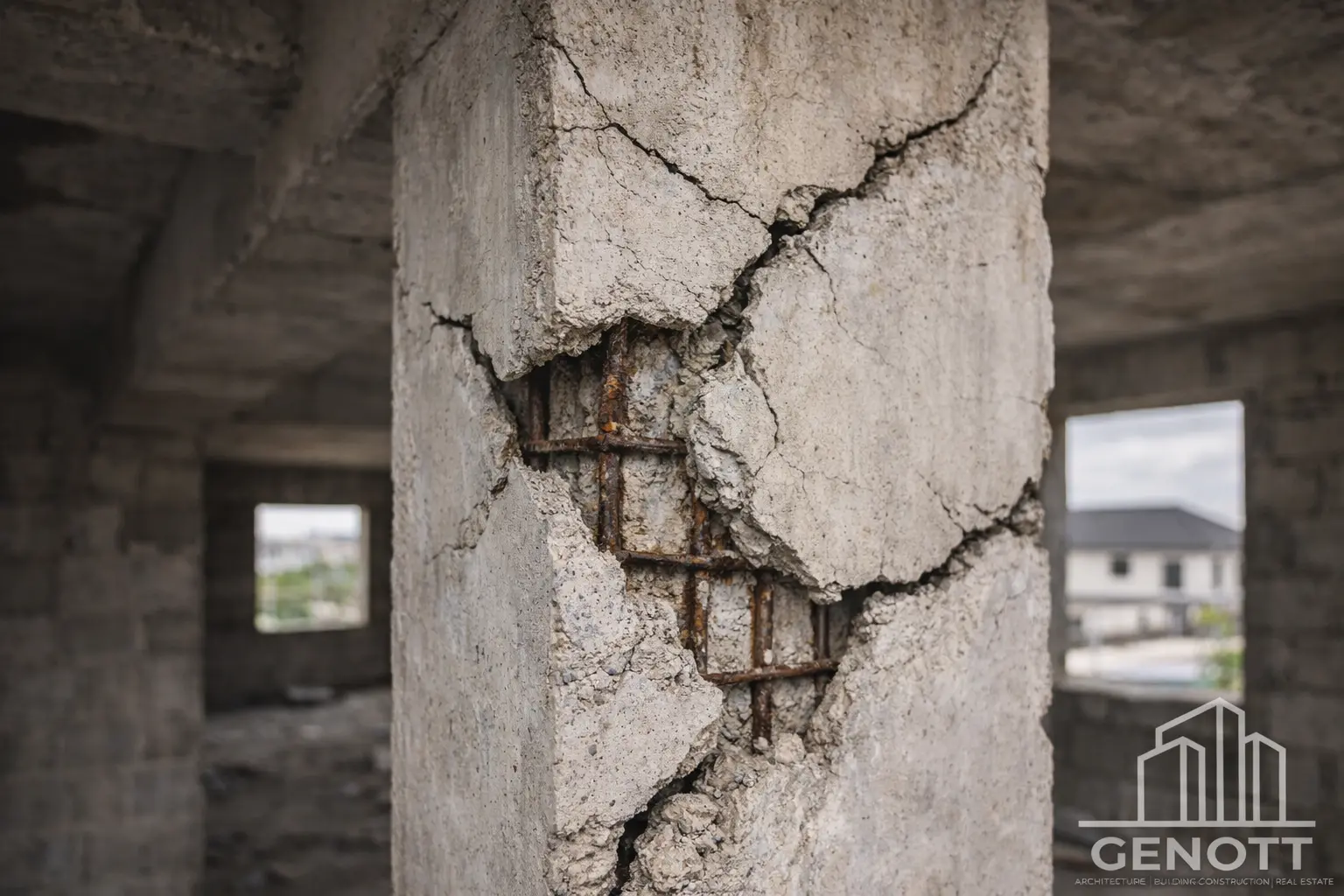
- Months 25-36: Cracks widen, spalling occurs
- Months 37-48: Columns visibly deformed
- Month 49: Sudden total collapse
Detection: Professional structural audit in Month 18 could identify undersized members, allow retrofitting, prevent collapse. Cost: ₦800,000 audit + ₦8M-₦15M strengthening vs. ₦120M total loss.
Material Quality Failures and Concrete Construction Defects
Concrete strength determines structural integrity in 90%+ of Nigerian buildings. Material quality compromises represent invisible time bombs ticking toward collapse.
The Cement Quality Crisis
Nigerian Cement Market Reality:
Premium Brands (Genuine):
- Dangote, Lafarge, BUA
- Price: ₦6,500-₦8,500/bag (50kg)
- Strength: Meets 42.5N/mm² standard
- Consistent quality control
Substandard/Counterfeit:
- Unknown brands, repackaged materials
- Price: ₦3,500-₦5,000/bag
- Actual strength: 15-25N/mm² (60% below standard)
- No quality guarantee
Developer “Savings” Calculation:
- Building requires 800 bags cement
- Savings: ₦3,000/bag × 800 = ₦2.4M
- Consequence: Concrete strength 40-60% below design assumption
- Building safety factor eliminated or inverted (unsafe load capacity)
Case Study: Ebute Metta Collapse (2022):
Post-collapse concrete testing revealed:
- Specified strength: 25N/mm² minimum
- Actual strength: 12-18N/mm² (50% deficiency)
- Cause: Substandard cement + wrong mix ratio
- Result: 6 deaths, ₦85M property loss
Concrete Mix Ratio Violations
Standard Structural Concrete Mix Ratios:
| Application | Mix Ratio | Strength | Use |
|---|---|---|---|
| Foundation | 1:2:4 | 20-25 N/mm² | Strip, pad foundations |
| Columns/Beams | 1:1.5:3 | 25-30 N/mm² | Structural members |
| Slabs | 1:2:4 | 20-25 N/mm² | Floor slabs |
| High-Rise | 1:1:2 | 30-40 N/mm² | Tall building columns |
Common Site Violations:
- Using 1:3:6 (weak mix) for structural members
- Inconsistent batching (no measurement, “by eye”)
- Adding excessive water to improve workability (reduces strength 30-50%)
- Mixing different cement brands within single structural element
Premature Formwork Removal Disaster
Concrete Strength Development Timeline:
- 7 days: 65-70% of 28-day strength
- 14 days: 85-90% of 28-day strength
- 28 days: 100% design strength
Nigerian Construction Practice (Wrong):
- Remove formwork after 3-7 days to reuse immediately
- Load partially cured concrete with construction materials
- Result: Micro-cracking, permanent strength reduction, progressive failure
Correct Practice:
- Minimum 14 days before formwork removal for slabs/beams
- 21-28 days for heavily loaded members
- No loading until full strength achieved
- Adequate formwork inventory (cost: ₦2M-₦5M) prevents premature removal pressure
Reinforcement Steel Compromises
Standard Requirements:
- High-yield steel: 460 N/mm² minimum
- Proper sizing (8mm, 10mm, 12mm, 16mm, 20mm, 25mm as specified)
- Adequate cover (25-50mm) protecting from corrosion
- Proper lapping and anchorage lengths
Common Defects:
- Using mild steel (250 N/mm²) instead of high-yield
- Undersizing bars (12mm instead of specified 16mm)
- Insufficient cover leading to corrosion
- Poor lapping causing structural discontinuity
- Corroded bars from prolonged site storage
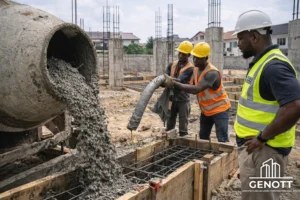
Mixing and pouring structural concrete 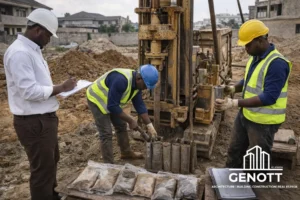
Professional soil investigation process
Construction Supervision Negligence and Professional Oversight Failures
The presence or absence of qualified structural engineering supervision during construction often determines building survival.
The Remote Sign-Off Scandal
Common Unethical Practice:
- Developer hires COREN-registered engineer to prepare structural drawings
- Engineer produces drawings, receives ₦2M-₦4M fee
- Developer proceeds with construction using unqualified site supervision
- Engineer never visits site during entire construction
- Engineer signs completion certificate remotely based on developer photos
- Building approved despite deviating significantly from drawings
Consequences:
- Critical design elements omitted or modified
- Material specifications ignored
- Construction sequence violations
- Defects hidden by finishes
- Engineer legally liable despite no actual oversight
Professional Standard:
- Minimum weekly site visits during structural construction phases
- Mandatory presence during critical pours (foundation, columns, slabs)
- Material testing verification
- Construction photo documentation
- Site instruction records
Supervision Cost: ₦500,000-₦2M for typical residential project (10-15% of structural engineering fee)
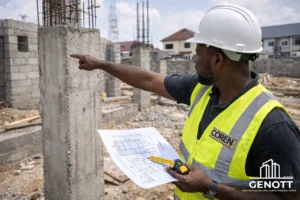
Building Without Approved Drawings
Lagos Statistics: An estimated 35-50% of buildings constructed without approved structural drawings or building permits.
Risks:
- No professional design review
- Structural adequacy unknown
- Regulatory violations
- Difficulty obtaining certificate of occupancy
- Property sale/transfer complications
- Collapse liability unclear
Approval Process:
- Submit architectural and structural drawings
- Regulatory review (LASBCA, Abuja FCDA, etc.)
- Approval timeline: 6-12 weeks
- Cost: ₦200,000-₦800,000 (varies by location and building size)
Developer Bypass Motivations:
- Avoid approval fees and delays
- Evade scrutiny of design inadequacy
- Build on disputed or improperly zoned land
- Construct unauthorized commercial use in residential zones
Missing Mandatory Stage Inspections
Required Construction Inspection Points:
Foundation Stage:
- Excavation depth and soil condition verification
- Reinforcement placement before concrete pour
- Concrete quality and curing
Structural Frame:
- Column and beam reinforcement
- Concrete strength testing
- Formwork adequacy
Roofing Stage:
- Roof structure load capacity
- Tie beam continuity
- Anchorage adequacy
Reality: Many developers skip inspections entirely or bribe inspectors to approve without actual verification.
Structural Distress Warning Signs and Building Collapse Prevention Strategies
Early detection and intervention prevent catastrophic failures. Building owners and occupants must recognize warning signs and act decisively.
Critical Warning Signs Requiring Immediate Professional Assessment
Crack Patterns and Severity:
Hairline Cracks (<1mm):
- Common in plaster/finishes
- Usually cosmetic (thermal expansion, minor settlement)
- Monitor for widening
Structural Cracks (>3mm):
- Diagonal cracks at 45° from corners (shear failure indication)
- Horizontal cracks in columns (serious structural distress)
- Vertical cracks in mid-span of beams (bending failure)
- Staircase separation from walls (differential settlement)
- Action Required: Immediate evacuation + structural engineer assessment
Severe Distress (>10mm or rapidly widening):
- Building tilting or leaning visibly
- Floor slabs sagging noticeably
- Columns bulging or spalling concrete
- Action Required: Immediate evacuation + emergency structural shoring + forensic investigation
Other Warning Indicators:
- Doors/windows no longer closing properly (frame distortion)
- Floor level changes or unevenness
- External wall bowing or bulging
- Roof structure sagging
- Foundation settlement visible externally
When to Conduct Structural Integrity Audits
Mandatory Assessment Scenarios:
Pre-Purchase (Existing Buildings):
- Cost: ₦300,000-₦1.5M depending on building size
- Includes: Visual inspection, non-destructive testing, loading assessment
- Identifies: Hidden structural defects, unauthorized modifications, distress signs
- Value: Prevents ₦20M-₦100M+ investment in compromised structure
Buildings >20 Years Old:
- Concrete deterioration assessment
- Reinforcement corrosion testing
- Foundation settlement monitoring
- Structural capacity reassessment for current codes
After Natural Events:
- Earthquakes (even minor tremors can create damage)
- Flooding that may have undermined foundations
- Major wind events causing structural stress
Before Major Renovations:
- Adding floors or significant loads
- Removing structural walls
- Changing building use (residential to commercial)
Non-Destructive Testing Methods
Rebound Hammer Test:
- Assesses concrete surface hardness
- Estimates compressive strength
- Cost: ₦50,000-₦150,000
- Non-invasive, quick results
Ultrasonic Pulse Velocity:
- Detects internal concrete defects
- Identifies honeycombing, voids
- Cost: ₦100,000-₦250,000
Core Sampling:
- Extracts concrete samples for laboratory testing
- Provides accurate strength measurement
- Slightly invasive (repairs needed)
- Cost: ₦80,000-₦200,000 per sample
Reinforcement Detection:
- Locates steel bars within concrete
- Measures cover depth
- Assesses corrosion potential
- Cost: ₦150,000-₦400,000
Structural Strengthening and Retrofitting
When existing buildings show deficiencies:
Column Jacketing:
- Add concrete or steel jacket around undersized columns
- Increases load capacity 40-100%
- Cost: ₦150,000-₦400,000 per column
Beam Strengthening:
- Carbon fiber wrapping or steel plate bonding
- Increases bending and shear capacity
- Cost: ₦200,000-₦600,000 per beam
Foundation Underpinning:
- Extends foundation depth or width
- Addresses settlement issues
- Cost: ₦2M-₦8M depending on extent
Shear Wall Addition:
- Improves lateral stability
- Critical for tall buildings without adequate bracing
- Cost: ₦5M-₦20M depending on building height
Regulatory Framework and Professional Certification
Key Nigerian Regulatory Bodies
COREN (Council for the Regulation of Engineering in Nigeria):
- Professional engineer registration and licensing
- Enforcement of engineering practice standards
- Verification: Check engineer registration at coren.gov.ng
NSE (Nigerian Society of Engineers):
- Professional association for engineers
- Continuing professional development
- Technical standards development
Lagos State Building Control Agency (LASBCA):
- Building permit approvals
- Construction monitoring and enforcement
- Post-collapse investigation
- Contact: lasbca.lagosstate.gov.ng
Abuja FCDA (Federal Capital Development Authority):
- FCT building regulations enforcement
- Development control and monitoring
Professional Fee Structures
Structural Engineering Services:
| Service | Cost Range | Project Size |
|---|---|---|
| Soil Investigation | ₦300K-₦800K | Standard residential plot |
| Structural Design (Residential) | ₦2M-₦8M | 3-bedroom to duplex |
| Structural Design (Commercial) | ₦5M-₦25M | Medium-scale development |
| Construction Supervision | ₦500K-₦2M | Per project monitoring |
| Structural Audit | ₦300K-₦1.5M | Existing building assessment |
| Retrofitting Design | ₦1M-₦5M | Strengthening works |
ROI Perspective: ₦8M professional engineering investment prevents ₦200M+ collapse loss (2,500% return).
Legal Liability and Insurance Framework
Who Pays When Buildings Collapse?
Legal Liability Hierarchy:
1. Developer/Property Owner:
- Primary responsibility for structural adequacy
- Criminal liability for negligence causing death
- Civil liability for property damage and injury compensation
2. Structural Engineer:
- Professional negligence if design inadequate
- Liability if supervision contractually required but not performed
- Defense: Professional indemnity insurance
3. Contractor:
- Liability for construction defects
- Material quality responsibility
- Workmanship standards
4. Regulatory Authorities:
- Potential liability for approval process failures
- Rare but possible in egregious cases
Professional Indemnity Insurance
Coverage:
- Design errors and omissions
- Professional advice negligence
- Court defense costs
- Settlement/compensation payments
Cost: ₦150,000-₦800,000 annually for individual engineers (coverage ₦5M-₦50M)
Reality: Majority of Nigerian engineers practice without insurance, leaving collapse victims with limited compensation recourse.
Compensation Frameworks
Government Response:
- Emergency financial assistance (₦500,000-₦2M per family for deaths)
- Typically inadequate compared to actual losses
Legal Recourse:
- Civil suits against responsible parties
- Timeline: 3-7 years for resolution
- Success rate: Low due to proof challenges and defendant insolvency
Insurance Claims:
- Building insurance (if maintained)
- Life insurance for deceased
- Professional indemnity (if engineer insured)
FAQ SECTION
Q: What are the most common causes of building collapse in Nigeria? A: The top five causes are: (1) Foundation failures from inadequate soil investigation (40% of collapses), (2) Use of substandard building materials especially cement and reinforcement (25%), (3) Adding unauthorized floors without structural reassessment (15%), (4) Construction without qualified structural engineer supervision (10%), (5) Premature formwork removal and improper concrete curing (10%). Nearly all collapses result from human error and professional negligence rather than unavoidable structural failures.
Q: How much does proper soil investigation cost and why is it important? A: Professional geotechnical soil investigation costs ₦300,000-₦800,000 for typical residential plots in Nigeria. This testing determines soil bearing capacity, water table levels, and appropriate foundation type. Skipping this test to save costs frequently results in foundation inadequacy causing total building collapse worth ₦50M-₦500M+. The ROI on soil testing exceeds 8,000%—it’s the single most cost-effective building collapse prevention investment.
Q: How can I verify if a structural engineer is properly qualified in Nigeria? A: Check three essential credentials: (1) COREN (Council for the Regulation of Engineering in Nigeria) registration—verify at coren.gov.ng using engineer’s registration number, (2) Valid practicing license (renewed annually), (3) Professional indemnity insurance coverage. Unqualified “designers” or draftsmen cannot legally sign structural drawings. Approximately 40-60% of residential buildings in Nigeria are built without properly qualified structural engineers, significantly increasing collapse risk.
Q: What are the warning signs that a building may be structurally unsafe? A: Critical warning signs requiring immediate professional assessment include: Cracks wider than 3mm especially diagonal cracks at 45° angles, horizontal cracks in columns, or cracks in beam mid-spans; visible building tilting or leaning; floors sagging noticeably; columns bulging or concrete spalling; doors and windows no longer closing properly due to frame distortion; foundation settlement visible externally. Any of these signs indicate serious structural distress. Evacuate immediately and contact a COREN-registered structural engineer for emergency assessment.
Q: Is it safe to add extra floors to an existing building? A: Never add floors without hiring a qualified structural engineer to assess the existing structure’s capacity. Buildings are designed for specific loads—adding unauthorized floors is the third leading cause of collapse in Nigeria (15% of incidents). The original foundation, columns, and beams may be inadequate for additional stories. Professional structural reassessment costs ₦3M-₦15M but prevents catastrophic collapse worth ₦60M-₦150M+ and potential loss of life.
Q: What’s the difference between genuine and substandard cement, and how does it affect building safety? A: Genuine cement from reputable brands (Dangote, Lafarge, BUA) costs ₦6,500-₦8,500/bag and meets 42.5N/mm² strength standards. Substandard or counterfeit cement costs ₦3,500-₦5,000/bag but delivers only 15-25N/mm² strength (60% below standard). Using substandard cement eliminates the building’s safety factor, making collapse likely under normal loads. The ₦2.4M “savings” on 800 bags for a typical building creates ₦100M+ collapse risk—a catastrophically poor trade-off.
Q: How much does it cost to hire a structural engineer for a residential building project? A: Structural engineering fees for residential projects in Nigeria range from ₦2M-₦8M depending on building size and complexity (simple 3-bedroom bungalow to duplex). This includes soil investigation recommendations, structural design, drawings, and periodic construction supervision. Additional services: soil testing (₦300K-₦800K), full-time site supervision (₦500K-₦2M), structural audit of existing buildings (₦300K-₦1.5M). These fees represent 3-8% of total construction cost but prevent 100% total loss from collapse.
Q: What should I check before buying an existing building in Nigeria? A: Commission a professional structural integrity audit (₦300,000-₦1.5M) covering: (1) Visual inspection for cracks, settlement, distress signs, (2) Non-destructive testing of concrete strength and reinforcement, (3) Verification of approved building plans and permits, (4) Assessment of unauthorized modifications or additions, (5) Foundation settlement evaluation, (6) Loading capacity for intended use. This investment prevents purchasing a structurally compromised building worth ₦20M-₦100M+ that may require expensive repairs or pose collapse risk.
Q: What happens legally when a building collapses in Nigeria? A: Legal liability follows this hierarchy: (1) Developer/property owner bears primary criminal and civil responsibility for negligence causing death or injury, (2) Structural engineer liable for professional negligence if design inadequate or supervision contracted but not performed, (3) Contractor responsible for construction defects and material quality failures, (4) Regulatory authorities potentially liable for approval process failures. Victims or families can pursue civil compensation through courts (3-7 year process) or rely on government emergency assistance (typically ₦500K-₦2M per family—usually inadequate).
Q: Can a structurally deficient building be saved or must it be demolished? A: Many structurally deficient buildings can be retrofitted and strengthened if detected early through professional assessment. Options include: column jacketing (₦150K-₦400K per column), beam strengthening with carbon fiber or steel plates (₦200K-₦600K per beam), foundation underpinning (₦2M-₦8M), and shear wall addition (₦5M-₦20M). Total retrofitting costs ₦8M-₦50M depending on deficiency extent—far less than demolition and reconstruction (₦50M-₦200M+). However, severely compromised structures may require demolition for safety.
CONCLUSION
Building collapse prevention in Nigeria requires confronting an uncomfortable truth: nearly every structural failure results from preventable human decisions driven by cost-cutting, professional negligence, regulatory evasion, or ignorance. The Ikoyi 21-story collapse, Ebute Metta tragedy, and dozens of annual incidents share common threads—skipped soil investigations, unqualified designers, substandard materials, absent supervision, and regulatory gaps.
The solution exists and proves remarkably affordable compared to consequences. A ₦500,000 soil investigation prevents ₦500M+ foundation failure. ₦8M professional structural engineering prevents total collapse worth ₦200M+ and irreplaceable lives. ₦1.5M structural audit before property purchase prevents investment in disaster-waiting-to-happen. The economic case for proper engineering overwhelms any perceived savings from shortcuts.
Yet changing Nigeria’s building collapse epidemic demands action from multiple stakeholders. Developers must prioritize safety over maximum profit margins and hire qualified professionals. Property buyers must demand structural certification and conduct pre-purchase audits. Regulatory authorities must enforce building codes consistently regardless of political connections. Professional engineers must refuse remote sign-offs and maintain supervision integrity. The public must learn to recognize warning signs and evacuate distressed structures immediately.
The technical knowledge preventing collapse isn’t revolutionary—it’s fundamental engineering practiced worldwide for over a century. Nigeria’s challenge isn’t capability but commitment to implementing known solutions despite cost pressures, corruption temptations, and enforcement gaps. Every stakeholder choosing proper engineering over dangerous shortcuts contributes to transforming Nigeria’s construction industry from a public safety crisis into a model of professional excellence and structural integrity.
The next building that doesn’t collapse because a developer invested in soil testing, a structural engineer provided competent design and supervision, a contractor used quality materials properly, and regulators enforced standards—that building represents victory in building collapse prevention in Nigeria. Multiply that victory across thousands of projects annually, and the epidemic ends.
For professional structural engineering services, comprehensive soil investigation, construction supervision, and expert guidance ensuring building safety and compliance across architecture, construction, and real estate development, GENOTT LTD provides qualified COREN-registered expertise throughout Lagos, Abuja, Port Harcourt, and Nigeria nationwide.

 GENOTT LTD Editorial Team