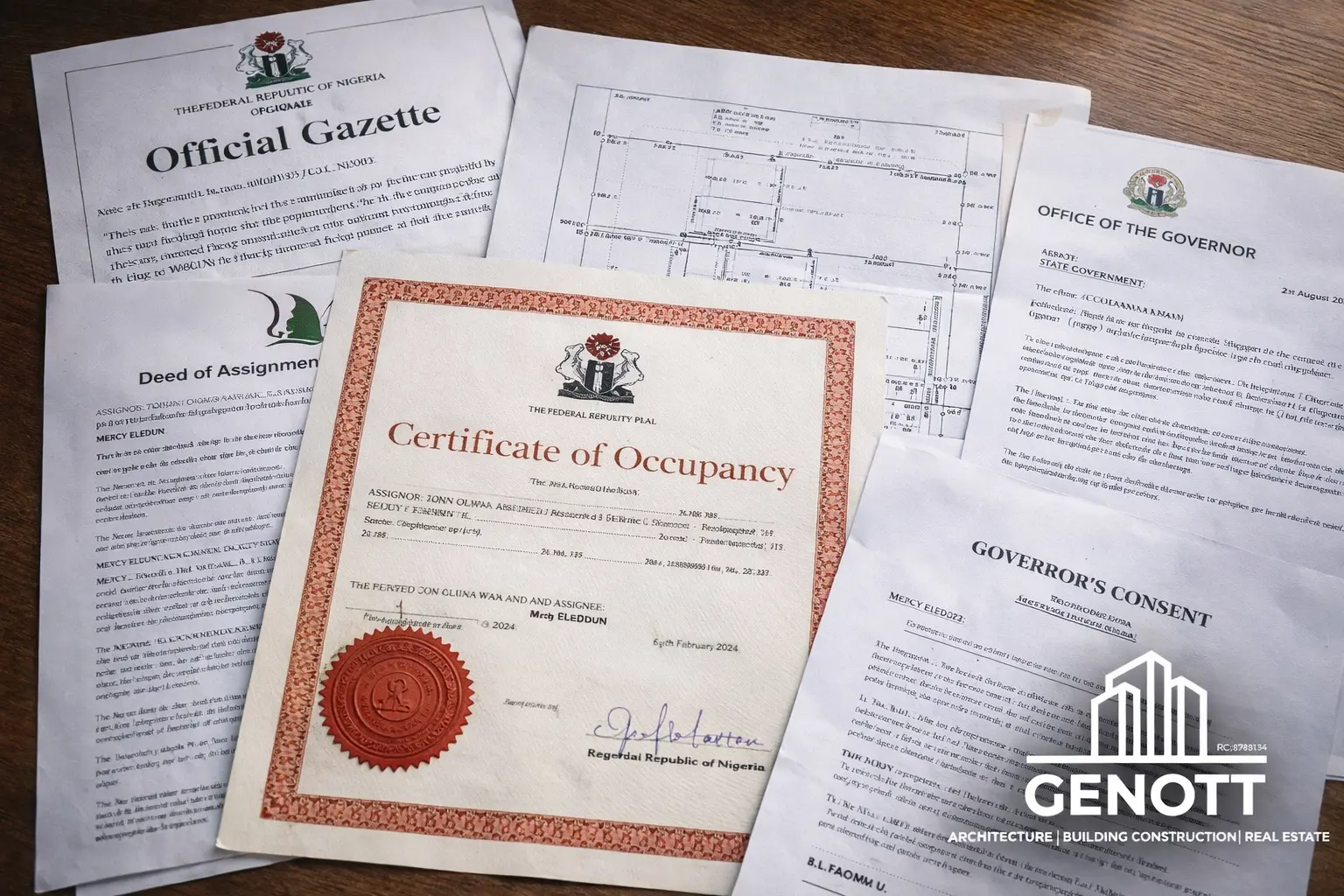
 GENOTT LTD Editorial Team
A Lagos banker paid ₦12 million for prime land in Ajah, received impressive documents including a survey plan and family allocation letter, only to discover six months later that three other buyers held identical documents for the same plot. The “seller” had vanished. Her lawyers confirmed the devastating truth: she owned nothing but worthless photocopies.
This story repeats daily across Nigeria, where an estimated ₦50 billion in land fraud occurs annually. The fundamental problem? Most Nigerians—including educated professionals—cannot distinguish between the various types of land titles in Nigeria or understand which documents actually prove ownership versus which merely support claims.
Nigeria’s land title system confuses even experienced investors with its maze of documents: Certificate of Occupancy, Deed of Assignment, Survey Plans, Governor’s Consent, Excision Gazettes, Letters of Allocation, and traditional receipts. Each serves different purposes, carries different legal weight, and requires specific verification procedures. Buying land without understanding these distinctions transforms property investment into expensive gambling.
This comprehensive beginner’s guide demystifies every land title type, explains verification procedures that prevent fraud, compares government versus family land acquisition, and provides the exact checklists, costs, and timelines you need to secure legitimate property ownership across Lagos, Abuja, Port Harcourt, and other Nigerian locations.
SUMMARY TABLE
| Land Title Type | Legal Weight | What It Proves | Approximate Cost |
|---|---|---|---|
| Certificate of Occupancy (C of O) | STRONGEST | Government-recognized 99-year ownership | Lagos: ₦3M-₦15M+; Abuja: ₦2M-₦10M+ |
| Deed of Assignment (Registered) | STRONG | Ownership transfer with legal registration | ₦200K-₦800K registration |
| Governor’s Consent | REQUIRED | Government approval for land transfer | ₦500K-₦5M+ depending on state |
| Excision & Gazette | MODERATE-STRONG | Government recognition of family land | Verification cost: ₦100K-₦300K |
| Survey Plan (Registered) | SUPPORTING | Land boundaries, NOT ownership proof | ₦150K-₦500K for verification |
| Letter of Allocation | MODERATE | Government land grant (pre-C of O) | Part of C of O application process |
| Family Receipt/Agreement | WEAK | Evidence of purchase, NOT legal title | Minimal, but high fraud risk |
| Power of Attorney | NOT OWNERSHIP | Authority to act, NOT proof of ownership | N/A – verify underlying documents |
Why Understanding Types of Land Titles in Nigeria Determines Investment Success or Disaster
Nigeria’s complex land ownership system traces to the 1978 Land Use Act, which vested all land in state governments, creating a dual system where traditional ownership coexists uneasily with statutory frameworks. This legal complexity, combined with weak enforcement and endemic corruption, has spawned a thriving land fraud industry that destroys billions of naira in wealth annually.
The Stakes:
- Over 60% of land disputes in Nigerian courts involve title defects or fraud
- Average legal battle over disputed land: 5-12 years duration, ₦2M-₦15M+ in costs
- Many “landowners” discover their documents are worthless only when attempting to develop property or sell
Understanding the types of land titles in Nigeria isn’t academic knowledge—it’s financial self-defense. Each document type serves specific legal functions, and mistaking one for another (especially confusing survey plans for ownership proof) causes the majority of fraud victims’ losses.
The Document Hierarchy
Ownership Proof (Can Stand Alone):
- Certificate of Occupancy (C of O) – strongest legal title
- Deed of Assignment (if properly registered with Governor’s Consent)
- Letter of Allocation (for government land, pending C of O)
Supporting Documents (Cannot Prove Ownership Alone):
- Survey Plan – shows boundaries, not ownership
- Receipts/Payment Evidence – proves transaction, not valid title
- Family Consent Letters – supports family land purchase
- Power of Attorney – grants authority, doesn’t transfer ownership
Government Approvals (Required for Validity):
- Governor’s Consent – mandatory for land transfers
- Excision & Gazette – government recognition of traditional land
Certificate of Occupancy (C of O)—The Gold Standard of Nigerian Land Ownership
The Certificate of Occupancy represents the strongest legal evidence of land rights in Nigeria. However, even this document is frequently misunderstood.
What C of O Actually Proves
Critical Understanding: C of O grants a 99-year leasehold from the state government, NOT permanent freehold ownership. After 99 years, renewal is theoretically required, though this provision is rarely enforced given Nigeria’s relatively recent adoption of the Land Use Act (1978).
Two Types of C of O:
1. Statutory Right of Occupancy:
- Applies to urban areas (Lagos, Abuja, Port Harcourt, state capitals)
- Issued by state governors
- Covers residential, commercial, industrial uses
- Required for properties in government-planned layouts
2. Customary Right of Occupancy:
- Applies to rural and traditional areas
- Issued by Local Government Chairmen
- Covers agricultural land, rural residential
- Converting to Statutory C of O possible but complex
C of O Application Process and Costs
Lagos State:
Application Steps:
- Submit application at Lagos State Lands Registry (Alausa) or online via lagos.ebs.gov.ng
- Provide: Survey plan, tax clearance, photographs, property valuation, application forms
- Site inspection by government officials
- Assessment and fee determination
- Payment of fees (varies by location and property value)
- Processing and issuance (if approved)
Timeline: 6 months to 3+ years (average: 18-24 months)
Costs:
- Application processing fee: ₦50,000-₦150,000
- Development levy: Based on property value
- Capital gains tax component: Varies
- Infrastructure development fee: Location-dependent
- Total for Lekki/Victoria Island properties: ₦5M-₦15M+
- Total for mainland locations: ₦3M-₦8M
- Facilitation/expediting (unofficial): ₦1M-₦5M additional (avoid if possible)
Abuja (FCT):
AGIS System (Abuja Geographic Information System):
- Online application: agis.fcta.gov.ng
- More streamlined than Lagos
- Timeline: 6-18 months typically
- Costs: ₦2M-₦10M depending on property location and value
Other States:
- Rivers State: ₦1M-₦5M
- Ogun State: ₦500,000-₦3M
- Kaduna State: ₦800,000-₦4M
- General range: ₦500,000-₦5M
Ground Rent and Obligations
Annual Ground Rent:
- Residential: ₦3,000-₦15,000 annually (often ignored)
- Commercial: ₦10,000-₦100,000+ annually
- Payment to state government
- Non-payment can theoretically cause revocation (rarely enforced)
Digital C of O Initiatives
Lagos and Abuja have introduced electronic C of O systems to reduce fraud:
- QR codes for verification
- Online database searches
- Digital issuance reducing forgery opportunities
- Still in implementation phase with mixed adoption
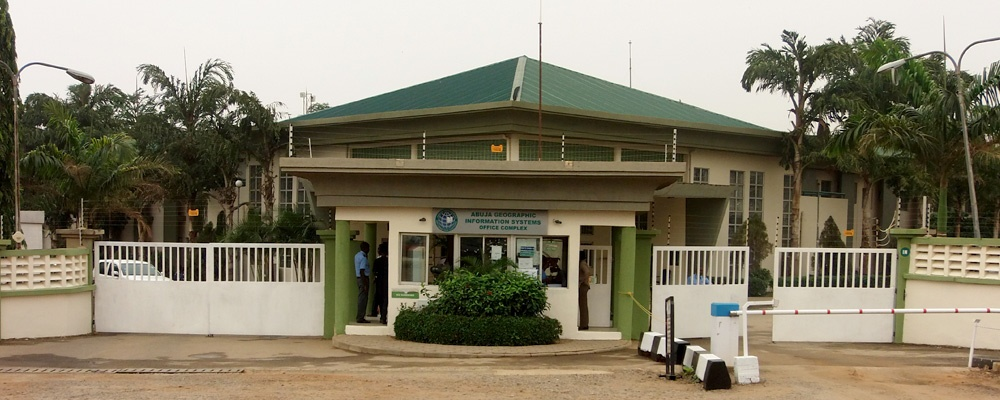
AGIS – Abuja Geographic Information Systems
Deed of Assignment and Governor’s Consent—Transferring Land Ownership Rights
When land changes hands (from original owner to buyer), a Deed of Assignment documents the transfer. However, this deed is legally incomplete without Governor’s Consent.
Deed of Assignment Explained
Purpose: Legal document transferring all ownership rights from seller (assignor) to buyer (assignee)
Requirements:
- Executed by both parties (seller and buyer)
- Witnessed by at least two independent witnesses
- Stamped at State Internal Revenue Service
- Registered at Lands Registry
- Accompanied by Governor’s Consent application
Cost:
- Legal drafting: ₦50,000-₦200,000
- Stamping fees: 3% of property value
- Registration: ₦30,000-₦100,000
- Total (excluding Governor’s Consent): ₦200,000-₦800,000 for typical transactions
Governor’s Consent—The Critical Missing Piece
Legal Requirement: Section 22 of the Land Use Act mandates Governor’s Consent for any land transfer. Without consent, the transfer is legally void.
Reality Check: An estimated 60-70% of land transactions in Lagos occur without obtaining Governor’s Consent due to cost and bureaucracy. This creates:
- Legal vulnerability (transfer can be challenged)
- Difficulty obtaining C of O in buyer’s name
- Complications in future sales
- Reduced property value (20-40% discount without consent)
Application Process:
- Submit application with Deed of Assignment
- Provide property valuation, survey plan, tax clearance
- Pay prescribed fees
- Site inspection
- Processing (if approved)
Timeline: 6-18 months typically
Costs (Lagos):
- Assessment based on property value
- Lekki/Island properties: ₦2M-₦8M
- Mainland properties: ₦500,000-₦3M
- Plus legal fees: ₦200,000-₦500,000
Abuja: ₦1M-₦5M typically
Strategic Decision: Many buyers delay Governor’s Consent application until they’re ready to develop or resell, accepting the legal risk to preserve capital.
Survey Plans, Excision Documents, and Supporting Title Evidence
Registered Survey Plan
Common Misconception: “I have a survey plan, so I own the land.”
Reality: Survey plans show boundaries and measurements, NOT ownership. A survey plan is essential for locating and describing land, but proves nothing about who owns it.
What Survey Plans Provide:
- Precise land dimensions and area (e.g., 600 sqm)
- Coordinate points and beacons
- Registered number at Surveyor General’s Office
- Adjacent property references
Verification:
- Hire licensed surveyor: ₦150,000-₦500,000
- Verify survey number at Surveyor General’s Office: ₦20,000-₦50,000
- Physical beacon verification on-site
- Check for overlapping surveys (multiple plans covering same land)
Red Flag: Sellers providing only survey plans without ownership documents (C of O, Deed, or registered allocation).
Excision and Gazette—Government Recognition of Family Land
Excision Explained:
Traditional families/communities owning land since pre-colonial times can apply for government recognition through “excision”—the government formally acknowledges their ownership and excises (carves out) the land from general government control.
Gazette Publication:
After excision approval, the government publishes the recognition in the Official Gazette—a public record confirming the family’s ownership.
Legal Weight:
- Excised and gazetted land can obtain C of O
- Provides legitimate basis for family land sales
- Significantly reduces (but doesn’t eliminate) fraud risk
Verification Requirements:
Mandatory Checks:
- Original Excision Document: Request to see original, not photocopy
- Gazette Publication: Verify in actual state gazette at Archives
- Gazette Number and Date: Confirm at Lands Ministry
- Family List: Gazetted land lists recognized family members
- Selling Authorization: All family heads must consent to sale
Costs for Verification:
- Lawyer verification: ₦100,000-₦300,000
- Archives search: ₦30,000-₦80,000
- Lands Ministry confirmation: ₦50,000-₦150,000
Common Fraud: Fake gazettes (photocopied documents with fabricated gazette numbers). Always verify at official government archives.
Letter of Allocation
Purpose: Government issues allocation letter when granting land, preceding C of O issuance.
Typical Scenario:
- Individual/company applies for government land
- State approves and issues Letter of Allocation
- Recipient pays prescribed fees
- Government processes C of O (takes 1-5 years)
Legal Status:
- Provides strong evidence of ownership
- Less secure than C of O (can be revoked more easily)
- Commonly seen in government estates and industrial layouts
Verification:
- Confirm at allocating ministry (Lands, Housing, Commerce)
- Verify payment of allocation fees
- Check for revocation or reassignment
Land Title Verification—Complete Due Diligence Process
Proper verification requires four parallel investigations: physical, official (Lands Registry), surveyor, and legal. Skipping any component invites disaster.
Physical Land Inspection (Cost: Your Time + Transport)
Mandatory Steps:
1. Multiple Site Visits:
- Visit at least 3-4 times on different days/times
- Weekday and weekend visits (different people present)
- Morning and evening (observe activities, security)
2. Physical Verification:
- Locate survey beacons matching survey plan
- Check for physical structures or encroachments
- Look for competing occupation or claims
- Photograph extensively from multiple angles
3. Neighbor Investigation:
- Speak with at least 3-5 neighboring properties
- Ask about land history, previous disputes
- Inquire about the selling family/individual
- Request contact information for Baale (community head) or landlord association
4. Community Engagement:
- Meet with Baale or traditional ruler
- Confirm land ownership history
- Ask about “Omo Onile” activity in area
- Understand security situation
5. Government Notices:
- Check for acquisition notices posted
- Look for pending litigation signs
- Verify no government projects planned (roads, drainage, etc.)
Red Flags:
- Multiple structures on supposed “vacant” land
- Neighbors unaware of land being for sale
- Conflicting stories about ownership history
- No visible survey beacons
- Recent disturbances or filled excavations
Official Lands Registry Search (Cost: ₦50,000-₦200,000)
Lagos Lands Registry (Alausa):
Process:
- Obtain file number from seller (C of O or registered deed)
- Submit search application with fee (₦50,000-₦100,000)
- Registry confirms: Ownership, encumbrances, caveat, existing liens
- Obtain Certified True Copy (CTC) of documents (₦80,000-₦150,000 additional)
What Search Reveals:
- Current registered owner
- Property description and survey details
- Existing mortgages or charges
- Caveats preventing transactions
- Governor’s Consent status
- Pending legal issues
Timeline: 2-6 weeks typically (can expedite for fees)
Abuja AGIS Portal:
- Online search: agis.fcta.gov.ng
- Submit property identification details
- Receive verification report
- Cost: ₦30,000-₦80,000
- Faster than Lagos (3-10 days typically)
Critical: Ensure registered owner matches seller. Mismatches indicate fraud or undisclosed transactions.
Surveyor Verification (Cost: ₦150,000-₦500,000)
Hire Licensed Surveyor To:
- Verify survey plan authenticity at Surveyor General’s Office
- Confirm survey number exists and matches land location
- Physically locate and verify beacons on-site
- Check for overlapping surveys covering same coordinates
- Measure actual land dimensions versus survey plan
- Identify encroachments or boundary disputes
- Produce verification report
Typical Cost:
- Survey verification: ₦150,000-₦300,000
- New survey (if needed): ₦300,000-₦800,000
- Depends on land size and location accessibility
Value: Prevents buying land that doesn’t exist, is smaller than claimed, or has survey conflicts.
Legal Due Diligence (Cost: ₦200,000-₦800,000)
Property Lawyer Conducts:
Title Search:
- Verify chain of ownership (from original allocation to current seller)
- Confirm all previous transfers included Governor’s Consent
- Identify gaps or irregularities in ownership history
Encumbrance Check:
- Search for mortgages, liens, or charges
- Identify pending litigation affecting property
- Confirm no caveats preventing sale
Document Authentication:
- Verify original documents (not photocopies)
- Confirm signatures and stamp authenticity
- Check document dates for consistency
Legal Opinion:
- Written assessment of title quality
- Risk identification and severity rating
- Recommendations (proceed, negotiate, or abandon)
Contract Preparation:
- Draft Sale Agreement with protective clauses
- Include refund guarantee if title defective
- Specify seller warranties and representations
Typical Fees:
- Basic title search and opinion: ₦200,000-₦400,000
- Comprehensive due diligence: ₦400,000-₦800,000
- Transaction management (full service): ₦800,000-₦2M
- Usually 2-5% of property purchase price
ROI: ₦500,000 legal investment prevents ₦10M-₦50M fraud loss (2,000-10,000% return).
The “Omo Onile” Problem
Who They Are:
- “Omo Onile” = Children of the land (Yoruba term)
- Area boys claiming family/community land rights
- Sometimes legitimate, often fraudulent extortionists
- Particularly prevalent in: Ibeju-Lekki, Epe, Ikorodu (Lagos), satellite towns
How They Operate:
- Demand payment to “allow” development
- Threaten violence or property destruction
- Present competing ownership claims
- Create endless payment demands
Prevention Strategies:
1. Thorough Community Engagement:
- Meet all relevant family heads before purchase
- Obtain written consent from recognized community leaders
- Pay appropriate “settlement” fees upfront if customary
- Document all agreements
2. Security Assessment:
- Understand area security situation
- Hire local security during development
- Develop relationships with community stakeholders
3. Legal Documentation:
- Ensure seller provides comprehensive indemnity
- Include Omo Onile resolution in Sale Agreement
- Obtain family consent letters from all relevant parties
4. Government Land Alternative:
- Government allocations largely immune to Omo Onile issues
- Worth premium price for peace of mind
Legal Recourse:
- Criminal charges (extortion, trespass)
- Injunctions preventing interference
- Police involvement (effectiveness varies)
- Reality: Prevention vastly superior to legal remedies after-the-fact
Government Allocation vs. Family Land—Comprehensive Comparison
The fundamental choice for Nigerian land buyers: pay premium for government-allocated land with clear title, or accept higher risk with cheaper family land?
Government Allocated Land
Characteristics:
- Original allocation from state government
- Typically in government-planned layouts/estates
- Clear ownership chain from inception
- Easier C of O obtainment
Pros: ✓ Strongest legal title ✓ Minimal Omo Onile issues ✓ Infrastructure often provided (roads, drainage) ✓ Straightforward verification (confirm at allocating ministry) ✓ Good resale value and marketability ✓ Mortgage-eligible (banks prefer government land)
Cons: ✗ Significantly higher cost (2-5x family land in same area) ✗ Limited availability in prime locations ✗ Lengthy allocation process if applying fresh ✗ Annual ground rent obligations
Typical Costs (2026):
- Lekki Peninsula (Lagos): ₦15M-₦50M per plot
- Ikoyi/Victoria Island: ₦50M-₦200M+ per plot
- Mainland Lagos estates: ₦8M-₦25M per plot
- Abuja (Maitama, Asokoro): ₦30M-₦100M+ per plot
- Abuja satellite districts: ₦5M-₦20M per plot
Best For:
- Commercial developments requiring bank financing
- Risk-averse investors
- High-value residential projects
- Institutional buyers
- Diaspora buyers unable to monitor land closely
Family/Community Land with Excision
Characteristics:
- Traditional ownership by families/communities for generations
- Government has issued excision recognizing ownership
- Published in official state gazette
- Can obtain C of O but requires family cooperation
Pros: ✓ Significantly cheaper (40-70% below government land) ✓ Flexible payment terms often available ✓ Legitimate ownership basis (if properly excised and gazetted) ✓ Can obtain C of O with proper process ✓ Large inventory available in growing areas
Cons: ✗ Complex ownership structures (multiple family members) ✗ Omo Onile challenges possible ✗ Governor’s Consent can be problematic ✗ Family disputes may emerge post-purchase ✗ Verification more complex and time-consuming ✗ Banks reluctant to finance without C of O
Typical Costs (2026):
- Ibeju-Lekki (Lagos): ₦3M-₦12M per plot
- Epe (Lagos): ₦2M-₦8M per plot
- Ajah/Sangotedo (Lagos): ₦5M-₦18M per plot
- Abuja satellite towns: ₦2M-₦10M per plot
Essential Verification:
- Original excision document (not photocopy)
- Gazette publication number and date
- Confirmation at State Archives
- Family consent letters from all recognized heads
- Community leader (Baale) confirmation
- Comprehensive legal due diligence
Best For:
- Experienced investors with local knowledge
- Those willing to invest time in verification
- Medium-term hold strategies (5-10 years)
- Buyers with cash (not requiring bank loans)
- Projects where development cost exceeds land cost
Family Land Without Excision—Extreme Risk
Characteristics:
- Traditional family ownership never officially recognized by government
- No gazette publication
- Common in peri-urban and rural areas
- Cheapest option but massive fraud potential
Risks: ✗ Cannot obtain C of O ✗ Extremely high fraud rate (40-60% estimated) ✗ Multiple sellers of same land common ✗ Government can acquire without compensation ✗ Virtually impossible to resell with clean title ✗ Banks will not finance ✗ Legal recourse very limited
Typical Costs:
- ₦500,000-₦5M depending on location
- Low price reflects high risk
Expert Recommendation: AVOID unless:
- You’re very experienced in Nigerian land transactions
- Pure speculative holding for 10-20+ years
- Family provides 30+ years traditional ownership proof
- Community chief provides strong confirmation
- Comprehensive legal due diligence conducted
- You can afford total loss if it’s fraudulent
Better Alternative: Save additional capital for excised family land or government allocation rather than gambling on unexcised land.
Common Mistakes, Red Flags, and Protection Strategies
Critical Beginner Mistakes
1. Trusting Survey Plan as Ownership Proof:
Error: “The seller has a survey plan, so ownership is confirmed.”
Reality: Survey plans prove boundaries, NOT ownership. This single misconception causes 30%+ of fraud cases.
Solution: Demand ownership documents (C of O, registered Deed of Assignment, Letter of Allocation) in addition to survey plan.
2. Skipping Professional Verification to Save Money:
Error: “The documents look legitimate. I’ll skip the ₦500K lawyer and surveyor fees.”
Reality: ₦500,000 professional verification prevents ₦10M-₦50M fraud loss.
Solution: Budget 15-25% beyond purchase price for professional fees. Non-negotiable.
3. Paying 100% Upfront:
Error: Seller demands full payment before providing documents or allowing verification.
Reality: Once seller has full payment, leverage to enforce agreement evaporates.
Proper Payment Structure:
- 10-30% deposit upon signing Sale Agreement
- 40-50% upon lawyer confirming title is clean
- 20-40% upon Governor’s Consent obtainment or at final closing
4. Buying from Non-Registered Owner:
Error: “The seller’s brother/agent is handling the transaction.”
Reality: Only the registered owner (confirmed at Lands Registry) can validly sell land.
Solution: Verify seller’s identity matches registered owner. Demand original ID and compare to registry records.
5. Ignoring Missing Governor’s Consent:
Error: “The previous owner didn’t get Governor’s Consent. I’ll deal with it later.”
Reality: Without consent on the chain of title, your purchase adds to the problem. Future Governor’s Consent may be denied or cost-prohibitive.
Solution: Require seller to obtain Governor’s Consent or significantly discount purchase price (30-40%) to account for future cost and risk.
Red Flags Signaling Potential Fraud
🚩 Urgent Pressure: “Another buyer is ready. You must pay today or lose the land.”
🚩 Below-Market Pricing: Land priced 30%+ below comparable sales without clear explanation (distress sale, family dispute, etc.)
🚩 Document Reluctance: Seller hesitant to provide original documents or allow registry verification
🚩 Inconsistent Information: Neighbors describe different ownership history than seller claims
🚩 Multiple Representatives: Different “family members” selling similar plots in same area
🚩 Photocopy-Only Documents: Seller provides only photocopies, claims originals are “at the lawyer’s office” indefinitely
🚩 Failed Verification: Survey numbers don’t exist at Surveyor General’s Office, or gazette numbers can’t be confirmed
🚩 No Original Sighting: Despite requests, you never see original C of O, Deed, or Excision documents
🚩 Incomplete Chain: Gaps in ownership history (land allocated in 1985, next document is 2018 with no intervening transfers)
🚩 Generic Guarantees: Seller refuses specific contractual warranties about title quality
Action When Red Flags Appear: Stop. Conduct additional verification. Consult lawyer immediately. Be prepared to walk away—better to lose ₦200,000 in sunk verification costs than ₦10M+ in fraud.
Legal Protection Framework
Essential Sale Agreement Clauses:
1. Refund Guarantee: “If title search reveals defects, encumbrances, or third-party claims, seller shall refund 100% of payments within 30 days.”
2. Seller Warranties: “Seller warrants that: (a) Seller is registered owner, (b) No undisclosed encumbrances exist, (c) No pending litigation affects property, (d) All previous transfers obtained Governor’s Consent.”
3. Indemnification: “Seller shall indemnify buyer against all claims, losses, and legal costs arising from title defects or Omo Onile disputes.”
4. Specific Performance: “Seller agrees to cooperate in obtaining Governor’s Consent and C of O transfer within specified timeline.”
5. Escrow Arrangement: “All payments shall be held in buyer’s lawyer’s client account pending title confirmation.”
Legal Recourse Options:
Criminal Charges:
- Fraud/obtaining money by false pretenses
- Forgery (if documents are fake)
- Report to EFCC (Economic and Financial Crimes Commission)
Civil Remedies:
- Recovery suit for refund of purchase price
- Injunction preventing seller from further transactions
- Specific performance (forcing seller to complete transaction properly)
Practical Reality: Legal recourse is slow (3-10 years), expensive (₦2M-₦10M+), and uncertain. Prevention through verification vastly superior to legal remedies after fraud.
FAQs
Q: What is the strongest type of land title in Nigeria? A: Certificate of Occupancy (C of O) is the strongest legal evidence of land ownership in Nigeria. It represents government recognition of your 99-year leasehold right to the land. C of O can be either Statutory (urban areas) or Customary (rural areas), with Statutory being slightly stronger. However, even C of O must be verified at the Lands Registry, as fake certificates exist in the market.
Q: What’s the difference between a Certificate of Occupancy and a Deed of Assignment? A: A C of O is government-issued proof of land ownership (original title from the state). A Deed of Assignment is a legal document transferring ownership from one person to another (derivative title). Think of it this way: C of O = original ownership recognition by government; Deed of Assignment = transfer of that ownership to someone new. Both are important, but a registered Deed of Assignment WITH Governor’s Consent approaches C of O in legal strength.
Q: Can I own land with just a survey plan in Nigeria? A: No. This is the most dangerous misconception. A survey plan shows land boundaries and measurements but does NOT prove ownership. Thousands of Nigerians have lost money believing a survey plan equals ownership. You must have ownership documents (C of O, registered Deed of Assignment, or Letter of Allocation) in addition to the survey plan. Never buy land based on survey plan alone.
Q: How much does it cost to verify land title in Lagos? A: Comprehensive verification costs ₦600,000-₦1.5M total: Lands Registry search (₦50K-₦200K), surveyor verification (₦150K-₦500K), legal due diligence (₦200K-₦800K). While this seems expensive, it prevents ₦10M-₦50M+ losses from fraud. Budget 15-25% of purchase price for all professional fees, government charges, and registration costs.
Q: What is Governor’s Consent and do I really need it? A: Governor’s Consent is government approval required by law for all land transfers in Nigeria. Without it, your land purchase is legally void and can be challenged. Cost: Lagos (₦500K-₦8M depending on location), Abuja (₦1M-₦5M). Timeline: 6-18 months. While 60-70% of transactions skip it due to cost, this creates serious legal vulnerability. You cannot obtain C of O in your name or safely resell without Governor’s Consent.
Q: Is family land safe to buy in Lagos or should I only buy government allocation? A: Family land with proper excision and gazette publication can be safe if thoroughly verified. Check: (1) Original excision document and gazette number, (2) Confirmation at State Archives, (3) Family consent from all heads, (4) Comprehensive legal due diligence, (5) Community leader verification. Family land costs 40-70% less than government allocation but requires more verification effort. Government land is safer but 2-5x more expensive. Your choice depends on budget, risk tolerance, and verification capability.
Q: How can I verify if land documents are genuine or fake? A: Follow this verification protocol: (1) Demand to see original documents (not photocopies), (2) Conduct Lands Registry search to confirm registered owner matches seller, (3) Verify survey number at Surveyor General’s Office, (4) If family land, confirm gazette publication at State Archives, (5) Hire licensed surveyor to verify physical beacons, (6) Engage property lawyer for title search and legal opinion, (7) Visit land multiple times and interview neighbors. Never rely on seller-provided documents alone.
Q: What is excision and gazette in land purchase? A: Excision is government recognition of traditional family/community land ownership. When approved, it’s published in the Official State Gazette—a public record. Excised and gazetted land can obtain C of O and is far safer than non-excised family land. Verification is critical: (1) See original excision document, (2) Confirm gazette number and date, (3) Check actual gazette publication at State Archives, (4) Verify at Lands Ministry. Many fraudsters present fake gazettes—always verify at official government archives.
Q: How long does it take to get Certificate of Occupancy in Nigeria? A: Timeline varies by state: Lagos (12-36 months average), Abuja via AGIS (6-18 months), other states (6-24 months). Factors affecting duration: Application completeness, property location, government processing capacity, whether “facilitation” fees are paid (unofficial but common). Many applicants wait 2-5 years. Digital initiatives in Lagos and Abuja aim to reduce this, but traditional delays persist.
Q: What should I do if I discover the land I bought is fraudulent? A: Immediate actions: (1) Stop all payments if transaction incomplete, (2) Engage property lawyer immediately, (3) Gather all documents and evidence, (4) Report to police and EFCC (Economic and Financial Crimes Commission), (5) File civil suit for refund and damages, (6) Seek injunction preventing seller from further fraud, (7) Join buyer advocacy groups for collective action. Realistic expectation: Legal recovery takes 3-10 years, costs ₦2M-₦10M, success rate is low. Prevention through proper verification is infinitely better than legal remedies after fraud.
Q: Can I buy land in Nigeria without traveling there physically? A: Technically yes, but extremely risky without proper safeguards. If buying remotely (common for diaspora): (1) Engage reputable property lawyer and surveyor on ground, (2) Require video evidence of land inspection, (3) Conduct all verifications (registry, survey, archives), (4) Use escrow arrangement through lawyer’s account, (5) Have trusted local representative inspect physically, (6) Never wire full payment before title confirmation, (7) Budget 20-30% more for professional fees given remote oversight needs. Many diaspora buyers have lost millions through remote purchases without adequate verification.
CONCLUSION
Understanding the types of land titles in Nigeria represents the difference between secure property investment and expensive disaster. The Nigerian land system’s complexity—combining statutory law, traditional ownership, and endemic fraud—creates a treacherous landscape where even educated professionals lose millions through simple mistakes like confusing survey plans for ownership proof or skipping verification to save money.
The essential truths: Certificate of Occupancy remains the gold standard, but must be verified at Lands Registry. Deed of Assignment transfers ownership, but requires Governor’s Consent for legal validity. Survey plans prove boundaries, not ownership. Family land with excision and gazette can be legitimate, but demands exhaustive verification. Documents alone prove nothing—verification at government offices separates genuine titles from worthless photocopies.
The verification investment—₦600,000-₦1.5M for comprehensive due diligence—appears expensive until compared to the ₦50 billion annual land fraud losses Nigerians suffer. Every ₦500,000 spent on proper legal, surveyor, and registry verification prevents potential ₦10M-₦50M fraud loss. This isn’t optional expense but essential financial self-defense.
Your land purchase success depends less on finding “good deals” than on implementing rigorous verification protocols. Demand original documents. Conduct registry searches. Hire qualified professionals. Structure protective payments. Engage community stakeholders. Budget 15-25% beyond purchase price for professional fees and government charges. Walk away from transactions with red flags—better to lose ₦200,000 in sunk verification costs than ₦15M in fraud.
The Nigerian land market rewards patience, professional guidance, and verification discipline while brutally punishing shortcuts, misplaced trust, and false economy. Armed with this knowledge of land title types, verification procedures, and fraud prevention strategies, you can navigate Nigeria’s complex property landscape successfully, securing legitimate ownership while avoiding the devastating losses that trap uninformed buyers daily.
For professional land title verification, comprehensive due diligence services, legal support throughout property transactions, and expert guidance across real estate, architecture, construction, agriculture, and transportation sectors, GENOTT LTD provides qualified expertise throughout Lagos, Abuja, Port Harcourt, and Nigeria nationwide.


 GENOTT LTD Editorial Team