 GENOTT LTD Editorial Team
Property management services in Nigeria have transformed how investors generate rental income, shifting from hands-on operational burden to professional passive income systems. A Lagos property owner with three rental apartments spent 15-20 hours weekly managing tenants, chasing rent, coordinating repairs, and handling complaints—essentially working a second unpaid job. After hiring professional property management services in Nigeria at 10% monthly fee (₦120,000 on ₦1.2M total rent), her vacancy rate dropped from 15% to 3%, rent collection improved from 78% to 97%, and she reclaimed her weekends while her portfolio performed better.
This scenario repeats across Nigeria as owners discover that professional property management services in Nigeria aren’t an expense—they’re an investment delivering measurable returns through reduced vacancy, improved collections, property preservation, and legal protection. Yet confusion remains about what these services actually include, costs, whether to hire professionals or self-manage, and how to evaluate quality among Lagos property management companies and Abuja providers.
This guide reveals everything: complete fee structures (8-12% monthly plus additional charges), professional tenant screening preventing 70-80% of payment defaults, property management contract template Nigeria guidelines, preventive maintenance saving ₦200,000-₦500,000 annually, property management software in Nigeria options, and performance metrics distinguishing excellent from mediocre management.
QUICK SUMMARY
| Service Component | Typical Cost | Value Delivered | DIY vs Professional |
|---|---|---|---|
| Monthly Management Fee | 8-12% of rent | Screening, collection, coordination | DIY: Save fees but invest 10-20 hrs/week |
| Tenant Placement | 50-100% of 1st month | Reduces defaults 70-80% | DIY: High risk of problem tenants |
| Maintenance Coordination | 10-15% of repair cost | Vetted contractors, quality control | DIY: Time-consuming, no relationships |
| Rent Collection | Included in monthly fee | 95-97% rate vs 75-85% DIY | Professional: Automated, consistent |
| Legal/Eviction Support | ₦200K-₦500K per case | Professional documentation | DIY: High legal error risk |
What Are Property Management Services in Nigeria?
Property management services in Nigeria are professional rental property operations that handle complete oversight of your investment properties, allowing owners to generate passive income without daily operational involvement. These services have become essential for serious real estate investors across Lagos, Abuja, Port Harcourt, and other Nigerian cities.
Core Components of Property Management Services in Nigeria:
- Tenant Management – Professional screening, placement, and communication (reduces defaults 70-80%)
- Rent Collection – Automated systems achieving 95-97% collection rates vs. 75-85% DIY
- Property Maintenance – Preventive schedules saving ₦200,000-₦500,000 annually compared to reactive repairs
- Financial Reporting – Monthly statements tracking occupancy, expenses, and ROI
- Legal Compliance – Lease enforcement, eviction procedures, dispute resolution
Standard fees: 8-12% monthly rent in Lagos, 8-10% in Abuja and Port Harcourt, plus 50-100% of first month’s rent for tenant placement. For a ₦400,000 monthly rental property, expect ₦32,000-₦48,000 in monthly management fees plus ₦200,000-₦400,000 one-time tenant placement fee.
Property Types Requiring Management:
- Residential: Apartments, duplexes, detached houses, student housing
- Commercial: Office spaces, retail shops, warehouses
- Mixed-use: Ground floor commercial with upper floor residential
- Short-term rentals: Airbnb-style properties (higher management intensity, typically 15-20% fees)
Understanding Property Management Services in Nigeria—Core Components and When You Need Them
Professional property management services in Nigeria encompass complete operational oversight: tenant acquisition and screening, rent collection and financial management, property maintenance and repairs, lease enforcement, legal compliance, and owner reporting. Professional managers handle day-to-day operations allowing owners to focus on portfolio growth rather than operational details.
Detailed Service Breakdown:
Tenant Sourcing and Screening: Professional marketing through PropertyPro, Nigeria Property Centre, Jiji, social media platforms, and real estate agent networks. Comprehensive screening includes employment verification (3-6 months bank statements confirming salary deposits), previous landlord references with direct contact asking specific questions about payment history and property care, guarantor checks requiring 1.5-2x rent income with full documentation, and background verification including personal references and social media review—reducing tenant default risk 70-80% versus informal screening methods.
Automated Rent Collection: Multiple payment channels (bank transfer, Flutterwave, Paystack, mobile money), payment reminders sent 7 days before due date, day of due date, and day after due date, consistent late fee enforcement (5-10% after 3-5 day grace period), and professional arrears management with structured escalation procedures. Professional property management services in Nigeria achieve 95-97% collection rates compared to 75-85% for self-managed properties where owners often lack systematic collection procedures and enforcement consistency.
Maintenance Coordination: Preventive maintenance schedules including monthly property inspections, quarterly deep cleaning and system checks, annual comprehensive building reviews, emergency response protocols (2-4 hour response time for urgent issues like burst pipes or electrical hazards), vetted contractor networks across all trades (plumbing, electrical, painting, AC, generator specialists), quality control inspections before final payment, and complete documentation with before/after photos. Annual maintenance budget: 10-15% of rental income prevents costly emergency repairs.
Financial Reporting and Communication: Monthly income statements showing rental income collected, all expenses by category, and net operating income (NOI). Property performance dashboards tracking occupancy rate (target 95%+), expense ratio (target <30-35% of gross income), and tenant retention (target 60-70%). Quarterly performance reviews analyzing trends and identifying improvement opportunities. Annual strategic planning sessions for rent adjustments, capital improvements, and portfolio optimization.
Legal Compliance and Dispute Resolution: Professional lease agreement preparation using standardized templates reviewed by property lawyers, enforcement of lease terms through proper documentation, eviction procedure management following legal requirements, tenant dispute mediation and resolution, and compliance with state-specific tenancy regulations. This protects owners from costly legal errors that can invalidate eviction proceedings or expose owners to tenant lawsuits.
When to Hire Professional Property Management Services in Nigeria
Multiple Properties Threshold: Managing 3+ units simultaneously overwhelms most owners with competing priorities, scheduling conflicts, and operational complexity. Professional management becomes cost-effective when time saved × your hourly value exceeds 8-12% management fee. Lagos property management companies typically recommend professional services once you reach 3-5 units as the complexity curve becomes steep beyond this point.
Distance Ownership: Lagos resident owning Abuja property cannot provide responsive tenant service, conduct property inspections, or coordinate emergency repairs effectively. 4-6 hour travel time makes hands-on management impractical. Professional local management becomes essential for out-of-state investments, ensuring properties receive same-day attention that maintains tenant satisfaction and property value.
Full-Time Employment Constraints: Salaried professionals earning ₦500,000-₦2M monthly find opportunity cost of 10-20 hours weekly property management (520-1,040 hours annually) exceeds ₦40,000-₦120,000 monthly management fees. Your time has value—calculate whether property management is your highest-value activity or whether professional services free you for career advancement, family time, or portfolio growth that generate greater returns.
Lack of Experience or Expertise: First-time landlords often make costly mistakes: accepting problematic tenants, mishandling maintenance leading to major repairs, poor documentation causing legal disputes, and inconsistent rent collection creating cash flow problems. Professional property management services in Nigeria provide expertise worth 3-5x the management fees through avoided costly errors and optimized property performance.
Commercial Properties: Office spaces, retail shops, and warehouses require specialized expertise in commercial leases (3-5 year terms with complex clauses), tenant improvement coordination, corporate tenant management, commercial property regulations, higher-stakes negotiations, and different maintenance standards. Commercial property management typically commands 6-10% fees due to specialized knowledge requirements.
Portfolio Growth Strategy: Investors scaling from 3 to 10+ properties need operational systems freeing acquisition time for identifying opportunities, conducting due diligence, arranging financing, and executing purchases. DIY management caps growth at 3-5 properties as operational demands consume all available time; professional property management services in Nigeria enable scaling to 20-50+ units by creating operational leverage.
Problematic Existing Tenants: Properties with payment default patterns, maintenance neglect, neighbor complaints, or lease violations benefit from professional management’s documented procedures, legal expertise, and firm-but-fair enforcement that often resolves issues self-management cannot.
Self-Management vs. Professional Management Economics
₦400,000 Monthly Rent Property Detailed Analysis:
Professional Management Financial Model:
- Monthly management fee (10%): ₦40,000
- Annual management cost: ₦480,000
- Performance delivered: 97% collection rate = ₦4.656M of ₦4.8M annual rent collected (₦144K shortfall), 3% vacancy rate = ₦144,000 annual loss (11 days vacant), professional preventive maintenance preventing major failures, comprehensive legal protection through proper documentation, 15-20 hours monthly time saved (180-240 hours annually)
- Annual financials: ₦4.656M collected – ₦480K management fees – ₦720K operating expenses (15% of gross) = ₦3.456M net annual income
- Effective net yield: 7.2% on ₦48M property value
Self-Management Financial Reality:
- Management fee savings: ₦480,000 annually (appears attractive initially)
- Hidden performance costs: 12% vacancy rate = ₦576,000 annual loss (44 days vacant due to slower tenant placement), 85% collection rate = ₦720,000 annual shortfall (late payments, partial payments, uncollected arrears), reactive maintenance costing 30% more than preventive = ₦216,000 extra annually (emergency repairs, deferred maintenance causing major failures), legal errors risk = potential ₦200,000-₦2M exposure
- Time investment: 15-20 hours weekly = 780-1,040 hours annually (equivalent to 97-130 full working days)
- Annual financials: ₦4.08M collected (85% of ₦4.8M) – ₦936K operating expenses (includes reactive maintenance premium) = ₦3.144M net annual income
- Effective net yield: 6.55% on ₦48M property value
Reality Check: Self-management “saves” ₦480,000 in fees but loses ₦312,000 in net income through vacancy inefficiency, collection shortfalls, and maintenance cost premium. Additionally, self-manager invests 780-1,040 hours annually—if your time is worth ₦3,000-₦5,000/hour, opportunity cost is ₦2.34M-₦5.2M annually. Professional property management services in Nigeria pay for themselves through performance optimization while freeing owners for higher-value activities.
Property Management Fees and Contract Structures in Nigeria (2026)
Standard Fee Structures Across Nigerian Cities
| Location | Monthly Management | Tenant Placement | Example (₦400K rent) | Annual Total Cost |
|---|---|---|---|---|
| Lagos | 10-12% | 100% of 1st month | ₦40K-₦48K monthly + ₦400K placement | ₦880K-₦976K |
| Abuja | 8-10% | 50-100% of 1st month | ₦32K-₦40K monthly + ₦200K-₦400K | ₦584K-₦880K |
| Port Harcourt | 8-10% | 50-100% of 1st month | ₦32K-₦40K monthly + ₦200K-₦400K | ₦584K-₦880K |
| Ibadan/Enugu | 8-10% | 50% of 1st month | ₦32K-₦40K monthly + ₦200K | ₦584K-₦680K |
Why Lagos Property Management Companies Cost More: Higher operational complexity with competitive rental market requiring sophisticated marketing campaigns, more tenant disputes requiring legal expertise and mediation skills, higher property values creating greater liability exposure requiring enhanced insurance and professional standards, greater contractor costs (Lagos contractors charge 20-30% premium over other cities), and regulatory complexity with Lagos State tenancy laws being more detailed than other states.
Additional Service Charges Beyond Monthly Fees:
- Property inspection and detailed inventory: ₦30,000-₦80,000 (one-time at property takeover)
- Lease preparation and agreement drafting: ₦20,000-₦50,000 per lease
- Major repair coordination and project management: 10-15% of repair cost (for projects >₦200,000)
- Eviction proceedings management: ₦200,000-₦500,000 (includes notice preparation, lawyer coordination, court appearances) plus separate legal fees ₦150,000-₦400,000
- Renovation project management: 10-20% of renovation budget (for projects >₦500,000)
- Financial audit and detailed annual reporting: ₦50,000-₦150,000 annually for comprehensive tax-ready documentation
- Specialized marketing for luxury properties: ₦80,000-₦200,000 (professional photography, virtual tours, premium listings)
Commercial Property Management Fee Structures:
- Monthly management: 6-10% of rent (lower percentage but higher absolute amounts on ₦500K-₦5M monthly commercial rents)
- Tenant improvement coordination: 10-15% of TI budget (managing ₦2M-₦20M tenant buildouts)
- Lease negotiation services: ₦100,000-₦500,000 per transaction depending on lease value and complexity
- Common area maintenance (CAM) reconciliation: ₦50,000-₦150,000 annually for multi-tenant properties
- Quarterly financial reporting for commercial investors: ₦80,000-₦200,000 annually
Performance-Based Fee Structures (Emerging Trend): Some progressive property management services in Nigeria now offer hybrid fee models:
- Base fee: 5-7% of monthly rent (lower than standard)
- Performance bonus: 2-5% additional based on achieving targets:
- Occupancy >95%: +1%
- Rent collection >97%: +1%
- Expense management (staying within budget): +1%
- Tenant retention >70%: +1-2%
- Example: ₦400K property with 97% occupancy, 98% collection, 72% retention earns manager 9% (5% base + 4% bonus) vs. underperforming property earning only 5%
What’s Included vs. Extra Charges
Included in Standard Monthly Management Fee:
- Complete tenant screening and placement (employment verification, references, guarantor checks)
- Monthly rent collection and arrears follow-up
- Detailed monthly accounting and financial reporting to owner
- Routine property inspections (typically quarterly)
- Tenant communication and day-to-day issue resolution
- Emergency coordination (manager calls contractor, monitors response—not the repair cost itself)
- Lease renewals and documentation
- Basic financial reporting and owner communication
- Regulatory compliance monitoring
Typically Extra Charges (Owner Pays Separately):
- Actual repair and maintenance materials and labor costs
- Legal fees for evictions, disputes, or specialized advice
- Professional photography and marketing materials (₦30,000-₦80,000)
- Specialized services: Pest control (₦15,000-₦40,000), deep cleaning (₦30,000-₦80,000), fumigation (₦50,000-₦150,000)
- Property improvements and renovation projects
- Major capital expenditures (roof replacement, generator installation, perimeter fencing)
- Utilities during vacancy periods
- Property insurance (landlord policy: ₦80,000-₦300,000 annually depending on property value)
Essential Property Management Contract Template Nigeria Guidelines
When reviewing or drafting property management contract template Nigeria documents, ensure these critical clauses are included:
Scope of Services and Authority:
- Detailed list of included services vs. additional fee services
- Specific response time commitments: Emergency repairs (defined as immediate safety/habitability threats) within 2-4 hours, urgent issues (impacts comfort but not safety) within 24 hours, routine maintenance within 24-48 hours
- Spending authority limits clearly defined: Manager can approve emergency repairs up to ₦50,000-₦200,000 without prior owner approval (critical for burst pipes at midnight), routine repairs ₦20,000-₦50,000, anything above requires owner pre-approval
- Marketing and tenant selection authority with owner’s screening criteria
- Lease agreement signing authority on owner’s behalf
Performance Standards with Measurable Targets:
- Vacancy rate target: Maximum 5% annually (18 days per year acceptable)
- Rent collection target: Minimum 95% collection rate (5% allowance for late/delinquent reasonable)
- Tenant retention target: Minimum 60% annual renewal rate
- Maintenance response times with specific financial penalties for non-compliance (e.g., ₦10,000 penalty for each emergency exceeding 4-hour response)
- Property inspection frequency: Quarterly minimum, with detailed written reports including photos
- Reporting deadlines: Monthly financial statements by 10th of following month
Financial Terms and Owner Payment:
- Complete fee structure breakdown showing base management percentage, tenant placement fees, and all additional service charges
- How and when owner receives rental income: Typically monthly by 15th after expense deduction, or weekly for larger portfolios
- Maintenance reserve fund requirement: 10-20% of annual rent held in separate account for repairs and emergencies
- Transparent accounting with itemized monthly statements showing every income source and expense category
- Late fee and eviction cost allocation: Who pays legal fees, filing costs, lost rent during eviction
- Interest on owner funds held (if applicable—some managers pay 3-5% interest on reserve balances)
Termination Clauses and Exit Strategy:
- Notice period required by either party: Typically 60-90 days written notice
- Property handover procedures: Complete accounting, return of all funds, transfer of tenant deposits, provision of all documentation
- Tenant transition responsibilities: Who manages current tenant leases during transition, how security deposits transfer
- Early termination penalties (if any): Some contracts charge 1-2 months management fees for termination within first year
- Final accounting and fund settlement timeline: All funds due within 30 days of termination
Liability, Insurance, and Risk Allocation:
- Professional indemnity insurance requirements: Manager should carry ₦5M-₦50M coverage depending on portfolio size
- Property damage liability allocation: Who pays if manager’s negligence causes damage
- Tenant dispute liability: Clarity on who handles and pays legal costs for tenant lawsuits
- Performance guarantees and remedy provisions: What happens if manager fails to meet performance standards
- Errors and omissions coverage for financial mistakes
- Hold harmless clauses protecting both parties from actions of the other
Red Flags in Property Management Contracts:
- Long lock-in periods: Avoid contracts >12 months without performance review or exit options (1-year initial term renewable is standard)
- Vague service descriptions: “Property management services” without specific deliverables listed
- Excessive additional fees not clearly disclosed: Hidden charges appearing later
- No measurable performance standards: Contract should specify occupancy, collection, retention targets
- Manager controls owner’s funds without clear, auditable accounting: Separate trust accounts required
- Automatic renewal clauses without opt-out: 60-90 day written notice should cancel at term end
- Hidden fees for “administrative services”: All fees should be explicit upfront
- Unilateral contract modification rights: Changes should require both parties’ written agreement
Reputable Property Management Companies in Nigeria (2026)
Lagos-Based Property Management Services:
- PropertyPro Property Management: Technology-driven, online portal, 10-12% fees, minimum 1 property
- Nigeria Property Centre Services: Nationwide coverage, residential focus, 10-11% fees, minimum 3 properties
- Prop247: Full-service management, 10-12% fees, Lagos focus
- Metropol Property Services: Luxury and high-value properties, 11-12% fees, Victoria Island/Ikoyi/Lekki specialization
- Zylus Homes: Multiple property owners, comprehensive services, 10-11% fees
- Prime Property Management Lagos: Commercial and residential, 10-12% fees
Abuja Property Management Services:
- Haven Homes Property Management: Commercial and residential expertise, 8-10% fees, minimum 5 properties
- Purple Property Management: Full-service, technology integration, 8-10% fees
- Prime Property Management Abuja: Established reputation, 8-10% fees
- Capital Property Services: Government and corporate tenant specialization, 8-10% fees
Port Harcourt Property Management Services:
- Rivers Property Management: Local expertise, industrial area knowledge, 8-10% fees
- GRA Property Services: Garden City/GRA focus, 8-10% fees
- Port Harcourt Property Solutions: Commercial and residential, 9-10% fees
Verification Process Before Hiring:
- Check online reviews: Google Business Profile, Facebook ratings, independent review sites
- Request 3-5 current client references and actually contact them (not just accept reference letters)
- Verify CAC business registration: Confirm company is registered and active on CAC portal
- Confirm professional liability insurance: Request certificate of insurance showing current coverage
- Check years in business: Minimum 3-5 years preferred for established track record
- Visit office in person: Assess professionalism, systems, staff competence
- Review sample reports: Request monthly financial statement template to assess quality
- Interview management team: Meet people who will actually manage your property
Top Property Management Services in Nigeria: Comparison and Selection
Comparison of Leading Property Management Services in Nigeria
| Company | Primary Locations | Monthly Fee | Specialty | Best For | Minimum Units | Technology |
|---|---|---|---|---|---|---|
| PropertyPro Management | Lagos, Abuja | 10-12% | Tech-driven, online portal | Tech-savvy owners | 1+ | Excellent |
| Nigeria Property Centre | Nationwide | 8-10% | Residential focus | Mid-market rentals | 3+ | Good |
| Metropol | Lagos, VI, Lekki | 11-12% | Luxury properties | High-value ₦50M+ | 1+ | Excellent |
| Haven Homes | Abuja | 8-10% | Commercial + Residential | Abuja investors | 5+ | Good |
| Zylus Homes | Lagos | 10-11% | Full-service | Multiple owners | 2+ | Good |
| Prop247 | Lagos | 10-12% | Residential, quick turnaround | Fast-growing portfolios | 1+ | Fair |
Fees are approximate 2026 rates. Contact companies for quotes based on property specifics, location, and portfolio size.
How to Choose Property Management Services in Nigeria: Step-by-Step Selection
Step 1: Define Your Requirements
- Property count, types, locations, and values
- Your availability: Hands-off vs. active involvement preference
- Technology expectations: Online portal, mobile app, real-time data access
- Budget constraints: 8% vs. 12% fees = ₦192,000 annual difference on ₦2M yearly rent
Step 2: Research and Shortlist
- Online search: “property management services in Nigeria [your city]”
- Property portal recommendations: PropertyPro, Nigeria Property Centre management divisions
- Professional referrals: Lawyer, accountant, real estate agent recommendations
- Investor networks: Lagos Real Estate Investors Forum, property owner associations
- Create shortlist of 3-5 companies meeting basic criteria
Step 3: Conduct Detailed Interviews
Essential Questions to Ask:
Performance Track Record:
- How many properties do you currently manage in [specific area]?
- What’s your average client retention rate? (Target: 70%+ indicates client satisfaction)
- What’s your average tenant retention rate? (Target: 60-70%)
- What’s your average rent collection rate? (Target: 95-97%)
- What’s your average vacancy rate? (Target: <5% annually)
- What’s your average time to fill vacant property? (Target: <30 days)
Operational Procedures: 7. Walk me through your complete tenant screening process. 8. How do you handle emergency repairs at 2 AM on Sunday? 9. What’s your contractor network like? How do you ensure quality? 10. What property management software in Nigeria do you use? 11. How and when will I receive rental income and reports? 12. Can you provide 3-5 current client references I can contact?
Step 4: Verify References Thoroughly
Contact provided references and ask:
- How long have you worked with this manager?
- How responsive are they to your questions?
- How would you rate their tenant screening? (Any problem tenants?)
- How accurate and timely is their financial reporting?
- Would you recommend them? Why or why not?
- On a scale of 1-10, how would you rate them overall?
Step 5: Compare and Decide
Create scoring matrix weighing:
- Performance metrics (25%): Collection rate, vacancy rate, retention
- Tenant screening quality (20%): Process thoroughness, success rate
- Technology and reporting (10%): Software, portal access, report quality
- Communication responsiveness (15%): How quickly they respond during interview process
- Fee competitiveness (15%): Not lowest, but reasonable for value
- Experience and reputation (10%): Years in business, reviews, references
- Contract terms (5%): Flexibility, termination provisions
Don’t choose solely on lowest fees—8% poor manager costs more than 12% excellent manager through vacancy and collection losses.
Professional Tenant Screening and Management Systems
Comprehensive Five-Step Screening Protocol
Step 1—Employment and Income Verification:
- Employment confirmation letter from HR on company letterhead with contact details
- 3-6 months bank statements showing consistent salary deposits (verify amounts match stated income)
- Income requirement: Monthly rent ≤30-35% gross monthly income (₦400K rent requires ₦1.14M-₦1.33M monthly income)
- Self-employed applicants: CAC business registration, 12 months bank statements showing consistent deposits, tax returns, business references
- Income stability assessment: Employment duration, industry stability, promotion history
Step 2—Previous Landlord References:
- Contact previous landlord(s) directly by phone (don’t accept letters—easily forged)
- Critical questions:
- Payment history: Always on time? How many late payments in tenancy?
- Property care: Maintained well or damages/neglect?
- Neighbor relations: Complaints or disturbances?
- Reason for leaving: Voluntary or asked to leave?
- Most revealing: Would you rent to them again? (Hesitation or “no” is disqualifying)
- Contact two previous landlords when possible (current landlord may lie to remove problem tenant)
Step 3—Guarantor Verification:
- Guarantor income must be 1.5-2x monthly rent minimum
- Employment letter + 6 months bank statements demonstrating financial stability
- Valid government-issued ID and proof of address
- Guarantor signs legally binding agreement accepting financial liability
- Verify guarantor relationship to tenant (family, friend, employer—understand motivation)
- Nigerian reality: Legal enforcement difficult but adds psychological security and alternative contact
Step 4—Character and Background Investigation:
- Personal references from non-family (employers, professional colleagues, business associates)
- Social media profile review: Assess lifestyle compatibility, red flags (excessive partying, financial complaints, landlord disputes publicly shared)
- High-value properties: Formal background check services (₦20,000-₦50,000) checking employment history, address history, any legal records
- In-person interview assessing: Communication style, professionalism, honesty, lifestyle compatibility
Step 5—Application Interview and Verification:
- In-person or video meeting to review all documentation together
- Clarify any inconsistencies immediately
- Discuss property rules, expectations, lease terms clearly
- Observe responsiveness and attention to detail
- Trust your instincts—if something feels wrong, investigate further
Critical Red Flags:
- Reluctant to provide complete documentation
- Inconsistent information (employment dates don’t match, income numbers vary)
- Poor previous landlord references or unavailable landlords
- Income-to-rent ratio >35-40% (high default risk)
- Pressure to skip steps (“I’ll pay extra”, “I need it urgently”)
- Cash-only income without verifiable documentation
- Eviction history or landlord legal disputes
- Defensive or aggressive to standard questions
Screening Impact: Professional screening by property management services in Nigeria reduces payment defaults 70-80%, property damage 60-70%, neighbor complaints 50-60%, legal disputes 80-90%

Lease Agreement Critical Components
Essential Lease Clauses:
- Financial Terms: Rent amount (₦X monthly), due date (1st-5th of month), payment methods (bank transfer, online payment), late fees (5-10% after 3-5 day grace)
- Security Deposit: Amount (1-2 months rent), return conditions (within 30 days of move-out, minus documented damages exceeding normal wear)
- Lease Duration: Exact start date, end date (typically 1-2 years), renewal process and timing
- Maintenance Split: Tenant responsible for light bulbs, minor repairs <₦10,000, cleanliness; Landlord responsible for structural, major systems, appliances >₦10,000
- Utilities: Which utilities tenant pays directly (PHCN, water, waste) vs. included in rent
- Use Restrictions: Residential only, no subletting without written permission, no commercial/business use
- Occupancy Limits: Maximum occupants, overnight guest limitations
- Pet Policy: Allowed/prohibited, pet deposit, breed/size restrictions
- Modification Rules: No structural changes, painting requires approval, no additional locks without permission
- Termination: Notice period (1-3 months), early termination penalties, lease break conditions
Ongoing Tenant Management Best Practices
Rent Collection Optimization:
- Multiple convenient payment channels
- Automated three-stage reminders: 7 days before (courtesy), day of (reminder), day after (late notice)
- Clear late policy: 3-5 day grace, then 5-10% late fee automatically applied
- Consistent enforcement without exceptions (teaches all tenants to pay on time)
- Immediate same-day contact if rent not received by due date
- Structured escalation: Day 1 late—phone call, Day 5—written notice, Day 14—formal quit notice, Day 30—lawyer engagement
Maintenance Request Excellence:
- Easy multi-channel reporting: Phone, WhatsApp, email, online portal
- Three-tier prioritization:
- Emergency (2-4 hour response): Burst pipes, electrical hazards, gas leaks, security breaches, roof collapse
- Urgent (24-hour response): AC failure during hot season, water heater failure, toilet completely blocked, door/window lock failures
- Routine (48-72 hour response): Dripping taps, paint touch-ups, minor electrical, cabinet hinges
- Standard five-step protocol: (1) Acknowledge within 24 hours, (2) Assess and categorize urgency, (3) Provide clear resolution timeline, (4) Dispatch quality contractors, (5) Follow up confirming satisfaction
- Complete documentation: Before/after photos, detailed invoices, tenant sign-off, records for future reference
Tenant Retention Strategies: Each turnover costs ₦400,000-₦800,000 (for ₦400K monthly property), so retention is profitable:
- Competitive annual increases: 5-10% vs. market’s 15-25% jumps (keeps good tenants affordable)
- Responsive maintenance building goodwill and demonstrating care
- Property improvements during tenancy: New paint, appliance upgrades, security enhancements
- Lease renewal incentives: 1-month rent discount for 2-year commitment, free deep cleaning, minor renovation allowance
- Professional communication maintaining positive relationship
- Target 60-70% retention (6-7 of 10 tenants renew)
Property Maintenance Systems and Cost Management
Preventive Maintenance Schedule
Monthly Tasks (₦15,000-₦30,000):
- Compound/common area inspection and cleaning
- Security lighting testing and bulb replacement
- Plumbing leak checks (taps, toilets, pipes, connections)
- Gate, door, window, lock functionality inspection
- Pest control preventive treatment (cockroaches, rodents, termites)
- Generator testing and servicing
- Water pump operation verification
Quarterly Tasks (₦50,000-₦100,000):
- Property exterior deep cleaning (walls, windows, roof)
- Gutter cleaning and drainage clearing (March/April and September/October before/after rainy seasons)
- Air conditioning servicing all units (coil cleaning, gas check, filter replacement)
- Comprehensive plumbing system check
- Electrical system inspection (breakers, wiring, sockets, switches, grounding)
- Paint touch-ups on high-traffic areas and water-damaged spots
- Septic and drainage system inspection and clearing
Annual Tasks (₦200,000-₦400,000):
- Full structural building inspection (foundation, walls, roof integrity)
- Exterior repainting (every 2-3 years) and interior repainting (every 3-5 years)
- Roof comprehensive inspection and minor repairs
- Security system maintenance and technology upgrades
- Water tank deep cleaning, disinfection, and servicing
- Septic tank pumping (every 1-2 years depending on usage)
- All appliance servicing (water heaters, kitchen appliances if provided)
- Property value reassessment for rent adjustment planning
Maintenance Budget Planning:
- Annual preventive maintenance: 10-15% of annual rental income
- Emergency repair fund: Additional 5-10% for unexpected failures
- Example: ₦4.8M annual rent = ₦480K-₦720K preventive budget + ₦240K-₦480K emergency fund = ₦720K-₦1.2M total maintenance allocation
- Critical insight: Preventive maintenance costs 40-60% less than reactive emergency repairs while extending property life and maintaining rental appeal

Property manager checking fixtures and systems
Common Maintenance Costs in Nigerian Properties (2026)
| Issue Category | Typical Cost | Frequency | Prevention ROI |
|---|---|---|---|
| Plumbing repairs | ₦15,000-₦80,000 | Very common | Quarterly checks prevent 60% |
| Electrical repairs | ₦10,000-₦120,000 | Frequent | Quarterly inspections prevent 50% |
| AC servicing | ₦15,000-₦30,000/unit | Quarterly essential | Extends equipment life 40-50% |
| AC replacement | ₦150,000-₦400,000 | Every 5-8 years | Regular servicing delays 2-3 years |
| Generator service | ₦40,000-₦80,000 | Quarterly | Prevents 70% of breakdowns |
| Generator major repair | ₦100,000-₦200,000 | Occasional | Monthly checks catch issues early |
| Roof leak repairs | ₦50,000-₦300,000 | Seasonal (rainy) | Annual inspection prevents 70% |
| Painting (3-bed) | ₦250,000-₦600,000 | Every 3-5 years | Touch-ups extend cycles |
| Water heater | ₦30,000-₦150,000 | Every 5-7 years | Annual service doubles lifespan |
| Pump replacement | ₦25,000-₦100,000 | Every 3-5 years | Regular testing prevents sudden failure |
Maintenance Cost-Benefit Examples:
- ₦15,000 quarterly AC service prevents ₦150,000-₦400,000 compressor replacement (900-2,600% ROI)
- ₦50,000 annual roof inspection prevents ₦300,000-₦500,000 water damage (500-900% ROI)
- ₦30,000 quarterly generator service prevents ₦150,000-₦200,000 major overhaul (400-565% ROI)
Contractor Network Management
Building Reliable Networks:
- Maintain 2-3 specialists per trade: Plumbers, electricians, painters, AC technicians, generator specialists, waterproofing experts, security system installers
- Vetting process: Verify qualifications, check previous work samples, test with small ₦20,000-₦50,000 jobs before major projects, verify licenses where applicable
- Long-term relationship benefits: 10-15% preferred pricing, priority scheduling during peak seasons, higher quality work maintaining reputation
Quality Assurance:
- Written work orders specifying exact scope, materials, timeline, payment terms
- Multiple quotes for major work (>₦100,000): Obtain 2-3 competitive bids
- Warranty requirements: 3-6 months warranty on all completed work
- Payment structure: 30-50% upfront for materials, balance on satisfactory completion
- Photo documentation: Before, during, after photos proving work quality
- Tenant satisfaction confirmation before final payment release
Technology, Financial Systems, and Performance Optimization
Property Management Software in Nigeria
Nigerian-Developed Solutions:
- PropertyPro Manager: ₦8,000-₦25,000 monthly, tenant screening database, rent tracking, maintenance management, financial reporting, best for 5+ Lagos/Abuja units
- Rent Small Small: ₦5,000-₦15,000 monthly, rent collection, tenant verification, digital leases, best for residential properties
Cost-Effective Custom Solutions: Many successful Nigerian property managers use:
- Google Sheets: Free, flexible financial tracking
- WhatsApp Business: Free tenant communication
- Accounting software: QuickBooks or Zoho Books (₦3,000-₦10,000 monthly)
- Payment platforms: Flutterwave or Paystack integration (1.4-1.5% transaction fees)
Essential Software Features:
- Tenant portal: Online rent payment, maintenance requests, document access
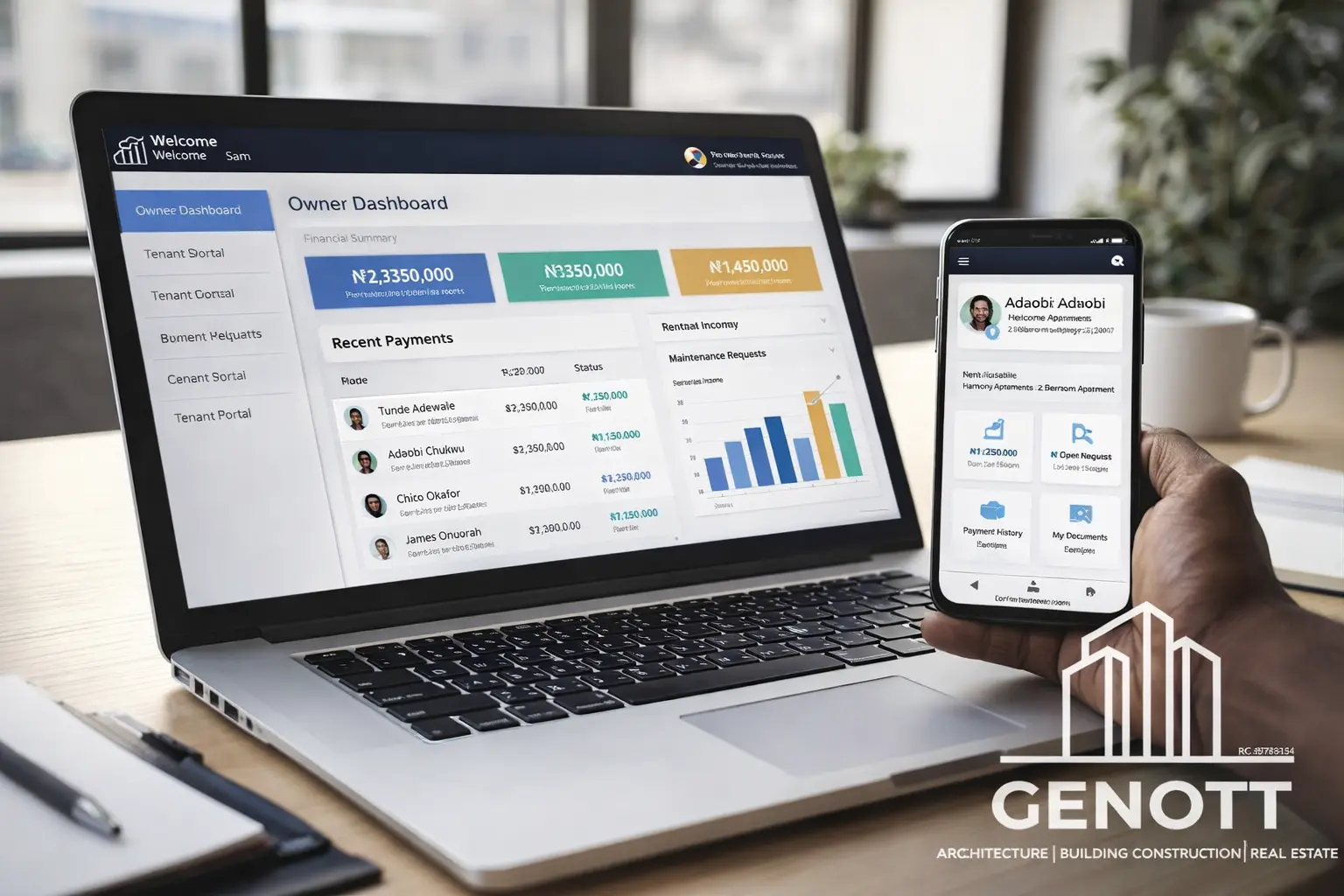
- Owner portal: Real-time financial dashboards, performance metrics
- Automated collection: Payment reminders, late fee application
- Maintenance tracking: Request logging, contractor coordination, completion verification
- Financial management: Income/expense categorization, P&L statements, tax reports
- Document storage: Leases, inspection reports, invoices, photos
Implementation Investment:
- Software: ₦5,000-₦50,000 monthly depending on features
- Setup and training: ₦50,000-₦200,000 one-time
- ROI: Pays for itself through 10-15 hours monthly time savings, 2-5% improved collections, reduced accounting errors
Key Performance Indicators (KPIs)
Occupancy Rate: Target 95%+ annually
- Calculation: (Occupied days ÷ Available days) × 100
- Below 90%: Investigate pricing, marketing, property condition
- Above 98%: Consider rent increase opportunity
Rent Collection Rate: Target 97%+
- Calculation: (Collected rent ÷ Rent due) × 100
- Below 93%: Review screening and collection procedures
- Track by property identifying problem units
Expense Ratio: Target <30-35% of gross income
- Calculation: (Operating expenses ÷ Gross rental income) × 100
- Above 40%: Investigate excessive maintenance or fees
- Compare to similar area properties
Tenant Retention: Target 60-70%
- Calculation: (Renewed tenants ÷ Total up for renewal) × 100
- Below 50%: Investigate satisfaction or pricing issues
- Above 80%: Excellent, but verify market rate pricing
Average Days to Rent: Target <30 days
- Calculation: Total vacant days ÷ Number of turnovers
- Above 45 days: Review pricing, marketing, property appeal
- Track seasonally (December-January slower)
Common Property Management Mistakes
Mistake #1: Inadequate Screening
- Error: Accepting first applicant without verification
- Cost: Problem tenants cause ₦800,000-₦2M losses
- Solution: Never compromise 5-step screening regardless of vacancy pressure
Mistake #2: Reactive Maintenance
- Error: Ignoring minor issues until major failures
- Cost: ₦50,000 leak becomes ₦300,000-₦500,000 damage
- Solution: Budget 10-15% annual rent for preventive programs
Mistake #3: Emotional Management
- Error: Inconsistent policy enforcement based on tenant stories
- Cost: Trains all tenants to expect leniency, 15-25% collection shortfalls
- Solution: Professional boundaries, uniform policy application, structured payment plans only
Mistake #4: Poor Record-Keeping
- Error: Co-mingled funds, no expense tracking, shoebox receipts
- Cost: Tax issues, missed ₦100,000-₦500,000 deductions, poor decisions
- Solution: Separate accounts, monthly reconciliation, professional bookkeeping for 5+ properties
Mistake #5: Verbal Agreements
- Error: No written leases or photo documentation
- Cost: Legal exposure ₦500,000-₦5M in worst cases
- Solution: Written leases, move-in/out photos, email trails
Mistake #6: Choosing Cheapest Manager
- Error: Hiring 6% manager vs. 12% without evaluating performance
- Cost: Poor 6% manager costs more through vacancy/collection losses
- Solution: Evaluate on performance metrics, not just fees
FAQS
Q: What are property management services in Nigeria and what do they include? A: Property management services in Nigeria handle complete rental property operations: (1) Tenant screening and placement with employment verification and guarantor checks reducing defaults 70-80%, (2) Rent collection through automated systems achieving 95-97% rates vs. 75-85% DIY, (3) Property maintenance coordination with vetted contractors, (4) Monthly financial reporting tracking occupancy, expenses, ROI, (5) Legal compliance including lease enforcement and eviction procedures. Services free owners from 10-20 hours weekly work while improving performance.
Q: How much do property management services in Nigeria cost? A: Standard fees: 8-12% monthly rent (Lagos 10-12%, Abuja/Port Harcourt 8-10%). For ₦400,000 monthly property: ₦32,000-₦48,000 monthly fee. Additional charges: Tenant placement 50-100% first month (₦200,000-₦400,000), property inspection ₦30,000-₦80,000, lease prep ₦20,000-₦50,000, repair coordination 10-15% of cost, evictions ₦200,000-₦500,000 plus legal fees.
Q: Should I self-manage or hire professional property management services in Nigeria? A: Hire if: 3+ properties, different city ownership, full-time job preventing 10-20 hours weekly, lack experience, commercial property, growing portfolio. Professional management at ₦480K annually (10% of ₦4.8M rent) delivers better net income than self-management through 95-97% vs. 75-85% collections and 3% vs. 12% vacancy.
Q: What should I look for in a property management contract in Nigeria? A: Essential clauses: Detailed service scope, response times (emergency 2-4 hours, routine 24-48 hours), performance standards (vacancy <5%, collection >95%, retention >60%), clear fees, spending authority limits, 60-90 day termination notice. Red flags: Vague services, hidden fees, >12-month lock-in, no accountability, opaque fund control.
Q: How do property managers screen tenants in Nigeria? A: Five-step protocol: (1) Employment verification—HR letter + 3-6 months statements, rent ≤30-35% income, (2) Previous landlord references—direct contact about payment/care, (3) Guarantor verification—income 1.5-2x rent with documentation, (4) Background check—references, social media, formal services for high-value properties, (5) Interview assessing professionalism. Reduces defaults 70-80%.
Q: How can I measure property manager performance? A: Monitor KPIs: Occupancy 95%+ annually, collection 97%+, expense ratio <30-35%, tenant retention 60-70%, average days to rent <30, maintenance response (emergency <4 hours, routine <48 hours). Review monthly reports, quarterly summaries, annual comprehensive assessment.
Q: How much should I budget for property maintenance annually? A: Budget 10-15% annual rent for preventive maintenance plus 5-10% emergency reserve. Example: ₦4.8M rent = ₦480K-₦720K maintenance + ₦240K-₦480K emergency = ₦720K-₦1.2M total. Preventive costs 40-60% less than reactive repairs. Well-maintained properties command 15-25% premium.
Q: What should I do if a tenant stops paying rent in Nigeria? A: Protocol: (1) Contact same day—understand circumstances, (2) Payment plan for genuine hardship with written agreement, (3) Formal quit notice after 7-14 days, (4) Legal eviction if no resolution (₦200K-₦500K + 2-6 months), (5) Prevention—thorough screening reduces defaults 70-80%. Never accept partial payments without written agreement.
CONCLUSION
Property management services in Nigeria have evolved into professional operations delivering measurable investment returns through systematic processes, technology integration, and performance optimization. Professional management at 8-12% monthly fees transforms rental ownership from time-consuming burden into passive income generation through reduced vacancy (15% to 3%), improved collections (75-85% to 95-97%), preventive maintenance saving ₦200,000-₦500,000 annually, and legal protection.
The self-manage versus hire decision depends on property count (3+ units justify professional services), location (distance ownership requires local managers), available time (10-20 hours weekly requirement), expertise (first-time landlords benefit from guidance), and growth strategy (scaling beyond 5 properties requires professional systems). Financial analysis consistently shows professional property management services in Nigeria pay for themselves through performance optimization while freeing owners for higher-value activities.
Critical success factors apply universally: comprehensive tenant screening reducing defaults 70-80%, preventive maintenance budgeting 10-15% annual rent, performance monitoring through KPIs (95%+ occupancy, 97%+ collection, 60-70% retention), proper legal documentation preventing 80-90% disputes, and technology systems streamlining operations.
Lagos property management companies and property management services across Nigeria demonstrate that operational excellence—not location or purchase price—determines rental property success. The ₦40,000-₦120,000 monthly management investment on ₦400,000-₦1M rent properties consistently delivers superior net income through optimized operations, preserved property value, and reclaimed time enabling portfolio growth from 3 to 20+ units.
About the Author: This guide is produced by GENOTT LTD’s property management and real estate team, drawing on 15+ years Nigerian real estate experience managing portfolios across Lagos, Abuja, and Port Harcourt.
For professional property management services, comprehensive tenant screening, maintenance coordination, real estate investment advisory, and integrated expertise across architecture, construction, real estate development, agriculture, and transportation, GENOTT LTD provides complete development and management solutions throughout Lagos, Abuja, Port Harcourt, and Nigeria nationwide.

 GENOTT LTD Editorial Team