 GENOTT LTD Editorial Team
If you live or build in Nigeria, you can feel the shift: Lagos is going vertical, Abuja is standardising “premium office” expectations, and Port Harcourt is balancing industrial reality with modern commercial aesthetics. These changes aren’t random—they’re part of the bigger wave of architecture trends in Nigeria driven by land scarcity, rising construction costs, power challenges, security concerns, and a real estate market that increasingly rewards efficiency and mixed-use convenience.
Today, the most successful projects are designed like systems, not standalone buildings: energy strategy, ventilation and shading, access control, parking and traffic flow, flood-resilient site planning, and faster construction methods that reduce exposure to inflation and delays. Developers are also moving toward mixed-use developments, where retail, office, and residential uses share infrastructure—and where one project can capture multiple income streams.
This guide breaks down the major design and development trends transforming Nigerian cities, with practical insights for investors, homeowners, and developers: what’s driving high-rise growth, why climate-responsive façades are becoming “mandatory,” how green certification is influencing design decisions, what smart buildings really mean in Nigeria, and how to avoid costly mistakes when following trends.
SUMMARY TABLE
| Topic | Key Insight | Notes |
|---|---|---|
| Mixed-use boom | One site, multiple revenue streams | Strong in Lagos growth corridors |
| High-rise Lagos | Vertical density rising in premium districts | Eko Atlantic continues to attract high-rise residential projects |
| Green building | Certification is now a market signal | EDGE targets ≥20% energy & water savings |
| Smart buildings | “Smart” = energy, access control, monitoring | Research examines smart green strategies in Abuja high-rise office context |
| Faster delivery | Modular/precast interest rising | Industry reports project growth in prefabricated construction |
| Climate façades | Screens/overhangs now practical, not “style” | Heat + power costs push passive design |
| Urban regeneration | Upgrading districts beats greenfield sprawl | More value where infrastructure exists |
Why Architecture Trends in Nigeria Are Shifting Fast
Architecture in Nigeria is being reshaped by four pressures:
-
Land economics + density
Prime land in Lagos and parts of Abuja forces developers to build upward or build mixed-use to justify land costs. -
Power reality + operating cost
Buildings that run hot or rely on inefficient systems punish owners and tenants with higher bills—so climate-responsive design is moving from “nice to have” to commercial necessity. -
Construction risk + inflation exposure
Long project cycles increase exposure to price swings and delays; faster methods (precast, modular components) reduce risk windows. -
Buyer/tenant sophistication
The market increasingly asks: “Is there parking? Is it secure? How stable is power? Is the building maintainable?” These questions directly shape design decisions.
Step-by-Step: How to Read City Trends Like an Investor (Lagos vs Abuja vs Port Harcourt)
A useful framework is: City economics → land constraint → infrastructure reality → building response.
Lagos
-
Constraint: land scarcity, traffic, coastal flooding risk, premium demand zones
-
Design response: high-rise, mixed-use pods, robust drainage, parking-heavy podiums, façade shading
Eko Atlantic is frequently cited as a major mixed-use, master-planned development and continues to host multiple high-rise residential projects.
Abuja
-
Constraint: planning control, wide roads, heat, premium office market expectations
-
Design response: formal massing, energy-managed offices, access control, strong building services (MEP), shade and solar-ready planning
There’s active research focus on adoption of “smart green” strategies in Abuja high-rise office design, reflecting this market direction.
Port Harcourt
-
Constraint: industrial economy, humidity/corrosion, rainfall, mixed residential-commercial demand
-
Design response: durable finishes, moisture-resistant envelopes, practical ventilation, security-first site layouts, efficient mixed-use commercial blocks
Investor takeaway: Trends are not copied from Instagram—they are responses to local constraints.
The Rise of Mixed-Use Developments (Retail + Office + Residential)
Mixed-use developments Nigeria-wide are growing because they:
-
spread risk across multiple tenant types (retail, office, residential)
-
share infrastructure costs (power, water, security, parking)
-
increase footfall and “destination value”
What good mixed-use design looks like in Nigeria
-
Separate access for residential vs commercial (security + privacy)
-
Loading/service routes that don’t clash with customer movement
-
Noise zoning (restaurants below, apartments above = acoustic planning)
-
Parking and turning radii designed for Nigerian vehicle patterns
Where it’s strongest: Lagos corridors (Ikoyi/Victoria Island/Lekki) and emerging nodes around Abuja growth areas.
High-Rise Living and Vertical Density: What’s Driving It
High-rise development Lagos is pushed by:
-
premium land pricing
-
demand for secure, serviced living
-
developer preference for higher yield per square metre
Recent reporting highlights ongoing luxury residential tower projects in Eko Atlantic with multiple developments and timelines stretching into 2026.
What high-rise architecture demands (beyond “tall buildings”)
-
stronger structural systems and wind considerations
-
reliable vertical transport planning (elevators + backup power)
-
life safety planning (egress, fire strategy)
-
better façade engineering (solar heat gain control + maintenance access)
Reality check: High-rise is not automatically “more profitable.” It’s profitable when services, maintenance, and market fit are properly engineered.
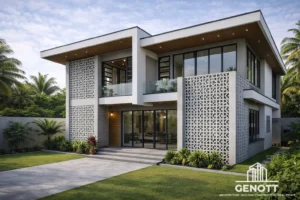
Climate-Responsive Design: Screens, Shading, Cross-Ventilation (Now a Competitive Advantage)
In Nigeria’s heat and humidity, climate-responsive architecture is a money decision.
The big moves reshaping façades
-
deep overhangs and balconies for shading
-
façade screens (perforated panels, fins) to cut direct sun
-
courtyards/lightwells for airflow and daylight
-
cross-ventilation planning in residential layouts
Research and practice increasingly tie passive strategies to improved indoor comfort and reduced energy demand.
Developer lens: If a building needs constant AC to feel livable, tenants feel the pain monthly—and churn faster.
Sustainable Architecture and Green Building Trends Nigeria: From “Buzzword” to Market Signal
Green building is moving from branding to measurable performance:
-
stronger corporate tenant appeal
-
“future-proof” positioning
EDGE and market adoption
Nigeria’s Green Building Council highlights EDGE benefits, including that EDGE-certified buildings reduce energy and water use by at least 20%.
What “green” looks like in Nigerian projects (practical version)
-
solar-ready roof planning
-
efficient lighting and controls
-
water efficiency (low-flow fixtures, harvesting where appropriate)
-
shading + envelope efficiency (reduce cooling load)
-
durable local material strategies where suitable
Trust note: Not every project needs certification. But performance thinking (energy + water + maintenance) is becoming a baseline expectation.
Building Materials Trends Nigeria: Local Innovation Meets Performance
Developers are increasingly balancing:
-
availability
-
cost volatility
-
speed of installation
-
durability (especially in coastal zones)
-
thermal performance
What’s trending in “material logic”
-
façade shading systems as a “material choice” (screens, fins, louvers)
-
reflective roofing and insulation to reduce heat gain
-
hybrid wall systems (where appropriate) to improve comfort
-
exploration of local innovations (compressed earth approaches, bamboo applications) where supply chains and workmanship quality support it
Practical caution: The best material is the one your contractor can execute correctly, consistently, and maintain.
Smart Buildings in Nigeria: What “Smart” Really Means
Smart buildings are not just apps—they’re building operations.
Smart building features gaining traction
-
energy monitoring (metering by floor/tenant)
-
access control (biometrics, card systems, visitor management)
-
CCTV and perimeter monitoring
-
automation for lighting/AC scheduling
Research focused on Abuja high-rise office design shows growing attention to smart green strategies in professional practice discussions.
ROI lens: Smart investments pay off when they reduce waste, improve security, and lower downtime—not when they’re only “cool features.”
Public Space, Placemaking, and Walkable Districts
Urban regeneration Nigeria-wide increasingly values:
-
usable parks and waterfront edges
-
safe walkability inside estates and mixed-use districts
-
“place identity” that increases property value
Placemaking is no longer just government work—private master-planned developments are packaging public realm quality as a premium feature.
New Construction Methods: Modular, Precast, and Faster Delivery
Faster construction reduces:
-
inflation exposure
-
financing carry cost
-
delay risks
Industry market intelligence reports project growth in Nigeria’s prefabricated construction market.
Where these methods fit best in Nigeria
-
repeatable residential blocks (terraces/apartments)
-
warehouses and industrial structures
-
schools/health facilities with repeatable modules
-
structural elements like staircases, beams, slabs (precast strategy)
Caution: Speed only works with quality control and site logistics planning.
Affordable Housing Design Trends and Space Efficiency
Affordability is driving:
-
smarter space planning (less corridor waste)
-
flexible rooms (study/guest conversion)
-
terrace and low-rise apartment typologies for density
-
cost-smart finishes with durability focus
Key trend: Buyers will accept smaller spaces if comfort, light, ventilation, security, and services are strong.
Infrastructure-Led Architecture: Transport Hubs, Flyovers, and Transit-Oriented Thinking
Urban development in Nigeria increasingly follows infrastructure:
-
new roads reshape land value
-
transport nodes attract retail and mixed-use
-
corridors become investment magnets
The design implication: buildings must plan for access, turning, parking, drainage, and service routes as “first-class” requirements—not afterthoughts.
Cost Analysis and Investment Insights (Nigeria): What Trends Do to Your Budget
Architecture trends influence cost mainly through:
-
façade systems (screens/fins/curtain wall choices)
-
MEP intensity (smart systems, backup power, controls)
-
structural complexity (high-rise engineering)
-
speed strategy (precast/modular logistics)
Decision table (developer-style)
| Trend Feature | CAPEX Impact | OPEX Impact | When it’s worth it |
|---|---|---|---|
| Façade shading screens | Medium | Lowers cooling cost | Hot façades, premium markets |
| Smart energy monitoring | Medium | Cuts waste | Multi-tenant commercial |
| Green certification (EDGE) | Medium | Efficiency + market signal | Corporate tenants / premium resale |
| Precast/modular strategy | Medium | Indirect savings via speed | Repetitive typologies |
| High-rise elevators/services | High | High (maintenance) | Only when rents/sales justify |
Comparisons: Lagos vs Abuja vs Port Harcourt Trend Snapshot
| Trend | Lagos | Abuja | Port Harcourt |
|---|---|---|---|
| High-rise push | Strong | Moderate | Selective |
| Mixed-use | Strong | Growing | Growing |
| Façade shading | Rising fast | Rising | Essential (humidity + sun) |
| Smart buildings | Premium districts | Strong in offices | Selective |
| Materials durability | Coastal corrosion focus | Heat/dust focus | Moisture/corrosion focus |
Common Mistakes Nigerians Make When Following Architecture Trends
-
Copying “Dubai aesthetics” without Nigerian climate response
-
Underestimating MEP and maintenance (smart/high-rise systems)
-
Ignoring drainage and flood risk (especially coastal Lagos corridors)
-
Designing mixed-use without separating service routes and access
-
Building tall without a realistic elevator/power/maintenance plan
-
Selecting exotic materials without local workmanship capacity
-
Treating approvals and compliance as an afterthought (causes redesign, delays)
Expert Recommendations
-
Design for constraints first: heat, rain, power, traffic, security
-
Use trend filters: “Does it improve comfort, cost, durability, or market value?”
-
Build systems, not buildings: envelope + MEP + operations planning together
-
Phase masterplans: deliver infrastructure first (roads, drainage, power strategy)
-
Make approvals and documentation investor-ready: clear drawings, BOQ alignment, compliance pathway
Future Trends and Strategic Insights
-
More vertical development in Lagos premium zones, including continued high-rise activity in Eko Atlantic-style districts
-
Green certification becoming mainstream for corporate-grade assets, with EDGE positioned as a practical route
-
Smart building features becoming default in high-end commercial assets, especially in Abuja office markets
-
Faster delivery methods (precast/prefab components) increasing as developers manage cost volatility and timelines
-
More climate-resilient envelopes as energy cost pressure grows and comfort becomes a selling point
FAQs
1) What are the biggest architecture trends in Nigeria right now?
Mixed-use projects, selective high-rise growth in Lagos, climate-responsive façades, and rising interest in green and smart building features.
2) Why are mixed-use developments growing in Nigeria?
They diversify income (retail/office/residential), share infrastructure costs, and create “destination value,” especially in Lagos and Abuja.
3) Is high-rise development in Lagos still increasing?
Yes—premium districts continue to see high-rise residential and mixed-use activity, including Eko Atlantic projects reported with ongoing timelines.
4) What does “green building” mean in Nigeria in practical terms?
Energy and water efficiency, better envelopes, and often certification pathways like EDGE, which targets at least 20% savings in energy and water.
5) Are smart buildings common in Nigeria?
They’re growing in premium commercial assets—typically focused on energy management, security, access control, and monitoring.
6) Which city leads in contemporary building design Nigeria—Lagos or Abuja?
Lagos leads in vertical density and mixed-use pressure; Abuja often leads in formal office-grade expectations and structured development control—each shapes design differently.
7) What’s the biggest mistake developers make with trends?
Copying styles without adapting to Nigeria’s climate, power realities, drainage, and long-term maintenance costs.
8) What materials trends are shaping Nigerian buildings?
More shading systems and envelope strategies, durability-driven finishes, and growing interest in faster construction methods like precast/prefab components.
CONCLUSION
Architecture trends in Nigeria are not just “design fashion”—they’re practical responses to land pressure, power costs, climate stress, and investor expectations. Lagos is pushing vertical density and mixed-use convenience; Abuja is strengthening corporate-grade building standards; Port Harcourt is balancing durability with modern commercial needs. Across all cities, the winning formula is consistent: climate-responsive envelopes, smarter building services, efficient layouts, and faster delivery strategies that reduce project risk.
For developers and homeowners, the best approach is not to chase trends blindly, but to adopt the ones that measurably improve comfort, operating cost, durability, compliance, and market value.
For professional support, GENOTT LTD provides expert guidance in architectural design, development planning, approvals documentation, climate-responsive façade strategy, and integrated project delivery—helping clients build future-ready assets across Nigeria.

 GENOTT LTD Editorial Team