 GENOTT LTD Editorial Team
Building plan approval in Nigeria is the stage that separates a “buildable project” from an expensive problem waiting to happen. Many Nigerians buy land, rush to fence, and even start foundation—only to face stop-work actions, redesign costs, or a stalled project because approvals, setbacks, or documentation were not properly handled. In cities like Lagos, Abuja (FCT), Enugu, Port Harcourt, and Ibadan, the rules are not just bureaucracy—they are the framework that ensures your building aligns with planning standards, safety expectations, and the intended land use.
The most costly mistake is treating approval as an afterthought. In reality, approvals affect everything: your site layout, your footprint, your number of floors, drainage strategy, parking, and even your future resale value. In Lagos, building control and stage inspections are tied to obtaining a Certificate of Completion/Fitness for Habitation, and the process begins with securing the relevant planning permit. In Abuja, the Development Control system has also moved toward online submission and tracking to streamline applications.
This guide explains the approval process clearly: who regulates it, the documents you need, the real step-by-step workflow, what approvals typically cost, how long they realistically take, why plans get rejected, and how to work with the right professionals—so you can build legally, safely, and without expensive delays.
SUMMARY TABLE
| Topic | Key Insight | Notes |
|---|---|---|
| What approval means | Legal permission to build what you designed | Protects you from stoppage, redesign, and future disputes |
| Lagos workflow | Planning permit first, then building control stage compliance | LASBCA links stage inspection/certification to completion certificate |
| Abuja workflow | Development Control handles building plan submissions; online tracking exists | AMMC/DODC describes automated submission/tracking |
| Core documents | Survey + title evidence + sealed drawings + forms/fees | Example state guideline lists ARCON/COREN/SURCON seals |
| Cost reality | Fees vary by state, size, and use; budget buffers matter | FHA schedule shows per-unit and per-m³ fees (estate context) |
| Timeline reality | “Portal promises” vs real approvals | Lagos ePPPS advertises fast turnaround; real delays still occur |
| Rejection triggers | Setbacks, zoning, missing seals, incomplete docs | Common in practice; avoidable with pre-checks |
What Is Building Plan Approval in Nigeria and Why It Matters
Building plan approval is the official process where a planning authority reviews your proposed building (drawings + documents) and confirms it complies with planning rules, zoning, and safety expectations. Practically, it answers:
-
Is the land use correct (residential vs commercial vs mixed use)?
-
Are setbacks respected (front/side/rear and right-of-way)?
-
Is the building height/floors within limits for the area?
-
Are access, parking, drainage, and services acceptable?
Why it matters (Nigeria realities)
-
It reduces demolition/stoppage risk.
-
It improves resale credibility (“approved building plan in Nigeria” becomes a selling point).
-
It supports safer construction through inspections and compliance. In Lagos, LASBCA describes stage inspection and a completion/fitness certificate pathway tied to compliance through the build.
Who Regulates Building Approvals in Nigeria
Nigeria’s approvals are state/FCT-driven, not “one national office.” Your location determines the authority and workflow.
Lagos
-
LASPPPA handles planning permits (the development permit stage).
-
LASBCA handles building control: stage inspections and certification through construction, including a certificate of completion/fitness for habitation after compliance.
Lagos also uses an electronic platform (ePPPS/EPP) for physical planning applications.
Abuja (FCT)
-
The Department of Development Control (DDC/DODC) under AMMC is presented as responsible for development control oversight and has implemented online submission/tracking for building plan processes.
Other states
State urban development boards and town planning authorities run approvals. An example guideline (Ebonyi) shows a typical structure: application form + document checklist + processing timeline + fee schedule.
Documents Needed for Building Plan Approval in Nigeria
While exact requirements vary by state, Nigerian approval packages usually contain four categories:
1) Land and survey evidence
-
Survey plan (often sealed by SURCON-registered surveyor in formal processes)
-
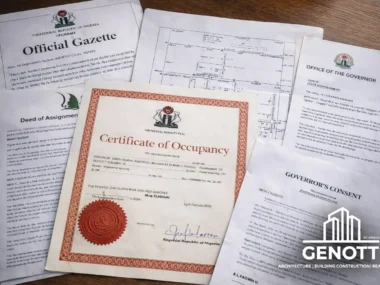
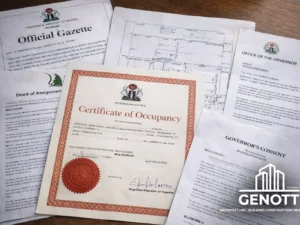
Evidence of ownership (e.g., C of O, Deed of Assignment, Deed of Lease, Power of Attorney—depending on your situation)
2) Professional drawings (sealed and signed)
A well-documented state guideline explicitly requires:
-
Architectural plan sealed by an ARCON registered architect
-
Structural/Mechanical/Electrical plans sealed by a COREN registered engineer
3) Planning/supporting reports (as applicable)
Depending on building type:
-
Site analysis / appraisal (some states request planning reports)
-
EIA for certain commercial uses (petrol stations, hotels, schools, hospitals, etc., depending on state requirements)
-
Soil investigation for multi-storey thresholds in some jurisdictions
4) Application and payment evidence
-
Completed application forms
-
Payment receipts/invoices
-
Passport photo / company seal requirements may appear in state checklists
Step-by-Step: Building Plan Approval Process in Nigeria (Core Walkthrough)
This is the “spine” of the process, regardless of state:
Step 1: Pre-check your land use and setbacks
Before you pay any fees:
-
Confirm zoning (what the land is permitted for)
-
Confirm right-of-way issues and estate rules
-
Confirm flood/drainage constraints (Lagos coastal zones require serious drainage thinking)
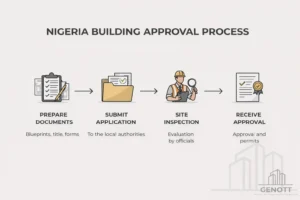
Step-by-Step flow from documents to submission to inspection to approval
Step 2: Produce a complete drawing set (avoid partial submissions)
A common failure point is submitting architecture only, then scrambling for structural/MEP later. Some state guidelines explicitly expect multi-discipline sealed sets.
Step 3: Submit application via the right channel
-
Lagos: planning permit applications are routed via LASPPPA channels including the ePPPS platform.
-
Abuja: Development Control describes online submission and tracking.
-
Other states: often physical submission with tracking reference number (as shown in Ebonyi’s guideline).
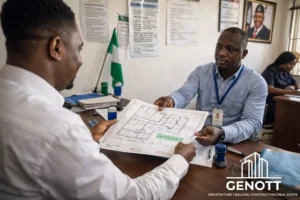
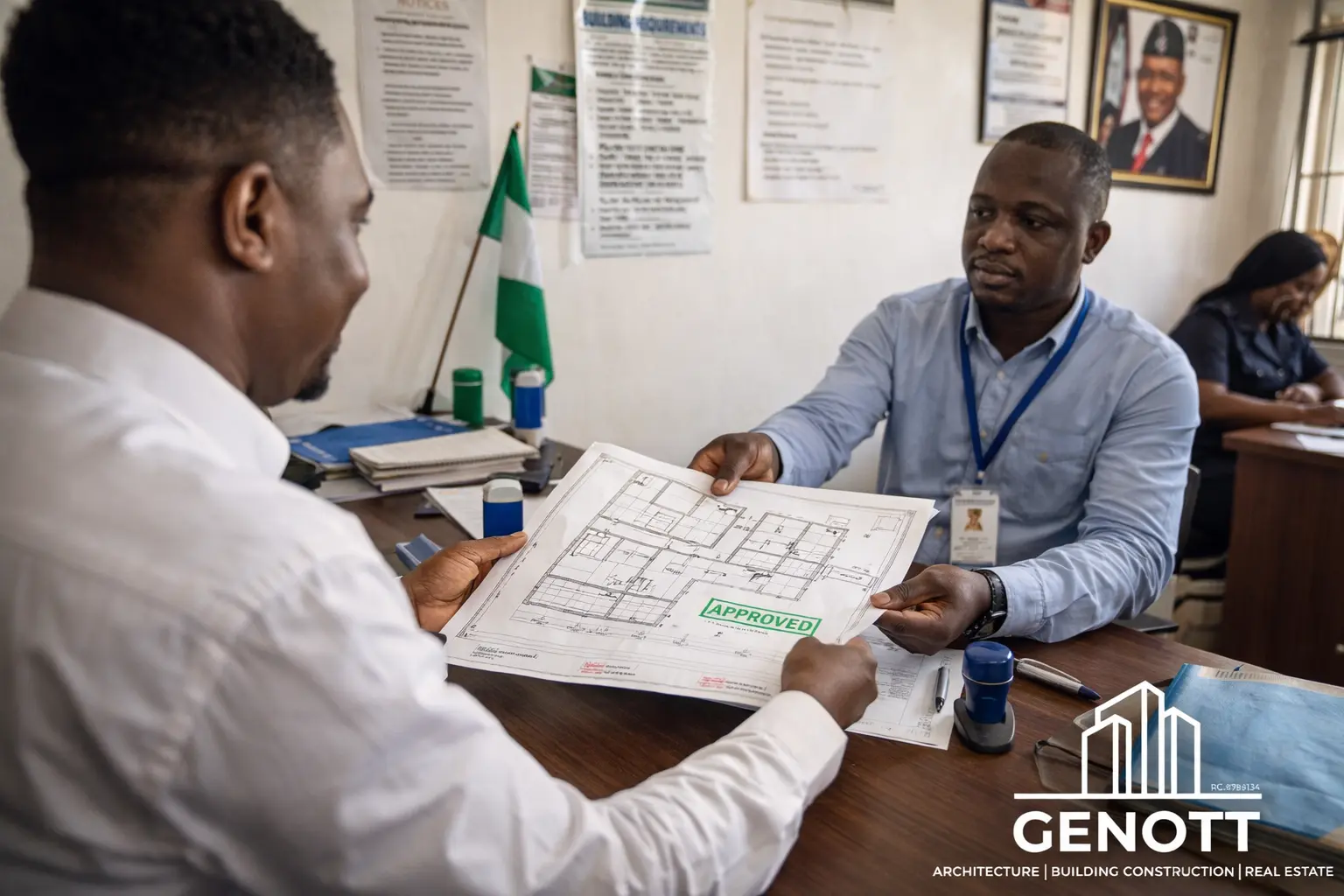
Architect submitting stamped drawings at planning authority
Step 4: Technical review and queries
Your submission is reviewed. If issues are found:
-
You receive a query
-
You revise drawings/documents
-
You resubmit for continued processing
Ebonyi’s guideline explicitly states plans may be returned for correction if discrepancies are found.
Step 5: Site inspection / verification (where applicable)
Authorities may inspect:
-
Boundary alignment
-
Setback compliance
-
Site conditions
Step 6: Approval issuance + stamped drawings
Once approved, you typically receive:
-
Approval letter/permit
-
Stamped drawing sets (“approved building plan Nigeria” evidence)
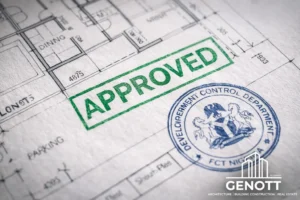
Official stamp on architectural drawings with floor plan
Step 7: After approval—construction monitoring and inspections
This is where many people get surprised: approval is not “finish line.”
In Lagos, LASBCA describes stage inspections and certification from foundation through completion, linked to obtaining a Certificate of Completion and Fitness for Habitation.
Building Plan Approval Cost in Nigeria: What You Pay For and How It’s Calculated
There is no single national fee. Costs vary by:
-
State/FCT and district
-
Residential vs commercial vs industrial
-
Building volume/size and number of floors
-
Fencing permits, inspection fees, and completion certificates (in some places)
Real examples (to anchor expectations)
-
FHA’s published processing fees show per-unit approvals and per-m³ rates for serviced plots and estate contexts (e.g., different fees for bungalows, duplexes, blocks of flats, and fences).
-
Ebonyi’s published schedule includes application form fees, registration fees, development rates per m², inspection fees per cubic metre, fencing permit fees, and completion certificate fees.
Budgeting rule
Plan for:
-
Government/statutory fees
-
Professional fees (architect, engineers, surveyor, planning consultant)
-
Revisions/queries buffer
-
Time cost (delays can inflate construction cost later)
How Long Does Building Plan Approval Take in Nigeria
Timelines vary by state, workload, and document completeness.
Published/indicative references
-
Lagos ePPPS messaging promotes fast processing and even advertises “within 3 working days” in its portal messaging (treat this as an aspiration, not a guarantee in complex cases).
-
Ebonyi’s guideline states processing is within 30 working days if requirements are met.
-
LASBCA’s guide notes approximately 10 days to process the certificate of completion/fitness after submission of necessary documents (post-construction certificate stage).
What actually causes delays (Nigeria reality)
-
Incomplete drawings or missing seals
-
Setback/zoning violations
-
Title documentation problems
-
Payment/receipt mismatches
-
Backlogs and inspection scheduling constraints
Speed tip: Submitting a complete, professionally sealed package upfront is the fastest “hack.”
Common Reasons Building Plans Get Rejected in Nigeria
These are the repeat offenders:
-
Setback violations (building too close to boundary/ROW)
-
Wrong land use / zoning conflict
-
Incomplete document set
-
Unsealed or improperly sealed drawings
-
Discrepancies between survey and drawings
-
Parking/access issues (especially for commercial and multi-unit)
-
Changes mid-process without updating the submission
State guidelines explicitly highlight compliance with setback requirements and scrutiny against planning schemes.
The Role of a Registered Architect (and Other Professionals) in Approval Success
Why ARCON/COREN credibility matters
-
State guidelines can require architectural drawings sealed by an ARCON registered architect and engineering drawings sealed by a COREN registered engineer.
-
ARCON itself explains it is responsible for registering architects in Nigeria and positions plan approval as a crucial step in the construction process.
-
ARCON’s own materials also link licensure to the authority to stamp and seal drawings for approvals.
Practical takeaway: Approval is faster when the submission is prepared by professionals who understand local rules and submit properly sealed documentation.
Lagos vs Abuja vs Other States: What Changes
| Factor | Lagos | Abuja (FCT) | Other States |
|---|---|---|---|
| Submission style | Strong push toward portal workflows (ePPPS) | Development Control describes online submission/tracking | Often hybrid: physical + some online, varies |
| Building control stage | LASBCA stage inspections + completion certificate pathway | Development Control enforcement + Abuja master plan alignment (context) | Similar principles, different agencies |
| Fee structure | Area/zone dependent; multiple fee components | Varies by authority/estate; FHA schedule shows examples | Some publish detailed schedules (Ebonyi example) |
| Timeline | Can be fast for clean cases; delays for queries | Varies; process discipline matters | Some states publish timeframes (e.g., 30 working days) |
What Happens If You Build Without Approval in Nigeria
Consequences can include:
-
Stop-work actions and enforcement
-
Demolition risk for severe violations
-
Fines/penalties and forced regularization processes
-
Difficulty selling or using the property as collateral
LASBCA’s guide references offences such as erecting structures without permit and failure to do stage inspection/certification under Lagos planning/building control regulations.
Can you regularize?
Sometimes, but it is typically:
-
More expensive than doing it correctly upfront
-
Risky if the structure violates setbacks/zoning
-
Dependent on authority discretion and compliance pathway
After Approval: Stamped Drawings, Conditions, Inspections, and Handling Changes
Approval typically comes with:
-
Stamped drawings (keep multiple copies)
-
Conditions (e.g., drainage provisions, setbacks, sometimes service requirements)
Inspections during construction
-
Expect stage checks (especially in Lagos under LASBCA’s described framework)
-
Keep a site file: approvals, consultants’ letters, and inspection invitations
Handling variations
If you change:
-
number of rooms,
-
footprint,
-
floors,
-
façade openings,
-
use of space,
…treat it as a formal design variation, not “we’ll adjust on site.” This is how people lose approval validity.
Common Mistakes Nigerians Make (High-Impact, Avoidable)
-
Paying for drawings before confirming zoning and setbacks
-
Submitting incomplete documentation (then losing weeks to queries)
-
Using unregistered “draughtsman-only” packages without required seals
-
Starting construction before approval and inspections
-
Ignoring drainage/flood risks (especially in Lagos and riverine contexts)
-
Building a different design from what was approved (future compliance crisis)
Expert Recommendations
-
Do a compliance-first concept
Confirm setbacks, access, drainage, and planning scheme fit before final design. -
Submit a complete multi-discipline package
Architectural + structural + MEP + survey + required reports, properly sealed. -
Budget with “approval reality” in mind
Use published schedules as anchors, but expect variation by location and building type. -
Treat approvals as an investment asset
Approved plans increase resale trust and reduce enforcement risk. -
Plan post-approval inspections early
Align your construction schedule with inspection milestones (especially where stage certification is expected).
Future Trends and Strategic Insights
-
More digitization of planning workflows (Lagos ePPPS; Abuja online submissions)
-
Greater enforcement focus on safety and building control as public risk awareness grows
-
Increased demand for “approval-ready” design packages from professionals to reduce delays and rework
FAQs
1) What is building plan approval in Nigeria?
It’s official authorization confirming your proposed building complies with planning rules, zoning, and safety expectations before construction.
2) What documents are needed for building plan approval in Nigeria?
Typically: survey plan, title evidence, sealed architectural drawings (ARCON), sealed engineering drawings (COREN), and required reports/forms—requirements vary by state.
3) How long does building plan approval take in Nigeria?
It depends on state and completeness. Some published processes cite 30 working days (example state guideline), while portals may advertise faster for clean cases.
4) How much does building plan approval cost in Nigeria?
Fees vary widely by location and building type. Published schedules show per-unit and per-m³ fees in some systems and additional fees for fences/inspections.
5) Who handles building plan approval in Lagos?
Planning permits are handled under Lagos physical planning permit authority workflows (including ePPPS), while LASBCA handles building control stage compliance and certification.
6) Who handles building approvals in Abuja (FCT)?
Development Control under AMMC/DODC oversees building plan submissions and has implemented online submission/tracking.
7) Can I build without approval and regularize later?
It’s risky and can cost more. Enforcement actions may occur, and regularization depends on compliance (setbacks/zoning) and authority processes.
8) Why do building plans get rejected in Nigeria?
Common reasons: setback violations, zoning conflicts, incomplete documents, and missing/invalid professional seals.
CONCLUSION
Getting Building plan approval in Nigeria is not a “paperwork tax”—it’s the process that protects your land investment, prevents enforcement surprises, and makes your project bankable and resale-ready. The fastest approvals come from a simple discipline: confirm zoning and setbacks early, prepare a complete sealed drawing package, submit through the correct authority, respond to queries quickly, and treat inspections as part of the build plan—not an interruption.
Whether you’re building in Lagos, Abuja (FCT), Enugu, Port Harcourt, or elsewhere, approval success is less about shortcuts and more about professional documentation and compliance-first design.
For professional support, GENOTT LTD provides expert guidance in approval-ready architectural design, documentation packaging, compliance checks, consultant coordination (ARCON/COREN), and end-to-end development planning—helping you secure approvals faster and build with confidence.

 GENOTT LTD Editorial Team