 GENOTT LTD Editorial Team
Introduction
Building or renovating your home in Nigeria doesn’t mean you have to compromise on aesthetics to stay within budget. The roofing material you choose significantly impacts your property’s curb appeal, resale value, and long-term maintenance costs. With roofing accounting for 15-20% of total construction costs, finding the cheapest roofing materials in Nigeria that still deliver a premium appearance is a strategic financial decision.
Nigerian property owners often face a dilemma: invest in expensive imported tiles that strain budgets, or settle for basic corrugated sheets that scream “budget build.” However, the modern roofing market offers sophisticated alternatives—stone-coated steel sheets, premium-finish aluminum, and architecturally profiled long-span materials—that bridge the gap between affordability and luxury aesthetics.
This comprehensive guide analyzes budget-friendly roofing options available across Lagos, Abuja, Port Harcourt, and other Nigerian cities, providing real pricing, durability comparisons, and expert installation insights to help you make informed decisions.
Quick Summary Table
| Roofing Material | Price Range (per sqm) | Luxury Appearance Rating | Expected Lifespan | Best For |
|---|---|---|---|---|
| Stone-Coated Steel Sheets | ₦4,500 – ₦8,000 | ⭐⭐⭐⭐⭐ (9/10) | 30-50 years | Bungalows, duplexes seeking tile aesthetics |
| Premium Aluminum (0.5mm) | ₦3,200 – ₦5,500 | ⭐⭐⭐⭐ (7/10) | 25-40 years | Modern designs, coastal areas |
| Long-Span Architectural Profile | ₦2,800 – ₦4,500 | ⭐⭐⭐⭐ (8/10) | 20-35 years | Commercial buildings, large estates |
| Corrugated Sheets (Premium Colors) | ₦2,200 – ₦3,500 | ⭐⭐⭐ (6/10) | 15-25 years | Budget-conscious projects |
Prices vary by brand, gauge thickness, and supplier location
Understanding Budget Roofing Materials in the Nigerian Context
Nigeria’s tropical climate, characterized by intense UV radiation, heavy seasonal rainfall, and high humidity (especially in coastal regions), demands roofing materials that balance affordability with durability. The cheapest roofing materials in Nigeria have evolved significantly over the past decade, with manufacturers now offering budget options that mimic premium aesthetics without compromising structural integrity.
The Nigerian roofing market is dominated by several key material categories:
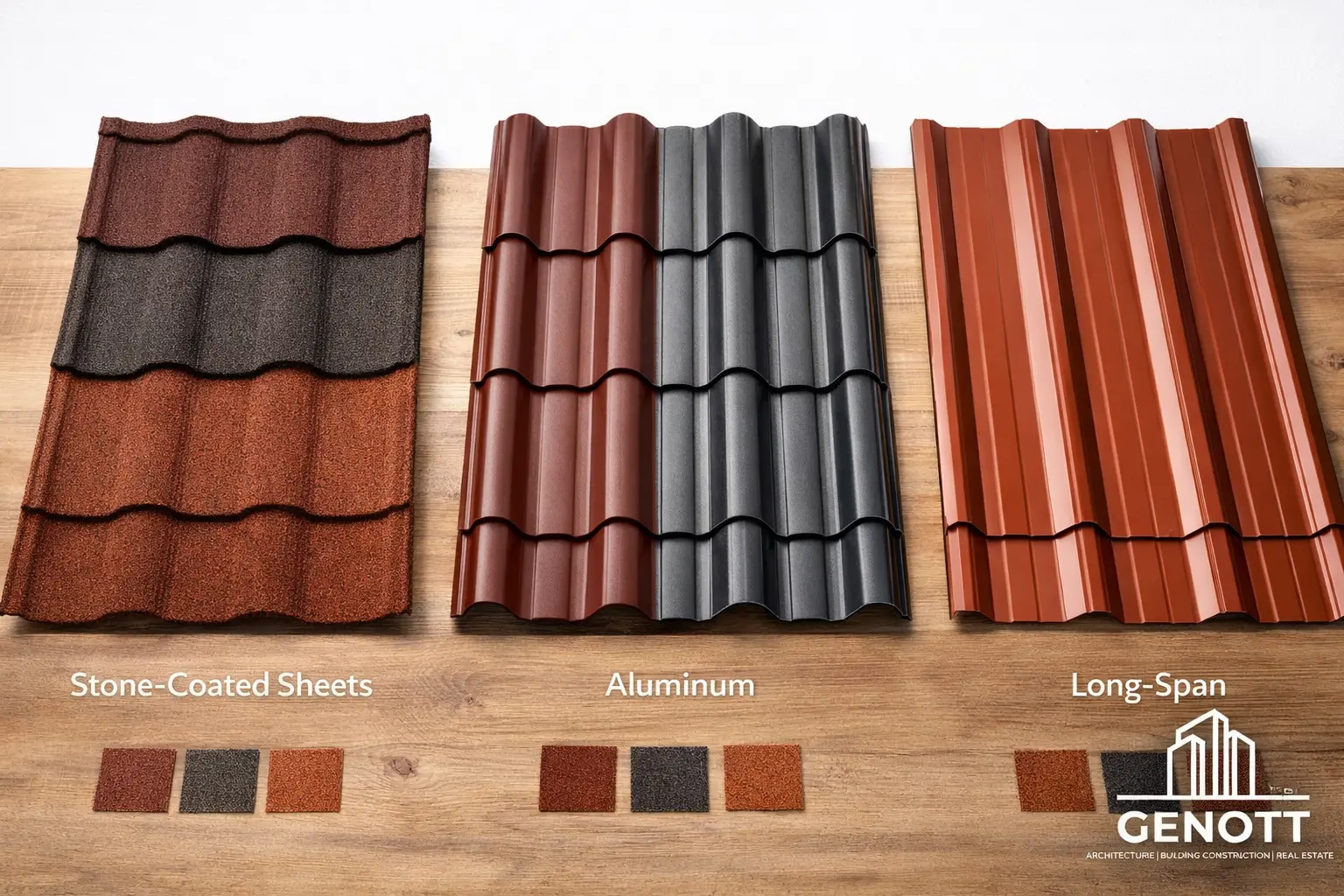
Stone-Coated Steel Sheets represent the sweet spot for homeowners seeking luxury appearance on moderate budgets. These materials combine the durability of steel with the visual appeal of traditional clay or concrete tiles. Popular brands like Docherich, Gerard, Metro, and Shingles offer various profiles that replicate Spanish tiles, shake shingles, or flat tiles at 40-60% lower cost than actual tile installations.
Aluminum Roofing Sheets have gained market share due to their rust resistance, particularly valuable in Nigeria’s humid southern regions and coastal cities like Port Harcourt, Calabar, and Lagos. Modern aluminum sheets feature polyester or PVDF coatings in premium colors that elevate their appearance beyond traditional silver finishes.
Long-Span Roofing Sheets offer economic advantages for larger roof areas. With lengths reaching 3-6 meters, these materials reduce joint lines and create cleaner visual profiles. Architectural long-span varieties incorporate ribbing patterns and premium finishes that challenge the aesthetics of more expensive options.
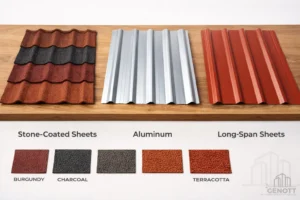
Premium Corrugated Sheets may seem basic, but strategic color selection and proper installation transform them into respectable roofing solutions. Burgundy, charcoal grey, dark green, and terracotta shades in matte finishes create sophisticated appearances that belie their budget classification.
Material selection extends beyond initial purchase price. Nigerian property owners must consider total lifecycle costs, including installation complexity, maintenance requirements, replacement frequency, and energy efficiency impacts on cooling costs—a significant consideration given Nigeria’s electricity tariffs.
Stone-Coated Roofing Sheets – The Affordable Luxury Champion
Stone-coated roofing sheets have revolutionized budget roofing in Nigeria, offering the visual sophistication of traditional tiles at a fraction of the cost and weight. These materials consist of steel base sheets (typically 0.4-0.5mm gauge) coated with stone chips bonded through acrylic polymers, creating textured surfaces that replicate premium roofing aesthetics.
Price Analysis and Brand Comparison
Local Brands:
- Docherich Stone-Coated Sheets: ₦4,500 – ₦6,200 per square meter
- Metro Tiles: ₦4,800 – ₦6,500 per square meter
- Shingles Nigeria: ₦5,200 – ₦7,000 per square meter
Imported Brands:
- Gerard (New Zealand): ₦7,000 – ₦9,500 per square meter
- Decra (Belgium): ₦7,500 – ₦10,000 per square meter
The price differential between local and imported brands primarily reflects manufacturing standards, coating quality, and warranty coverage. However, reputable local manufacturers like Docherich have significantly improved quality standards, offering warranties ranging from 15-30 years that make them competitive alternatives to imports.
Installation Cost Comparison
Stone-coated sheets require specialized installation to achieve their luxury appearance potential:
- Material Cost (3-bedroom bungalow, ~120 sqm roof): ₦540,000 – ₦840,000
- Accessories (battens, underlayment, ridge caps, valleys): ₦180,000 – ₦250,000
- Professional Installation Labor: ₦200,000 – ₦350,000
- Total Project Cost: ₦920,000 – ₦1,440,000
Compare this to actual concrete tiles (₦1.8M – ₦2.6M for the same project) or premium aluminum (₦650,000 – ₦950,000), and the value proposition becomes clear.
Why Stone-Coated Sheets Deliver Luxury Aesthetics
The textured surface creates shadow lines that mimic individual tiles, while varied color tones within each sheet prevent the monotonous appearance of flat-colored roofing. Stone granule coatings also absorb sound, dramatically reducing rain noise—a critical comfort factor in Nigerian homes.
Weight considerations favor stone-coated sheets over traditional tiles. At 6-7 kg per square meter versus 45-60 kg for concrete tiles, stone-coated options eliminate the need for structural reinforcement in most residential buildings, creating additional cost savings in the foundation and framing stages.
Complete Cost Breakdown – Materials Plus Installation in Nigerian Markets
Understanding total roofing costs requires analyzing material expenses, essential accessories, and regional labor variations across Nigeria’s major cities.
Material Costs Per Square Meter (Naira Prices)
Stone-Coated Steel:
- Economy tier: ₦4,500 – ₦5,500
- Premium tier: ₦6,000 – ₦8,000
Aluminum Roofing Sheets:
- 0.45mm gauge: ₦3,200 – ₦4,200
- 0.50mm gauge: ₦4,000 – ₦5,500
- 0.55mm gauge: ₦4,800 – ₦6,200
Long-Span Sheets:
- Standard profile: ₦2,800 – ₦3,800
- Architectural profile: ₦3,500 – ₦4,500
Corrugated Sheets:
- 0.40mm gauge: ₦2,200 – ₦2,800
- 0.45mm gauge: ₦2,600 – ₦3,500
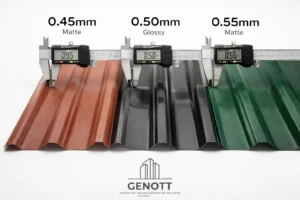
Three sheets side by side showing 0.45mm, 0.50mm, and 0.55mm thickness — different premium colors: terracotta, charcoal, forest green — matte and glossy finish
Real Project Examples
3-Bedroom Bungalow (120 sqm roof area):
- Stone-coated sheets: ₦920,000 – ₦1,440,000 (total)
- Premium aluminum: ₦650,000 – ₦950,000 (total)
- Long-span architectural: ₦580,000 – ₦820,000 (total)
4-Bedroom Duplex (180 sqm roof area):
- Stone-coated sheets: ₦1,380,000 – ₦2,160,000 (total)
- Premium aluminum: ₦975,000 – ₦1,425,000 (total)
- Long-span architectural: ₦870,000 – ₦1,230,000 (total)
Hidden Costs Often Overlooked
Essential Accessories (typically 30-40% of material cost):
- Timber battens/purlins: ₦150,000 – ₦300,000
- Roofing nails/screws: ₦25,000 – ₦40,000
- Ridge caps: ₦35,000 – ₦80,000
- Valley installations: ₦20,000 – ₦50,000
- Flashing materials: ₦30,000 – ₦60,000
- Underlayment/felt: ₦40,000 – ₦80,000
- Gutters and downspouts: ₦80,000 – ₦180,000
Regional Labor Cost Variations
Lagos (Ikeja, Lekki, Ikorodu):
- Skilled roofing installation: ₦1,800 – ₦2,500 per sqm
- Artisan work: ₦1,200 – ₦1,600 per sqm
Abuja (Central Area, Gwarimpa, Lugbe):
- Skilled installation: ₦2,000 – ₦2,800 per sqm
- Artisan work: ₦1,400 – ₦1,800 per sqm
Port Harcourt/Enugu/Ibadan:
- Skilled installation: ₦1,600 – ₦2,200 per sqm
- Artisan work: ₦1,000 – ₦1,400 per sqm
Seasonal Price Variations and Strategic Buying
Roofing material prices in Nigeria fluctuate based on several factors:
Dry Season Premium (November – March): Prices increase 10-15% due to high construction activity. Suppliers often experience stock shortages for popular profiles and colors.
Rainy Season Opportunities (May – September): Material prices drop 8-12% as construction activity slows. Suppliers offer discounts to maintain cash flow, presenting ideal buying windows for budget-conscious buyers.
Foreign Exchange Impact: Imported materials and even locally manufactured sheets (which use imported raw materials) fluctuate with Naira-Dollar exchange rates. Bulk purchases during stable forex periods protect against currency volatility.
Aluminum vs Stone-Coated vs Long-Span – Comprehensive Value Analysis
Selecting among budget roofing options requires understanding performance characteristics beyond initial purchase price.
Detailed Comparison Matrix
| Factor | Aluminum (Premium) | Stone-Coated Steel | Long-Span Architectural |
|---|---|---|---|
| Initial Cost | ₦650K – ₦950K (120sqm) | ₦920K – ₦1.44M (120sqm) | ₦580K – ₦820K (120sqm) |
| Installation Complexity | Moderate | High | Low |
| Lifespan (Years) | 25-40 | 30-50 | 20-35 |
| Warranty Period | 10-20 years | 15-30 years | 5-15 years |
| Coastal Durability | Excellent | Very Good | Good |
| Rain Noise Level | High | Low | Moderate |
| Heat Reflection | Excellent (light colors) | Good | Moderate |
| Maintenance | Minimal | Minimal | Low |
| Resale Value Impact | +8-12% | +12-18% | +5-8% |
| Luxury Appearance | 7/10 | 9/10 | 8/10 |
Climate Suitability Across Nigerian Regions
Coastal Areas (Lagos, Port Harcourt, Calabar): Stone-coated and aluminum excel due to corrosion resistance. Avoid standard galvanized steel sheets, which corrode rapidly in salt-laden air. Aluminum’s complete rust immunity makes it ideal for beachfront properties, while stone-coated sheets offer superior aesthetics with good coastal performance.
Northern Nigeria (Kano, Kaduna, Sokoto): All materials perform well in the drier climate. Heat reflection becomes critical—light-colored aluminum or stone-coated sheets in white, cream, or light grey reduce cooling loads significantly.
Rainforest Belt (Benin, Calabar, Warri): Stone-coated sheets’ noise reduction provides comfort during heavy rainfall periods. Proper underlayment installation prevents moisture infiltration in high-humidity environments.
The Rain Noise Factor – Critical for Nigerian Comfort
Nigerians consistently rank rain noise among their top roofing concerns. During intense tropical downpours:
- Stone-Coated Sheets: 60-70% noise reduction versus bare metal (sound-absorbing granules)
- Aluminum Sheets: Loudest option; consider acoustic insulation beneath
- Long-Span Sheets: Moderate noise; thicker gauges perform better
Thermal Performance and Energy Cost Implications
Nigeria’s energy costs make roof heat transfer a significant long-term expense. Reflective roofing reduces cooling loads:
- Light-colored aluminum: Reflects 60-70% of solar radiation
- Stone-coated in light tones: Reflects 50-60%
- Dark-colored materials: Reflect 20-35%
For a typical Nigerian home running AC 8-12 hours daily, reflective roofing can reduce cooling costs by ₦15,000 – ₦30,000 monthly, accumulating substantial savings over the roof’s lifespan.
Color and Profile Selection – Making Cheap Materials Look Expensive
Strategic aesthetic choices transform budget materials into luxury-appearing installations.
Premium Color Palette for Budget Materials
Colors That Elevate Perceived Value:
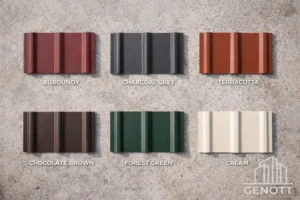
- Burgundy/Wine Red: Sophisticated, hides dirt well, complements cream/beige buildings
- Charcoal Grey: Modern, versatile, works with contemporary architecture
- Terracotta/Clay Red: Classic Nigerian favorite, warm aesthetic
- Dark Green (Forest/Hunter): Premium appearance, ideal for estates
- Chocolate Brown: Elegant, pairs well with natural stone finishes
Colors to Avoid for Luxury Appearance:
- Bright Blue: Dated, screams “budget construction”
- Basic Silver/Grey (shiny): Industrial, institutional look
- Faded Red: Shows age quickly, common in low-quality sheets
Profile Types and Their Aesthetic Impact
Tile-Profile Stone-Coated Sheets: Replicate Mediterranean or Spanish tiles. The S-curve or W-curve profiles create deep shadow lines visible from street level, dramatically enhancing curb appeal.
Standing Seam Profiles: Modern, architectural appearance. Long vertical lines create visual height and contemporary aesthetics. More expensive but deliver 9/10 luxury rating.
Corrugated with Wide Ribs: Traditional but timeless when executed in premium colors and matte finishes. Narrow spacing (50mm) looks cheap; wider spacing (76mm or 100mm) appears more substantial.
Finish Quality Impact
Matte Finishes:
- Sophisticated, hides minor imperfections
- Reduces glare
- Ages more gracefully
- Premium perception (+2 points on luxury scale)
Glossy Finishes:
- Can appear cheap if color selection is poor
- Shows dirt and streaking
- Better for modern, minimalist designs
- Use selectively
Matching Roofing to Architectural Style
Modern Minimalist Buildings:
- Charcoal grey or black in matte finish
- Standing seam profiles
- Clean lines without excessive ridge decorations
Traditional Nigerian Designs:
- Terracotta, burgundy, or clay tones
- Tile-profile stone-coated sheets
- Decorative ridge caps
Colonial/Mediterranean Styles:
- Terracotta or Spanish red
- Heavy tile-profile stone-coated
- White or cream facades
Where to Buy Authentic Roofing Materials at Best Prices in Nigeria
Navigating Nigeria’s roofing materials market requires knowledge of reputable suppliers and awareness of counterfeit products.
Major Supply Hubs by City
Lagos:
- Alaba International Market: Widest variety, competitive pricing, requires careful vendor selection
- Idumota: Traditional hardware hub, good for bulk purchases
- Ikeja (Computer Village area): Established dealers, higher prices but better quality assurance
- Ojota/Ketu: Growing supplier concentration, mid-range pricing
Abuja:
- Dei-Dei Building Materials Market: Largest concentration, competitive pricing
- Kubwa/Gwarimpa Suppliers: Convenient for northern Abuja, slightly premium pricing
- Nyanya Market: Budget options, thorough quality inspection recommended
Port Harcourt:
- Mile 1-3 Markets: Traditional supply center
- Trans-Amadi Industrial Layout: Direct manufacturer representatives
Ibadan:
- Dugbe Market: Central location, established dealers
- Challenge/Felele areas: Growing supplier presence
Identifying Fake and Substandard Materials
Nigeria’s roofing market contains significant counterfeit and substandard products. Warning signs:
Sheet Thickness Deception: Claimed 0.5mm sheets measuring 0.35-0.4mm upon verification. Always request gauge verification with a micrometer.
Color Coating Quality: Genuine materials show uniform color, smooth finish. Fake products exhibit:
- Uneven color patches
- Rough texture
- Color that rubs off on hands
- Visible rust spots even when new
Brand Misrepresentation: “Docherich-type” or “Gerard-style” sheets claiming association with established brands. Insist on manufacturer documentation and warranties.
Stone-Coating Issues: Low-quality stone-coated sheets shed granules within months. Test by rubbing firmly—excessive granule loss indicates poor bonding.
Bulk Purchase Strategies and Negotiation
Minimum Order Advantages: Purchasing 40+ bundles typically unlocks:
- 5-10% volume discounts
- Free delivery within city limits
- Complimentary ridge caps or accessories
- Extended payment terms (for established customers)
Negotiation Tactics:
- Request quotes from 3-4 suppliers (leverage competition)
- Pay cash for additional 3-5% discounts
- Bundle accessory purchases with main materials
- Time purchases during low-demand periods
Online Marketplaces vs Physical Dealers
Online Platforms (Jiji, Jumia, Konga):
- Advantages: Price comparison, delivery convenience, customer reviews
- Disadvantages: Cannot physically inspect before purchase, return complexities, delivery damage risks
Physical Dealers:
- Advantages: Quality inspection, immediate availability, relationship building, technical advice
- Disadvantages: Time investment, travel costs, potentially higher initial quotes
Recommended Hybrid Approach: Research prices online, identify target products, visit physical suppliers for inspection and final negotiation.
Installation Quality – How Poor Workmanship Ruins Budget Materials
Even the finest materials appear cheap when poorly installed. Professional installation separates luxury-looking roofs from obvious budget projects.
Critical Installation Elements for Luxury Appearance
1. Proper Alignment and Spacing Inconsistent overlap creates wavy roof lines visible from ground level. Professional installers use string lines and laser levels to ensure perfect alignment. Budget artisans eyeball measurements, resulting in unprofessional appearance.
2. Screw Placement and Sealing Exposed screws in random patterns look amateurish. Proper installation:
- Uses color-matched screws
- Follows straight line patterns
- Includes rubber washers for waterproofing
- Positions screws on sheet ridges (not valleys)
3. Ridge Capping and Edge Finishing The roof’s crown deserves attention. Quality ridge installation:
- Uses matching or complementary colors
- Ensures consistent overlap
- Incorporates ventilation strips
- Features clean, straight lines
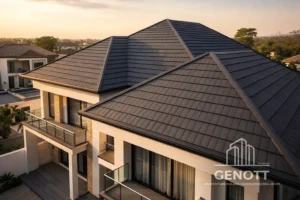
Premium aluminum roofing sheets in charcoal grey matte finish
4. Underlayment and Waterproofing This hidden element prevents leaks and extends roof lifespan. Many Nigerian contractors skip underlayment to reduce costs, leading to:
- Moisture infiltration during heavy rains
- Condensation problems
- Premature corrosion
- Reduced thermal insulation
5. Valley and Flashing Installation These transition areas often leak when improperly executed. Professional installation uses:
- Purpose-made valley sheets (not improvised bent sheets)
- Proper sealants
- Adequate overlap dimensions
- Corrosion-resistant materials
Common Installation Mistakes That Scream “Budget”
Visible Mistakes:
- Misaligned sheets creating irregular patterns
- Inconsistent overhang lengths
- Poor color matching between main sheets and accessories
- Exposed cut edges not sealed or capped
- Crooked ridge lines
Structural Mistakes (affecting longevity):
- Insufficient fasteners (roofing blows off in windstorms)
- Over-tightened screws crushing sheets
- Inadequate purlin spacing causing sagging
- Missing or improper roof ventilation
Professional Installation vs Artisan Work
Professional Roofing Companies:
- Provide written quotes and warranties
- Use specialized tools (seamers, benders)
- Follow manufacturer installation guidelines
- Complete typical bungalow in 3-5 days
- Cost: ₦1,800 – ₦2,800 per sqm in Lagos
Artisan (Independent) Roofers:
- Lower initial cost (₦1,000 – ₦1,600 per sqm)
- Variable quality (highly dependent on individual skill)
- Limited warranty or accountability
- May lack insurance
- Timeline flexibility (can be advantage or disadvantage)
When to Choose Professional Installation:
- Complex roof designs (multiple valleys, dormers)
- Premium material investments
- Multi-story buildings
- Coastal locations requiring corrosion-prevention expertise
- Projects where appearance critically impacts property value
When Artisan Work May Suffice:
- Simple gable roofs
- Very tight budgets
- Contractor with verified local reputation
- Supervised installation with clear specifications
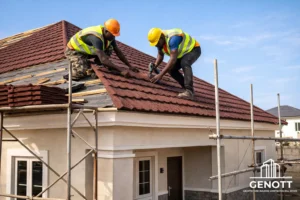
Professional roofers installing stone-coated sheets 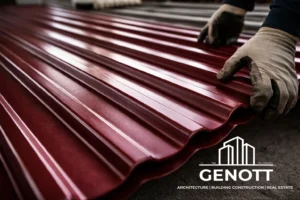
Burgundy corrugated profile with ribbing detail visible
Durability and Warranty – Ensuring Your Budget Choice Lasts
Long-term value depends on material lifespan and maintenance requirements.
Expected Lifespan by Material and Quality Tier
Stone-Coated Steel Sheets:
- Premium (Gerard, Decra): 40-50 years
- Quality Local (Docherich, Metro): 30-40 years
- Economy Brands: 20-30 years
Degradation typically occurs through stone granule loss rather than structural failure. Roofs maintain functionality but gradually lose aesthetic appeal.
Aluminum Roofing Sheets:
- 0.55mm gauge, premium coating: 35-40 years
- 0.50mm gauge, standard coating: 25-35 years
- 0.45mm gauge: 20-30 years
Coastal environments reduce these estimates by 15-20% even for aluminum due to coating breakdown from salt exposure.
Long-Span and Corrugated Sheets:
- 0.50mm+ gauge, quality coating: 25-35 years
- 0.45mm gauge: 15-25 years
- 0.40mm gauge: 10-20 years
Thinner gauges dent easily, accumulate rust at fastener points, and sag between purlins over time.
Warranty Realities in Nigeria
Manufacturer warranties often include clauses that void coverage:
- Coastal installation (salt air exclusion)
- Improper installation not performed by certified contractors
- Failure to register product within 30-90 days of purchase
- Lack of proof of purchase (lost receipts)
What Nigerian Warranties Actually Cover: Most warranties address manufacturing defects (coating failure, premature corrosion) but exclude:
- Installation errors
- Storm damage
- Fading from UV exposure
- Granule loss on stone-coated sheets after 10 years
Warranty Honoring Reality: Established brands (Docherich, Metro) generally honor claims with proper documentation. Lesser-known brands may be unreachable after 5-7 years if they cease operations.
Maintenance Requirements
Stone-Coated Sheets:
- Annual inspection for loose granules
- Clean gutters to prevent backup
- Touch up areas with granule loss (specialty paint available)
- Minimal active maintenance required
Aluminum Sheets:
- Periodic washing to remove corrosive deposits (especially coastal areas)
- Screw tightness checks after major storms
- Gutter maintenance
- Repaint or recoat every 15-20 years if coating degrades
Long-Span/Corrugated:
- Rust spot treatment when detected
- Fastener replacement as needed
- Seal coating every 10-15 years in harsh environments
Gauge Thickness Selection Strategy
0.5mm Gauge:
- Best for permanent residences
- Superior dent resistance
- Longer lifespan justifies higher initial cost
- Recommended for windy locations
0.45mm Gauge:
- Balanced option for budget-conscious quality builds
- Adequate for most Nigerian residential applications
- Sweet spot for value-seekers
0.4mm Gauge:
- Only for extremely tight budgets
- Suitable for temporary structures
- Expect shorter replacement cycles
- Avoid for multi-story buildings or exposed locations
Cost vs Lifespan Analysis: 0.5mm gauge costs 15-20% more than 0.4mm but lasts 40-60% longer, making it the superior long-term investment for permanent structures.
Common Mistakes Nigerians Make When Choosing Budget Roofing
Avoiding these pitfalls protects your investment and ensures satisfaction.
Mistake #1: Ultra-Cheap Materials That Fail Quickly
Purchasing the absolute cheapest available sheets (often ₦1,800-₦2,200 per sqm) typically results in:
- Replacement needed within 2-4 years
- Rust spots appearing within months
- Severe fading by year two
- Total project cost exceeding mid-tier materials when replacement is factored
Better Strategy: Budget for mid-tier materials (₦3,200-₦4,500 per sqm) that last 20-30 years, avoiding the “buy twice” trap.
Mistake #2: Ignoring Gauge Thickness to Save ₦50,000-₦100,000
Choosing 0.4mm over 0.5mm gauge saves approximately ₦60,000-₦120,000 on a typical bungalow but creates:
- Replacement cost of ₦800,000-₦1,200,000 within 10-15 years (versus 25-35 years)
- Higher maintenance costs throughout lifespan
- Reduced property resale value
Math Reality: The initial savings become a ₦700,000-₦1,000,000 loss over the building’s lifetime.
Mistake #3: Poor Color Choices
Selecting bright, unusual colors or finishes that:
- Date quickly (neon blue, lime green seen in early 2000s construction)
- Show dirt heavily (light grey in dusty areas)
- Clash with neighborhood aesthetics (reducing resale appeal)
- Fade unevenly (cheap coatings on saturated colors)
Better Approach: Choose timeless colors (burgundy, charcoal, terracotta, dark green) that age gracefully and appeal to broad buyer demographics.
Mistake #4: Skipping Proper Roof Ventilation
Many Nigerian builders omit roof ventilation to save ₦40,000-₦80,000, causing:
- Excessive heat buildup (increasing AC costs by 20-30%)
- Condensation leading to wood rot and mold
- Premature roofing material degradation
- Uncomfortable indoor temperatures
Solution: Install ridge vents, soffit vents, or gable vents. The modest upfront cost pays for itself through reduced energy bills within 2-3 years.
Mistake #5: Failing to Calculate Total Project Cost
Many Nigerians budget only for roofing sheets, then face sticker shock when accessories and labor add 60-80% to the estimate:
- Battens/purlins: 15-20% of material cost
- Ridge caps, valleys, flashing: 10-15%
- Nails, screws, sealants: 3-5%
- Labor: 30-50% of material cost
Planning Method: Budget 1.8-2.0x the quoted roofing sheet price for total project completion.
Mistake #6: Using Residential Roofing for Commercial Buildings
Applying standard residential materials to shops, warehouses, or commercial structures creates problems:
- Inadequate load capacity for rooftop equipment
- Insufficient drainage for large roof areas
- Accelerated wear from higher foot traffic (maintenance access)
- Noise issues unacceptable in commercial environments
Correct Approach: Commercial buildings require heavier-gauge materials, specialized profiles, and professional engineering even when budget-constrained.
Mistake #7: Hiring the Cheapest Installer
The ₦400-₦600 per sqm savings from ultra-budget installers typically results in:
- Poor alignment and appearance
- Leaks during first rainy season
- Warranty voidance due to improper installation
- Expensive corrective work
Value Calculation: Quality installation at ₦1,800-₦2,500 per sqm protects a ₦600,000-₦1,200,000 material investment. The ₦100,000-₦200,000 savings from cheap labor risks the entire project.
Hybrid Strategies – Maximum Visual Impact on Minimum Budget
Strategic material allocation optimizes appearance while controlling costs.
Front Elevation Priority
Most property value and curb appeal derives from street-facing facades. Strategy:
- Premium materials on front roof sections: Stone-coated sheets, architectural profiles
- Budget materials on rear/hidden sections: Standard long-span or aluminum
- Typical savings: 25-35% versus all-premium installation while maintaining 80-90% of visual impact
Example: 4-Bedroom Duplex
- Front roof (60 sqm): Stone-coated at ₦6,000/sqm = ₦360,000
- Rear/side roof (120 sqm): Premium aluminum at ₦4,000/sqm = ₦480,000
- Total: ₦840,000 versus ₦1,080,000 for all stone-coated (22% savings)
Main Structure vs Extensions
Apply premium materials to the primary building while using quality budget options for:
- Carports
- Storage sheds
- Boys’ quarters
- Kitchen extensions
Visual harmony is maintained through color coordination rather than material matching.
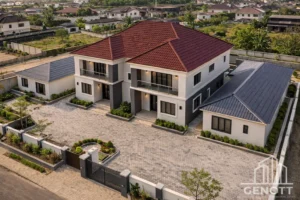
Strategic Architectural Accent Investment
Even budget roofs benefit from premium touches in high-visibility areas:
Dormers and Gables: Use stone-coated sheets or standing seam profiles on these vertical elements where they’re viewed at eye level. Budget materials work well on main roof slopes viewed from angles.
Entry Canopies: The area above main entrance deserves premium treatment—first impression point for visitors and potential buyers.
Tower or Turret Features: Architectural elements that define building character justify disproportionate material investment.
Phased Roofing Approach
For extremely tight budgets, consider:
Phase 1 (Initial Construction):
- Quality budget materials on entire roof (₦2,800-₦4,000 per sqm)
- Proper installation and waterproofing
- Functional, acceptable appearance
Phase 2 (2-5 years later):
- Upgrade visible sections to premium materials
- Retain budget materials on hidden sections
- Spread cost over time as finances improve
This strategy maintains weather protection while allowing aesthetic upgrades when financially feasible.
Expert Recommendations for Luxury Appearance on Budget
Based on Nigerian market realities and construction economics:
Best Overall Value: Premium Aluminum (0.5mm gauge)
For most Nigerian homeowners:
- Initial cost: ₦650,000 – ₦950,000 (120 sqm)
- Expected lifespan: 25-40 years
- Maintenance: Minimal
- Versatility: Suitable for all architectural styles
- Climate performance: Excellent, especially coastal areas
Recommended brands: Aluprime, Alukap, premium Chinese brands with local warranties
Best Luxury Appearance: Stone-Coated Sheets (Docherich, Metro)
For maximum curb appeal on moderate budget:
- Unmatched visual sophistication
- Noise reduction critical for comfort
- Resale value premium justifies higher cost
- Choose local brands over imports for better value
Strategy: Use on front-facing sections, combine with aluminum on hidden areas for cost control.
Best for Tight Budgets: Long-Span Architectural Profile
For budget-conscious quality:
- Clean modern appearance
- Lower installation costs
- Good durability at moderate price point
- Choose matte finishes in charcoal or burgundy
Regional-Specific Recommendations
Lagos/Coastal Cities:
- First choice: Aluminum (rust immunity)
- Second choice: Stone-coated with excellent warranty
- Avoid: Standard galvanized steel
Northern Nigeria (Kano, Kaduna):
- First choice: Light-colored aluminum or stone-coated (heat reflection)
- Second choice: Long-span with reflective coatings
- Avoid: Dark colors that increase cooling loads
Port Harcourt/Rainforest Belt:
- First choice: Stone-coated (noise reduction during heavy rain)
- Second choice: Premium aluminum with acoustic underlayment
- Avoid: Thin-gauge materials that amplify rain noise
Investment Priority Hierarchy
When budget is constrained, invest in this order:
- Gauge thickness (0.5mm minimum) – Never compromise
- Professional installation – Protects entire investment
- Proper accessories – Prevents leaks and failures
- Premium color/finish – Enhances appearance
- Brand premium – Nice but not essential
Future Trends and Strategic Insights
The Nigerian roofing market continues evolving, presenting opportunities for informed buyers.
Emerging Technologies
Cool Roof Coatings: Specialized reflective coatings applied to standard roofing materials reduce surface temperatures by 20-30°C. Initial market entry shows:
- Cost: ₦800 – ₦1,200 per sqm additional
- Energy savings: 15-25% reduction in cooling costs
- ROI: 3-5 years in Nigerian climate
Solar-Ready Roofing: Materials designed to integrate photovoltaic systems without compromising waterproofing. As solar adoption increases in Nigeria due to grid instability, investing in solar-ready roofing prevents costly future modifications.
Market Consolidation Impacts
Local manufacturing capacity is expanding with new facilities from:
- Docherich (expanding Lagos and Abuja production)
- Metro (new northern production facility)
- Chinese manufacturers establishing Nigerian operations
Implications for buyers:
- Improved availability and delivery times
- Price competition driving cost reductions
- Quality improvements from scale economies
- Better warranty support through local presence
Building Code Evolution
Proposed updates to Nigerian building codes may require:
- Minimum gauge thicknesses for residential roofing
- Energy efficiency standards affecting material choices
- Improved wind resistance specifications
Forward-thinking strategy: Choose materials meeting anticipated future standards to avoid forced premature replacement.
Economic Factors Affecting Pricing
Naira volatility: Imported materials and local products using imported inputs face price uncertainty. Strategy: Consider fixed-price contracts with suppliers when possible, or bulk purchase during stable forex periods.
Raw material trends: Global steel and aluminum prices affect Nigerian roofing costs with 2-4 month lag. Monitoring international commodity markets provides advance warning of price movements.
Sustainability Considerations
While not yet driving Nigerian purchasing decisions significantly, sustainability factors gaining relevance:
- Recyclability: Aluminum and steel are fully recyclable (resale value at end-of-life)
- Energy footprint: Light-colored roofing reduces AC load (environmental and cost benefit)
- Local manufacturing: Reduces carbon footprint, supports economy
FAQ Section
Q: What is the cheapest roofing material in Nigeria that looks expensive? A: Stone-coated steel sheets from local brands like Docherich (₦4,500-₦6,200 per sqm) offer the best balance of low cost and luxury appearance. They replicate the look of premium tiles at 40-50% lower cost while lasting 30-40 years with minimal maintenance.
Q: How much does it cost to roof a 3-bedroom bungalow in Nigeria in 2026? A: For a typical 3-bedroom bungalow (120 sqm roof area), total costs range from ₦580,000-₦820,000 for long-span sheets, ₦650,000-₦950,000 for premium aluminum, and ₦920,000-₦1,440,000 for stone-coated sheets. These figures include materials, accessories, and professional installation.
Q: Which lasts longer: aluminum or stone-coated roofing sheets? A: Quality stone-coated sheets (30-50 years) typically outlast aluminum sheets (25-40 years) by 5-10 years. However, aluminum offers superior coastal durability and requires less maintenance. Both provide excellent long-term value when properly installed.
Q: Where can I buy authentic roofing materials in Lagos to avoid fake products? A: Reputable suppliers include established dealers in Ikeja (around Computer Village), Alaba International Market (select verified vendors), and Ojota. Always verify gauge thickness with a micrometer, inspect coating quality, request manufacturer documentation, and insist on written warranties to avoid counterfeits.
Q: Is 0.45mm gauge roofing sheet good enough for a duplex in Nigeria? A: While 0.45mm gauge is acceptable for single-story buildings, duplexes benefit from 0.5mm gauge roofing due to larger roof spans, higher wind loads, and the need for extended lifespan. The additional ₦60,000-₦100,000 investment in thicker gauge prevents premature failure and reduces long-term costs.
Q: How do I make aluminum roofing sheets look expensive? A: Choose premium colors (burgundy, charcoal grey, terracotta) in matte finishes, ensure perfect alignment during installation, use color-matched screws and accessories, install proper ridge capping, and consider architectural profiles instead of standard corrugated. Professional installation is essential for luxury appearance.
Q: What’s the difference between Chinese and original roofing sheets in Nigeria? A: “Original” typically refers to established brands (Docherich, Gerard, Metro) with quality control and warranties. Chinese sheets vary widely—premium Chinese brands match established manufacturers in quality at lower prices, while ultra-cheap Chinese sheets (₦2,000-₦2,500 per sqm) often fail within 3-5 years. Verify warranties and gauge thickness regardless of origin.
Q: How much does professional roofing installation cost in Abuja? A: Professional installation in Abuja ranges from ₦2,000-₦2,800 per square meter (slightly higher than Lagos due to lower contractor density). For a 120 sqm bungalow, expect labor costs of ₦240,000-₦336,000. Artisan installers charge ₦1,400-₦1,800 per sqm but may compromise quality.
Q: Do stone-coated roofing sheets reduce rain noise? A: Yes, significantly. Stone-coated sheets reduce rain noise by 60-70% compared to bare aluminum or corrugated metal sheets. The stone granule coating absorbs sound vibrations, making them ideal for Nigerian homes where heavy tropical rainfall creates noise concerns with metal roofing.
Q: Can I install roofing materials myself to save money? A: DIY roofing installation is not recommended for multi-story buildings or complex roof designs. For simple single-story structures with basic gable roofs, experienced DIYers can potentially install roofing, but mistakes void warranties, create leak risks, and often require expensive professional correction. Professional installation protects your material investment and ensures proper appearance and functionality.
Conclusion
Selecting the cheapest roofing materials in Nigeria that still deliver luxury aesthetics requires balancing initial costs, long-term durability, and visual sophistication. Stone-coated steel sheets from reputable local manufacturers like Docherich and Metro offer the optimal combination of affordability and premium appearance, while quality aluminum sheets provide excellent value for coastal areas and modern designs.
The key to successful budget roofing extends beyond material selection—proper installation, appropriate gauge thickness, strategic color choices, and complete project cost planning determine whether budget materials achieve luxury results or appear cheap. Nigerian property owners who invest in professional installation, resist ultra-cheap materials that fail quickly, and prioritize visible roof sections for premium materials achieve high-end aesthetics while controlling costs.
In Nigeria’s evolving construction market, informed buyers who understand material performance characteristics, regional price variations, and supplier landscapes secure the best value. Whether roofing a 3-bedroom bungalow in Lagos or a duplex in Abuja, focusing on total lifecycle costs rather than initial purchase price alone ensures satisfaction and long-term financial wisdom.
The cheapest path rarely proves the most economical—but the strategic combination of mid-tier materials, premium finishes in key areas, and expert installation delivers luxury appearance and lasting value that budget-conscious Nigerian homeowners seek.
About GENOTT LTD
For expert guidance on roofing material selection, professional installation services, and comprehensive construction solutions across Architecture, Building Construction and Real Estate, GENOTT LTD provides integrated development expertise tailored to Nigerian market realities. Our team helps property owners make informed decisions that balance budget constraints with quality expectations, ensuring successful project outcomes.

 GENOTT LTD Editorial Team