 GENOTT LTD Editorial Team
In Nigeria’s environment, you’re building in the middle of:
-
Material price volatility and supply shocks
-
Rainy season disruptions (access roads, flooding, curing issues)
-
Power/water realities that affect MEP design
-
Regulatory requirements (planning permits and inspection expectations)
-
Labour variability and workmanship gaps
This pillar guide breaks down the house construction steps in Nigeria from pre-construction to handover—explaining what happens at each stage, what to inspect, how to prevent rework, and how to plan your budget using a construction BOQ in Nigeria. You’ll also get timelines, payment structure logic, and the mistakes Nigerians make that quietly double cost and time.
SUMMARY TABLE
| Topic | Key Insight | Notes |
|---|---|---|
| Pre-construction | Most cost overruns start before excavation | BOQ + procurement plan reduce surprises |
| Approvals | Don’t build “hopefully”—get permits early | Lagos uses EPPPS planning permit platform |
| Setting-out | Wrong set-out = permanent structural mistake | Confirm benchmarks + diagonals |
| Substructure | Drainage + DPC quality decides long-term durability | Wet base = damp walls + repairs |
| Superstructure | Quality control on concrete and alignment matters | Avoid “speed over strength” |
| Roofing | Poor roof detailing causes recurring leaks | Insulation + ventilation improve comfort |
| MEP | Coordinate early to avoid chasing pipes in finished walls | MEP clashes are expensive |
| Handover | As-builts + defect liability protect your money | Record what was actually built |
What “Construction Process” Means in Nigeria (Beyond Blocks & Cement)
The building construction process in Nigeria is a chain of decisions that must stay aligned:
-
Architecture & engineering: designs that are buildable and compliant
-
Real estate and approvals: land documents, planning permits, setbacks
-
Construction management: schedule, procurement, labour control
-
Quality assurance: inspections at every stage
-
Cost control: BOQ-driven purchasing, variation control, milestone payments
-
Infrastructure reality: water storage, septic/soakaway, power systems, access roads
If you miss alignment at any point, the project pays later—usually through rework, delays, and disputes.
Detailed Step-by-Step Breakdown: Stages of Building Construction in Nigeria
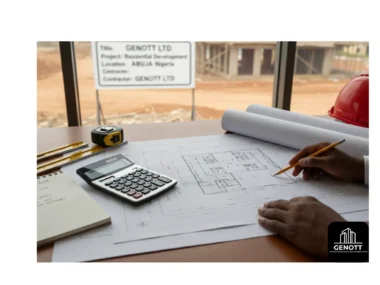
Step 1: Pre-Construction Planning (Brief → Design → Approvals → BOQ)
This stage determines 70% of your final cost and timeline.
Key deliverables
-
Project brief: size, lifestyle needs, rental goal, finish level
-
Architectural drawings + structural + MEP coordination
-
Compliance check: setbacks, access, parking (where applicable)
-
Construction BOQ in Nigeria (Bill of Quantities): itemized materials + labour + preliminaries
-
Procurement plan: what to buy early (high volatility items) vs later
Approval reality (Nigeria)
-
Lagos State runs an electronic platform for planning permits (EPPPS)
-
Professional registration matters: ARCON is the regulator of architectural practice and licensure in Nigeria
Developer tip: Don’t start excavation until your approvals and BOQ are clear—“start now, correct later” is one of the costliest Nigerian habits.
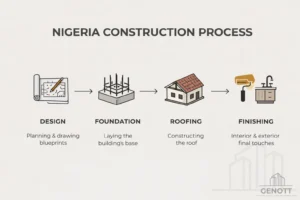
Step 2: Site Setup & Setting Out (Accuracy Before Speed)
This is where many Nigerian buildings get future cracks and boundary issues.
Site setup checklist
-
Clearing, leveling, and access paths
-
Temporary services: water, site store, secure tool area
-
Benchmarks and reference points (re-check after heavy rains)
Setting-out quality controls
-
Confirm building lines and setbacks
-
Confirm diagonals (square corners)
-
Confirm levels (to avoid drainage problems later)
Nigeria-specific warning: In flood-prone areas (common in parts of Lagos and riverine zones), wrong finished floor levels lead to permanent damp and seasonal flooding complaints.
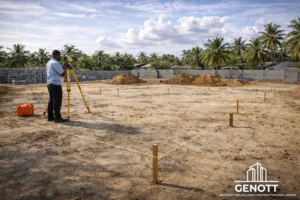
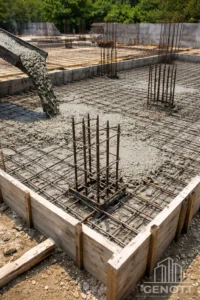
Step 3: Foundation Stage (Substructure)
This is the “hidden stage” that determines stability.
Typical foundation workflow
-
Excavation (trenches/pads)
-
Blinding concrete (where specified)
-
Rebar placement + formwork
-
Casting footings / ground beams
-
Blockwork to DPC level
-
Damp-proof course (DPC) / damp-proof membrane (DPM) as required
-
Backfilling and compaction
-
Drainage provisions (especially where water tables are high)
Quality control
-
Concrete mix discipline and curing
-
Rebar spacing/cover
-
DPC continuity (no gaps)
Cost note: Poor compaction and drainage errors are some of the most expensive “invisible mistakes” because repairs happen after finishes are already paid for.
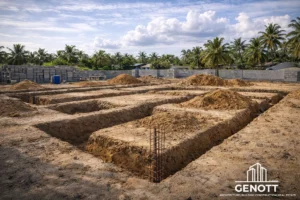
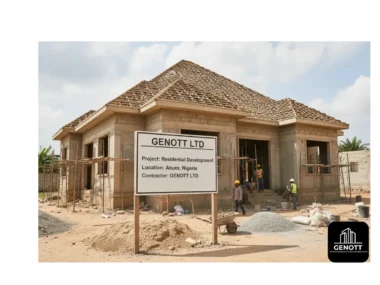
Step 4: Superstructure Stage (From Ground Floor to Lintels/Slab)
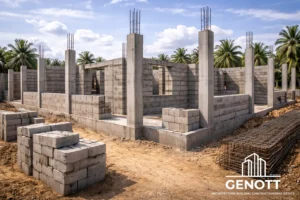
Now the structure rises—this is where speed temptation destroys quality.
Superstructure activities
-
Columns and beams (RC frame) or load-bearing walls (where used)
-
Blockwork alignment and verticality checks
-
Lintels and ring beams
-
Slab casting (for duplexes and multi-level structures)
-
Staircase construction (if duplex)
Inspection mindset
-
Keep records of reinforcement and concrete pours
-
Confirm openings sizes (doors/windows) before casting lintels
-
Don’t allow “adjust on site” without designer sign-off
Super Structure
Step 5: Roofing Stage (Trusses, Sheets, Gutters, Insulation, Ceilings)
Roofing is a major cost driver and a major leak risk.
Options
-
Timber truss (common)
-
Steel truss (often better for durability, cost depends on market)
Roof details that reduce future costs
-
Proper valley gutters and flashing
-
Correct slope and sheet overlap
-
Fascia and gutter detailing (rain management)
-
Attic/roof ventilation + insulation strategy (comfort + energy savings)
Nigeria reality: A roof that leaks once usually leaks again unless the detailing is corrected, not “patched.”
Step 6: MEP Installation (Plumbing, Electrical, AC, Water, Septic)
MEP is where houses become functional—and where rework becomes expensive.
MEP includes
-
Plumbing: supply lines, drainage, venting
-
Electrical: conduits, DB placement, earthing
-
AC provisions: sleeves, drainage routes
-
Water storage + pumping strategy
-
Septic/soakaway or treatment system (depending on context)
Coordination rule: MEP must be planned early. Chasing pipes through cured concrete or finished walls is one of the fastest ways to blow budgets.
Step 7: Finishes Stage (Where Budgets Often Die)
Finishes are where Nigerian projects swing from “manageable” to “uncontrolled.”
Finishes include
-
Plastering and screeding
-
Tiling and wall finishes
-
Doors/windows
-
Painting
-
Sanitary fittings, kitchen works
-
External works: paving, fences, gates
Cost control tactic: Lock a finishes schedule early (tile sizes, door counts, sanitary brands). If not, “small upgrades” multiply into millions.
Step 8: Quality Control & Supervision (Continuous, Not Final-Day)
Quality checks should be stage-based, not emotional.
Quality framework
-
Stage inspections (foundation, slab, roof, MEP rough-in, finishes)
-
Material checks (cement storage, steel quality, sand quality)
-
Snagging lists before handover
-
Compliance checks aligned with regulatory expectations (planning/building controls and inspections)
Nigeria’s National Building Code exists as a reference framework for building standards and safety expectations.
Step 9: Contracting & Payment Structure (Milestones, Retention, Variations)
Most disputes come from unclear scope and payment logic.
Best practice payment structure
-
Mobilization (small, controlled)
-
Substructure milestone
-
Superstructure milestone
-
Roofing milestone
-
MEP rough-in milestone
-
Finishes milestone
-
Practical completion + retention
Variation control
-
Written variation orders only
-
Costed before execution
-
Approved by client (and ideally designer/PM)
Step 10: Handover & Post-Construction
A professional handover protects value.
Handover package
-
As-built drawings (what was actually built)
-
Test certificates (where applicable)
-
Maintenance plan (roof, plumbing, pumps, paint cycles)
-
Defects liability period agreement
Cost Analysis & Investment Insights: Construction Cost Breakdown in Nigeria
Instead of guessing, split costs like a developer:
| Cost Bucket | What It Covers | Why It Matters |
|---|---|---|
| Preliminaries | site setup, security, temporary works | Often ignored but unavoidable |
| Substructure | excavation, concrete, rebar, DPC | Hidden but foundational |
| Superstructure | blockwork, beams/columns, slab | Controls structural quality |
| Roofing | truss, sheets, gutters, ceilings | A major leak-risk area |
| MEP | plumbing, electrical, water systems | High rework risk if delayed |
| Finishes | tiles, doors, paint, fittings | Biggest budget swing |
| External works | fence, paving, drainage, gate | Often forgotten until late |
Investment insight: If you’re building for rental income (Lagos/Abuja student hubs, Enugu family rentals), cost control and timeline control matter as much as design beauty—because delays destroy your payback period.
Comparisons or Alternatives: Bungalow vs Duplex Construction Process Differences
| Element | Bungalow | Duplex |
|---|---|---|
| Structural complexity | Often simpler | Slab + stairs add complexity |
| Timeline | Often shorter | Often longer |
| MEP routing | Mostly single level | Vertical stacks require more planning |
| Roofing | Larger roof footprint | Smaller roof footprint (often) |
| Best for | Elder-friendly living | Privacy zoning + tight plots |
Use this comparison to adjust your construction timeline for a house in Nigeria and your BOQ.
Common Mistakes Nigerians Make During the Construction Process
-
Starting without approvals and clear drawings (then redesigning on site)
-
No BOQ—buying materials emotionally and inconsistently
-
Poor setting-out (boundary problems, wrong room sizes)
-
Weak drainage planning (especially during rainy season)
-
Paying contractors without milestone verification
-
Allowing uncontrolled “variations” without written costs
-
Installing MEP late (leading to cutting finished work)
-
No supervision (quality becomes luck)
Expert Recommendations
-
Treat construction as a project system
Design + approvals + BOQ + schedule + procurement + QA must align. -
Use BOQ-led procurement
A BOQ is how professionals prevent market volatility from turning into chaos. -
Build climate-smart, Nigeria-smart
Plan drainage aggressively, elevate where needed, and detail roofs properly. -
Use milestone payments and retention
Pay for verified progress, not promises. -
Professional accountability
Work with registered professionals—ARCON provides the formal licensure framework for architects in Nigeria.
Future Trends & Strategic Insights
-
More adoption of portal-based approvals and documentation workflows in major states (e.g., Lagos EPPPS).
-
Stronger emphasis on quality control as building failures remain a public concern (driving demand for compliance and supervision)
-
Increased use of energy-smart detailing (roof insulation, shading, ventilation planning) to reduce running costs
-
More structured project management culture among private developers (especially for estates and mixed-use projects)
FAQs
1) What are the main stages of building construction in Nigeria?
Pre-construction planning, site setup/setting-out, foundation, superstructure, roofing, MEP, finishes, inspections, and handover.
2) How long is the construction timeline for a house in Nigeria?
It depends on size, design complexity, approvals, and funding flow. Bungalows often finish faster than duplexes, but procurement delays can extend both.
3) Why is a BOQ important in Nigeria?
A BOQ helps you control cost, plan procurement, and reduce waste—especially when material prices fluctuate.
4) What is “setting out” and why is it critical?
Setting-out transfers the drawing to the ground. Wrong set-out causes permanent room size errors, misalignment, and approval complications.
5) Do I need building approvals before construction?
Yes. Requirements vary by state, but Lagos uses an electronic planning permit platform (EPPPS) for processing applications.
6) When should plumbing and electrical work start?
Early—MEP should be coordinated during design and installed during the right construction stages to avoid cutting finished walls and slabs.
7) How do I choose a contractor in Nigeria?
Use written scope, BOQ, milestone payments, references, and supervision structure. Avoid “open-ended” pricing.
8) How do I verify an architect is properly recognized in Nigeria?
ARCON is the statutory body that regulates architectural practice and licensure.
CONCLUSION
The building construction process in Nigeria becomes affordable and predictable when you treat it like a professional workflow—not a trial-and-error journey. The most successful projects lock the brief, drawings, approvals, and BOQ early; execute setting-out accurately; build strong substructure with proper drainage and DPC; manage superstructure and roofing with disciplined quality control; coordinate MEP before finishes; and protect budgets using milestone payments and variation control.
Whether you’re building in Lagos, Abuja, Enugu, Ibadan, or Port Harcourt, the same truth applies: construction is either managed—or it becomes a cost leak.
For professional support, GENOTT LTD provides expert guidance in architectural design, BOQ preparation, project planning, site supervision, approvals documentation, construction delivery, and cost-control frameworks—helping you complete projects with quality, compliance, and budget discipline.

 GENOTT LTD Editorial Team