 GENOTT LTD Editorial Team
Introduction
Building on Nigerian soil presents unique challenges that many property developers learn about too late—often after foundation cracks appear or settlement issues emerge. Whether you’re constructing on the laterite soils of Abuja, the expansive clay of Port Harcourt, or the challenging swampy terrain of Lagos riverine areas, selecting the right foundation type is the single most critical decision that determines your building’s long-term stability.
The best foundation types for Nigerian soil conditions vary dramatically based on soil composition, groundwater levels, and structural load requirements. While a simple strip foundation might suffice for a bungalow on firm laterite soil in Kaduna, that same approach would spell disaster on the waterlogged soils of Lekki Phase 1. This comprehensive guide examines Nigeria’s diverse soil types, walks you through foundation selection criteria, breaks down realistic costs in Naira, and provides the technical insights you need to make informed decisions that protect your investment for decades to come.
Quick Reference: Foundation Types and Nigerian Soil Compatibility
| Foundation Type | Best For | Soil Conditions | Typical Cost Range (₦) | Load Capacity |
|---|---|---|---|---|
| Strip Foundation | Bungalows, light structures | Firm laterite, stable clay | ₦3,500 – ₦6,000/m | Low to medium |
| Pad Foundation | Column-supported structures | Firm ground, low water table | ₦15,000 – ₦35,000/pad | Medium |
| Raft Foundation | 2+ storey buildings, poor soil | Soft clay, uneven bearing capacity | ₦8,000 – ₦15,000/m² | High |
| Pile Foundation | Heavy structures, swampy areas | Waterlogged, reclaimed land, deep soft soil | ₦25,000 – ₦80,000/pile | Very high |
| Ground Beam System | Residential buildings | Variable soil conditions | ₦12,000 – ₦20,000/m | Medium to high |
Note: Costs are approximate 2026 figures and vary by location, material prices, and project specifications.
Understanding Nigerian Soil Types and Their Impact on Foundations
The Five Major Soil Categories Across Nigeria
Nigeria’s geological diversity means foundation requirements change dramatically from one region to another. Understanding your specific soil type is not optional—it’s foundational to structural success.
1. Laterite Soils (Most Common) Predominantly found in Abuja, Enugu, Jos, and the Middle Belt region, laterite soils are iron-rich, reddish-brown soils that harden when exposed to air. When well-drained and firm, laterite provides excellent bearing capacity of 150-250 kN/m², making it ideal for most residential construction. However, poorly compacted laterite or areas with high clay content can experience settlement issues.
2. Clay Soils (High Plasticity) Widespread in Port Harcourt, Warri, parts of Lagos, and the Niger Delta, clay soils present the most challenging foundation conditions. These soils exhibit shrink-swell behavior—expanding significantly during rainy seasons and contracting during dry periods. This movement can cause differential settlement, wall cracks, and structural distress if not properly addressed through foundation design.
3. Sandy Soils Common in coastal areas and parts of Northern Nigeria, sandy soils drain well but may have lower bearing capacity (100-150 kN/m²) unless well compacted. Pure sand typically requires deeper foundations or ground improvement to achieve adequate load distribution.
4. Silty Soils Found near river valleys and flood plains, silt has poor drainage and low bearing capacity. It’s particularly problematic when waterlogged, as it loses strength and can lead to excessive settlement.
5. Swampy/Peat Soils Characteristic of Lagos riverine areas (Ikorodu, parts of Lekki, Ajah), Warri, and Niger Delta communities, these organic-rich soils have extremely low bearing capacity (often below 50 kN/m²), high water tables, and significant compressibility. They require specialized foundation solutions.
How Soil Type Dictates Foundation Choice
The bearing capacity of your soil—essentially how much load it can safely support per square meter—directly determines which foundation type will work. A geotechnical investigation provides this critical data, but understanding general soil behavior helps you anticipate foundation requirements:
- High bearing capacity (>200 kN/m²): Strip or pad foundations suitable
- Medium bearing capacity (100-200 kN/m²): Raft foundation or improved strip/pad design
- Low bearing capacity (<100 kN/m²): Pile foundation or extensive ground improvement required
When You Absolutely Need a Soil Test Before Building
Red Flags That Demand Professional Investigation
Many Nigerian developers skip soil testing to save costs—a decision that often costs ten times more when foundation problems emerge. You must conduct a geotechnical investigation if your site exhibits any of these warning signs:
Critical Indicators:
- Existing Building Damage Nearby: Cracks in neighboring structures, tilted buildings, or visible settlement indicate problematic soil conditions that will affect your construction.
- Waterlogged Sites: If the site holds water after rain or shows signs of seasonal flooding, underground water tables will impact foundation design and require special drainage considerations.
- Reclaimed or Filled Land: Common in Lagos (especially Lekki, Ajah, Banana Island), Port Harcourt, and Warri, reclaimed land often has uncontrolled fill material with unpredictable settlement characteristics.
- Sloped Sites: Properties on hillsides or with significant grade changes require slope stability analysis and specialized foundation design to prevent sliding or rotational failure.
- Previous Agricultural Use: Farm lands, especially rice paddies or irrigated areas, often have altered soil structure and high organic content that reduces bearing capacity.
- Coastal or Riverine Locations: Within 1km of coastlines or rivers, assume high water tables, potential salinity issues, and organic soil content that demands investigation.
What Your Geotechnical Report Should Include
A proper soil investigation in Nigeria should cost between ₦250,000 – ₦800,000 depending on site size and required depth of investigation. The report must provide:
- Soil profile and classification to at least 6 meters depth (or refusal depth for pile foundations)
- Bearing capacity recommendations for different foundation types
- Groundwater table depth and seasonal variation expectations
- Soil compressibility and settlement predictions under proposed loading
- Recommendations for foundation type, depth, and design parameters
- Special considerations: drainage requirements, ground improvement needs, construction methodology
- Laboratory test results: moisture content, plasticity index, grain size distribution, California Bearing Ratio (CBR)
The report should be prepared by a registered geotechnical engineer and may be required for building approval in cities like Abuja and Lagos, particularly for developments above two storeys.
Common Foundation Types in Nigeria: Where Each Works Best
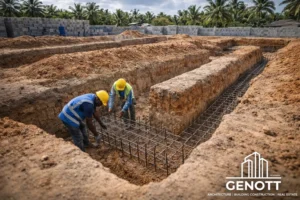
1. Strip Foundation (Continuous Footing)
How It Works: A continuous strip of concrete, typically 600-900mm wide and 900-1200mm deep, runs under load-bearing walls, distributing the building load linearly into the ground.
Best Applications in Nigeria:
- Single-storey bungalows on firm laterite or stable clay soil
- Residential buildings in Abuja, Kaduna, Jos, and areas with good soil bearing capacity
- Sites with bearing capacity above 150 kN/m²
Advantages:
- Most economical for light structures
- Simple construction requiring minimal specialized equipment
- Local artisans familiar with execution
- Material costs typically ₦3,500-₦6,000 per linear meter
Limitations:
- Unsuitable for poor soil conditions or high water tables
- Cannot accommodate differential settlement well
- Not recommended for buildings above one storey on medium-strength soils
Nigerian Design Considerations: For bungalows on laterite soil, a standard 225mm thick strip foundation at 900mm depth (600mm below ground level after 300mm ground floor slab) typically suffices. Include proper damp-proof course (DPC) at 150mm above ground level to prevent rising damp—a common issue in Nigerian construction.
2. Pad Foundation (Isolated Footings)
How It Works: Individual concrete pads placed under each column, sized according to column loads and soil bearing capacity. Common sizes range from 1.5m x 1.5m to 3m x 3m with depths of 1-2 meters.
Best Applications in Nigeria:
- Column-supported residential and commercial buildings
- Structures on firm ground with uniform soil conditions
- Locations where water table is below foundation depth
Advantages:
- Economical for framed structures
- Easy to construct and inspect
- Cost per pad: ₦15,000-₦35,000 depending on size and reinforcement
- Can be tied together with ground beams for added stability
Limitations:
- Requires relatively uniform soil bearing capacity across site
- Individual pads can settle differentially if soil conditions vary
- Not suitable for waterlogged conditions without ground improvement
Nigerian Application Tips: In areas with variable soil quality (common in developing estates), always connect pad foundations with ground beams. This creates a tied system that redistributes loads if localized settlement occurs. The ground beam also elevates the ground floor above potential flood levels—critical in Lagos, Port Harcourt, and areas with poor drainage.
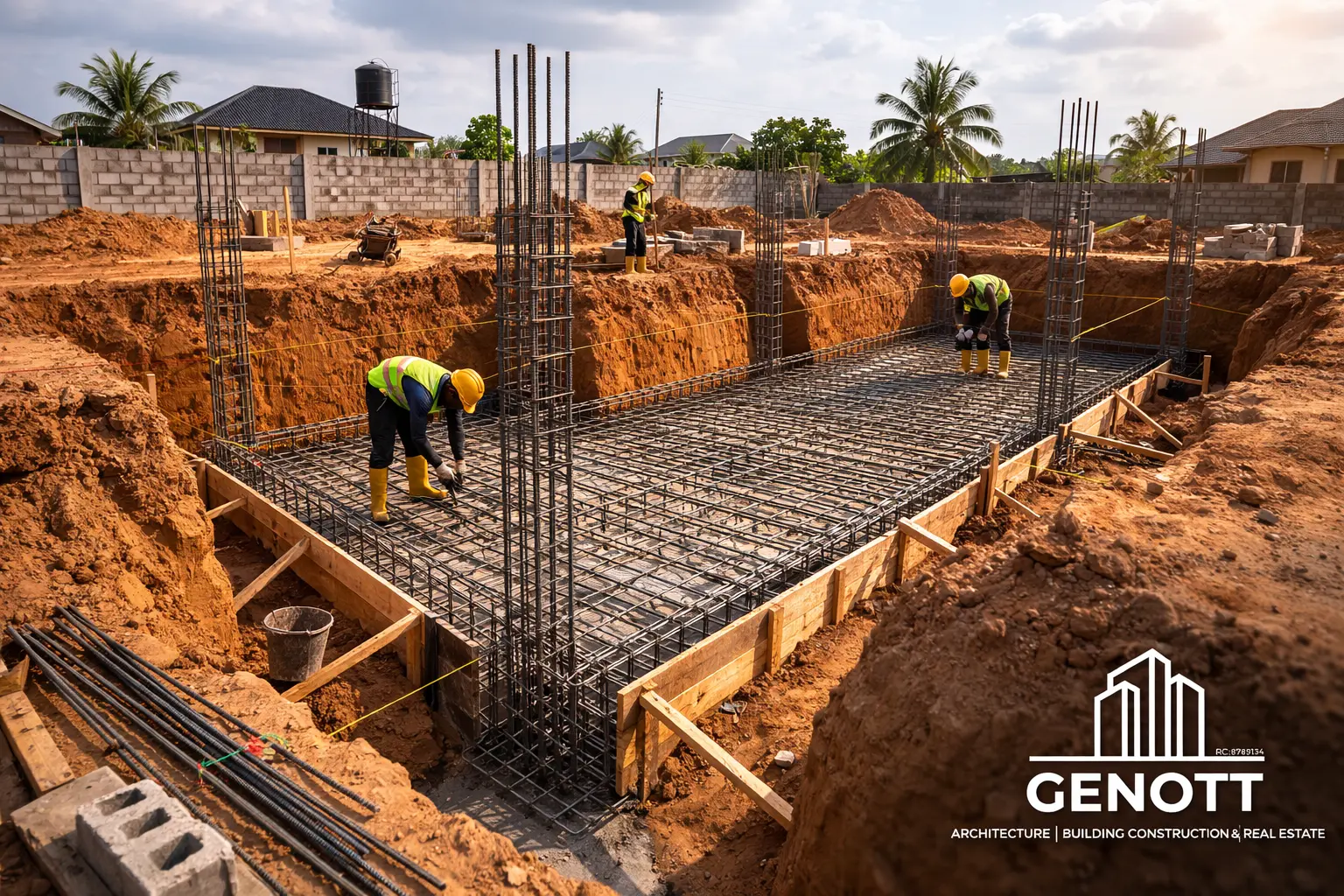
3. Raft Foundation (Mat Foundation)
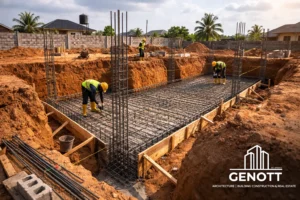
How It Works: A continuous reinforced concrete slab, typically 300-600mm thick, extending under the entire building area, spreading the total load over maximum soil contact area.
Best Applications in Nigeria:
- Multi-storey buildings on soft clay or soils with low to medium bearing capacity
- Sites with variable soil conditions where differential settlement is a risk
- Waterlogged areas where individual footings would be impractical
- Common in Lagos (Lekki, Ajah), Port Harcourt, and clay-dominated regions
Advantages:
- Distributes load over large area, reducing bearing pressure
- Handles differential settlement better than individual footings
- Acts as basement floor if below-ground construction is planned
- Provides inherent waterproofing when properly detailed
Cost Reality: Raft foundations cost ₦8,000-₦15,000 per square meter, making a 200m² building foundation approximately ₦1.6M – ₦3M. While more expensive than strip foundations, the cost is justified when soil conditions demand load distribution or when basement space adds value.
Design Variations for Nigeria:
Conventional Flat Raft: Uniform thickness slab, simplest to construct, suitable for most residential applications.
Beam-and-Slab Raft: Thickened beams under columns/walls with thinner slab between, reduces concrete volume while maintaining strength—popular for cost optimization.
Cellular Raft: With edge thickening and internal beams creating a rigid box structure—used for very poor soil or heavy structures.
4. Pile Foundation
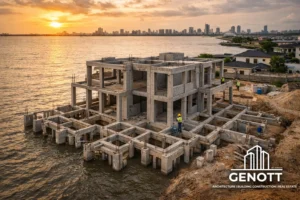
How It Works: Long structural members (concrete, steel, or timber) driven or drilled into the ground to transfer building loads to deeper, stronger soil layers or bedrock. Piles bypass weak surface soils entirely.
Critical Applications in Nigeria:
- Swampy and waterlogged sites in Lagos, Warri, Calabar, and Niger Delta
- Reclaimed land developments (Eko Atlantic, Banana Island, Lekki Phase 1)
- High-rise buildings requiring deep, stable support
- Sites where shallow soil has inadequate bearing capacity
Pile Types Used in Nigeria:
Driven Concrete Piles: Precast reinforced concrete piles driven into ground with pile-driving equipment. Common sizes: 250mm x 250mm to 400mm x 400mm, lengths 6-20 meters. Cost: ₦35,000-₦60,000 per pile installed.
Bored Piles (Drilled Shafts): Holes drilled to required depth, reinforcement cage inserted, and concrete cast in place. Diameters 300-1200mm, depths to 30+ meters. Cost: ₦40,000-₦80,000+ per pile depending on diameter and depth.
Micro-Piles: Small-diameter (100-300mm) drilled piles, useful for restricted access sites or foundation strengthening. Growing popularity in Lagos for renovation projects.
Economic Reality: A typical 4-bedroom duplex on swampy land might require 20-40 piles, translating to ₦800,000-₦3.2M in foundation costs alone—before pile caps and ground beams. This is why proper site selection remains the most cost-effective foundation strategy.
5. Ground Beam and Suspended Floor System
How It Works: Pad or pile foundations support a network of reinforced concrete ground beams (typically 225x300mm to 300x450mm), which in turn support a suspended concrete floor slab above ground level.
Strategic Applications:
- Sites with high water table but adequate bearing capacity for pads/piles
- Flood-prone areas where floor level must be elevated
- Variable soil conditions requiring load redistribution
- Combination with pad foundations for economical residential construction
Nigerian Advantages: This system has become increasingly popular for residential developments because it:
- Elevates living space above flood risk and dampness
- Provides ventilation under floor, reducing humidity
- Allows drainage and service routing beneath structure
- Costs moderately more than ground-bearing slab but adds significant value
Typical Costs: Ground beam and suspended slab system: ₦12,000-₦20,000 per square meter for residential construction, including formwork, reinforcement, and concrete.
Special Focus: Foundation Design for Clay Soils in Nigeria
Understanding Clay Soil Behavior
Expansive clay soils, prevalent in Port Harcourt, parts of Lagos, Delta State, and the Niger Delta region, present unique challenges due to their shrink-swell characteristics. These soils can expand up to 10-15% in volume when wet and shrink similarly when dry, creating cyclical movement that typical foundations cannot accommodate.
Design Strategies for Clay Foundations
1. Depth Strategy: Foundations must reach below the active zone—the soil layer that experiences seasonal moisture fluctuations. In Nigeria, this typically means minimum depths of:
- Port Harcourt/Delta region: 1.8-2.5 meters
- Lagos clay areas: 1.5-2.0 meters
- Northern Nigeria clay pockets: 1.2-1.8 meters
The objective is to bear on soil with relatively constant moisture content year-round.
2. Raft Foundation Preference: For clay soils, raft foundations outperform strip or pad foundations because they:
- Distribute load uniformly, reducing differential movement
- Are less affected by localized soil variations
- Can accommodate minor settlements without cracking
- Provide a rigid platform that moves as a unit
3. Drainage Control (Critical): Uncontrolled water infiltration exacerbates clay soil movement. Essential drainage measures include:
- Perimeter drains: French drains 600-900mm deep around building perimeter, sloped to discharge points
- Surface grading: Site graded to slope away from building (minimum 5% grade for first 3 meters)
- Roof water management: Gutters and downspouts discharging at least 2 meters from foundation
- Subsurface barriers: Vertical moisture barriers (plastic sheeting or bentonite panels) at foundation edge to prevent horizontal moisture migration
4. Reinforcement and Detailing:
- Use fully reinforced rafts, not plain concrete
- Top and bottom reinforcement mesh (minimum Y12@200mm both ways)
- Edge thickening with additional reinforcement (Y16@150mm)
- Incorporate construction joints carefully to allow controlled movement
5. Ground Treatment Options: For severe clay conditions, consider:
- Lime stabilization: Mixing hydrated lime into clay to reduce plasticity and swell potential (₦1,500-₦3,000/m³)
- Soil replacement: Excavating expansive clay and replacing with engineered fill—expensive but effective
- Moisture control: Installing vapor barriers below foundation to maintain constant moisture
Cost Premiums for Clay Soil Construction
Expect foundation costs on expansive clay to run 40-70% higher than comparable construction on stable laterite:
- Bungalow on laterite: ₦600,000-₦900,000 foundation
- Same bungalow on clay: ₦1,000,000-₦1,500,000 foundation
The premium comes from deeper excavation, larger foundation size, enhanced drainage, and soil treatment.
Foundations for Swampy and Coastal Land in Nigeria
The Lagos Riverine Challenge
The expansion of Lagos into reclaimed and swampy areas (Lekki, Ajah, Ikoyi waterfront, Abraham Adesanya) represents Nigeria’s most challenging foundation environment. These sites typically feature:
- Groundwater table at or near surface
- Soft organic soils with bearing capacity below 50 kN/m²
- Fill material of unknown composition and compaction
- Risk of settlement for years after construction
Pile Foundation as Primary Solution
For genuine swampy conditions, pile foundations remain the only reliable option:
Design Approach:
- Piles driven or bored through soft layers to reach competent soil or bedrock (typically 12-25 meters depth)
- Pile caps linking pile heads and distributing column loads
- Suspended ground floor slab on ground beams spanning between pile caps
- Floor level elevated 600-1200mm above surrounding grade
Installation Methods:
Driven Piles: Faster and more economical where equipment access permits. Vibration may concern neighboring structures. Popular in open sites.
Bored Piles: Essential in built-up areas or where vibration is unacceptable. More expensive but offers flexibility in diameter and depth.
Cost Breakdown Example (4-Bedroom Duplex on Swampy Land):
- Geotechnical investigation: ₦400,000
- 30 bored piles (300mm dia., 15m depth): ₦1,800,000
- Pile caps and ground beams: ₦1,200,000
- Suspended ground floor slab: ₦800,000
- Drainage and dewatering: ₦300,000
- Total foundation cost: ₦4,500,000
Compare this to ₦1,200,000 for the same building on good soil—a 275% premium for challenging site conditions.
Raft Foundation Alternative (Limited Applications)
In some reclaimed areas where thick sand fill has been properly placed and compacted, reinforced raft foundations may work:
Requirements:
- Minimum 2-3 meters of well-compacted sand fill above soft soil
- Groundwater lowered through fill (natural drainage or permanent dewatering)
- Heavy reinforcement (Y16@150mm both ways, top and bottom)
- Raft thickness minimum 500mm
- Acceptance of some long-term settlement (typically 25-75mm)
Cost Comparison: Heavily reinforced raft: ₦12,000-₦18,000/m² vs. pile foundation at ₦25,000-₦35,000/m² equivalent bearing area.
Sand Filling and Ground Improvement
Many Lagos waterfront developments use extensive sand filling:
Process:
- Remove vegetation and soft organic top soil
- Place marine sand in layers (300-500mm lifts)
- Compact each layer mechanically
- Build up to desired level (typically 1-2 meters above water table)
- Allow consolidation period (3-12 months ideal, though often rushed)
Cost Reality: Sand filling costs ₦8,000-₦15,000 per cubic meter delivered and compacted in Lagos (2026 prices). For a 500m² plot raised by 1.5 meters:
- Volume: 750 m³
- Cost: ₦6M-₦11.25M
This explains why waterfront plots command premium prices—site preparation alone represents substantial investment before construction begins.
Settlement Control Strategies
Long-term settlement remains the primary concern on reclaimed land:
Preloading: Applying temporary surcharge weight (sand or water-filled containers) to accelerate settlement before construction—rarely used in Nigerian residential projects due to time constraints.
Vertical Drains: Installing sand columns or wick drains to accelerate water expulsion and consolidation—practical for large developments but uncommon in small-scale construction.
Accepting Settlement: Design foundations and superstructure to tolerate predicted settlement through:
- Flexible service connections (water, sewer, electrical)
- Articulated floor slabs with movement joints
- Regular monitoring and remedial grouting if needed
Foundation Cost Drivers in Nigeria: What Really Affects Your Budget
1. Excavation Depth
Labor and equipment costs escalate with depth:
- 0-1 meter: Manual excavation feasible (₦2,500-₦4,000/m³)
- 1-2 meters: Requires shoring/support, manual or light equipment (₦4,000-₦7,000/m³)
- 2+ meters: Mechanical excavation essential, extensive shoring needed (₦7,000-₦12,000/m³)
Water Table Impact: Excavation below water table requires dewatering:
- Sump pumping: ₦50,000-₦150,000 per project
- Wellpoint systems: ₦200,000-₦500,000+ for larger sites
- Continuous operation cost: ₦15,000-₦30,000 per week for fuel/maintenance
2. Reinforcement Steel
Rebar costs represent 30-40% of foundation budget:
- Y10 rebar: ₦530,000-₦580,000 per ton (2026 prices)
- Y12 rebar: ₦540,000-₦590,000 per ton
- Y16 rebar: ₦550,000-₦600,000 per ton
A typical raft foundation for a 4-bedroom duplex requires 3-5 tons of reinforcement (₦1.65M-₦3M in steel alone).
Cost Optimization Without Compromising Safety:
- Use specified rebar sizes—oversizing wastes money without structural benefit
- Maintain proper spacing per engineering drawings
- Source from reputable suppliers—substandard steel is expensive when foundations fail
3. Concrete Volume
Ready-mix concrete pricing (per m³, Lagos 2026):
- Grade 20 (C20): ₦65,000-₦75,000/m³
- Grade 25 (C25): ₦70,000-₦80,000/m³
- Grade 30 (C30): ₦75,000-₦85,000/m³
Site-mixed concrete: ₦45,000-₦60,000/m³ (quality control concerns, suitable only for less critical applications)
Foundation concrete volumes:
- Strip foundation (bungalow): 15-25 m³
- Raft foundation (duplex): 30-50 m³
- Pile foundation: Variable, 0.3-1.5 m³ per pile plus pile caps
4. Access and Site Conditions
Remote or difficult-access sites incur premiums:
- Material delivery surcharges: 15-40% above urban prices
- Equipment mobilization: ₦150,000-₦500,000 for piling rigs
- Temporary access roads: ₦2,000-₦5,000 per linear meter
Lagos island vs. mainland cost differential: Expect 20-30% higher costs on Victoria Island, Ikoyi, or Lekki Phase 1 compared to mainland locations.
5. Professional Fees and Testing
Essential professional services:
- Geotechnical investigation: ₦250,000-₦800,000
- Structural engineering design: 3-5% of foundation cost
- Supervision and testing: ₦100,000-₦300,000
- COREN registration/approval: ₦50,000-₦150,000
While tempting to skip professional oversight, the cost of foundation failure far exceeds these fees.
6. Contractor Capability
Pricing reflects expertise:
- Artisan-level contractor: Lowest initial price, highest risk of defects
- Mid-tier contractor: Moderate pricing, variable quality control
- Established contractor: Premium pricing (15-30% higher) but proper methodology and reduced risk
Foundation work is not where to seek the cheapest quote—incompetent execution creates irreversible problems.
Foundation Depth Requirements: Bungalow vs. Duplex
Load Characteristics
Single-Storey Bungalow:
- Total dead + live load: 8-12 kN/m² of floor area
- Relatively light foundation requirements
- Greater flexibility in foundation type selection
Two-Storey Duplex:
- Total load: 18-25 kN/m² of floor area
- Significantly higher bearing pressure on soil
- May require foundation upgrade even on the same soil type
Recommended Minimum Depths by Structure Type
Bungalow Foundations:
- Good laterite soil: 900mm depth (600mm below ground slab level)
- Medium clay soil: 1,200-1,500mm depth
- Poor soil: Raft at 1,000-1,200mm or piled foundation
Duplex Foundations:
- Good laterite soil: 1,200-1,500mm depth
- Medium clay soil: 1,500-2,000mm depth
- Poor soil: Raft at 1,200-1,800mm or piled foundation
Ground Floor Level Considerations
Flood Risk and Drainage: Nigerian building regulations and good practice dictate:
- Ground floor level minimum 150mm above surrounding grade
- In flood-prone areas (Lagos, Port Harcourt, riverine locations): 600-1,200mm above grade
- Allow for future drainage deterioration and climate change impacts
DPC (Damp-Proof Course) and DPM (Damp-Proof Membrane):
- DPC: Installed 150mm minimum above external ground level in walls
- DPM: Placed under ground floor slab to prevent rising moisture
- Both essential in Nigerian humid climate to prevent mold, dampness, and material deterioration
Load Path and Foundation Integration
Foundation depth must consider:
- Frost depth: Not applicable in Nigeria (no frost)
- Active soil zone: 1.2-2.5m depending on climate and soil type
- Adequate embedment: Foundation should be deep enough that lateral soil pressure provides stability
- Service clearance: Allow depth for water, sewer, electrical conduits below foundation
Example: 4-Bedroom Duplex on Abuja Laterite:
- Foundation type: Raft foundation preferred for uniform support
- Depth: 1,200mm (900mm below ground floor slab level)
- Ground floor level: +300mm above external grade
- DPC: At +450mm above external grade
- Raft thickness: 400mm with Y12@200mm top and bottom reinforcement
Foundation Failures Nigerians Commonly See: Causes and Prevention
1. Differential Settlement
Symptoms:
- Diagonal cracks from door/window corners
- Doors and windows jamming or not closing properly
- Visible gaps between walls and floors
- Tilting or leaning of structure
Primary Causes in Nigeria:
- Variable soil conditions not identified during design (no soil test)
- Poor compaction of filled areas before construction
- Water infiltration causing localized soil weakening
- Tree roots extracting moisture from clay soil unevenly
- Loading one portion of structure before completing rest
Prevention:
- Conduct proper geotechnical investigation
- Use foundation type suited to soil conditions (raft or tied pads on variable soil)
- Ensure uniform fill compaction across site
- Control water drainage around foundation
- Complete foundation and load structure uniformly
2. Foundation and Wall Cracking
Symptoms:
- Horizontal cracks in foundation walls
- Vertical cracks in columns or load-bearing walls
- Step-pattern cracks in block work
- Spalling of concrete at foundation level
Causes:
- Excessive bearing pressure on weak soil
- Inadequate reinforcement in foundation elements
- Substandard concrete (wrong mix, insufficient curing)
- Ground movement from nearby excavation or trees
- Expansive clay soil movement (shrink-swell cycles)
Prevention Checklist:
- ✓ Size foundation for actual soil bearing capacity
- ✓ Use specified reinforcement quantity and placement
- ✓ Ensure minimum 28-day concrete strength (testing recommended)
- ✓ Maintain 50mm minimum rebar cover for durability
- ✓ Proper curing (7-14 days wet curing for foundations)
- ✓ Control soil moisture through drainage
3. Dampness and Water Infiltration
Symptoms:
- Rising damp on internal walls (dark staining, peeling paint, mold)
- Wet foundation walls
- Musty odors in ground floor rooms
- Deterioration of floor finishes
Root Causes:
- Missing or defective damp-proof course/membrane
- Poor site drainage allowing water pooling near foundation
- High water table without adequate foundation waterproofing
- Cracks in foundation providing water entry paths
- Defective plumbing below ground floor
Prevention Strategy:
- Install DPC at correct level (150mm above external ground)
- Use DPM under all ground floor slabs
- Grade site to drain water away from building
- Install perimeter drains where groundwater is concern
- Waterproof foundation walls in contact with soil
- Test plumbing before covering/backfilling
4. Heaving and Upheaval
Symptoms:
- Upward movement of floor slab or foundation
- Cracks appearing as floor lifts
- Separation of ground floor from walls
Causes in Nigerian Context:
- Expansive clay swelling when moisture increases after construction
- Removal of large trees that previously extracted soil moisture
- Underground water pressure (rare but possible in coastal areas)
- Poor soil backfill around foundation
Prevention:
- Design foundation depth below active clay zone
- Control soil moisture through drainage
- Consider tree removal impacts on clay soil
- Use properly compacted, non-expansive backfill material
Quality Control on Site: Ensuring Your Foundation is Built Right
1. Reinforcement Placement and Cover
Critical Standards:
- Cover to rebar: Minimum 50mm for foundation concrete in contact with soil; 75mm if directly on blinding concrete
- Rebar spacing: Verify matches engineering drawings—typically 150-200mm centers for foundations
- Bar intersection tying: All rebar intersections tied with binding wire
- Chairs/spacers: Proper bar chairs to maintain cover (every 1.0-1.5m)
What to Check Before Concrete Pour:
- All reinforcement installed per drawings
- Cover maintained by adequate chairs/spacers
- No rust scale or excessive corrosion on rebar
- Rebar laps at specified lengths (typically 40-50 times bar diameter)
- Services (pipes, conduits) not placed where they compromise reinforcement
2. Concrete Mix and Quality
Nigerian Context Challenges: Sharp sand shortages, adulterated cement, wrong mix proportions, and insufficient water control undermine concrete quality regularly.
Best Practices:
- Ready-mix concrete recommended for foundations >10m³ (ensures consistency)
- Site-mixed concrete: Enforce strict batching by weight, not volume
- Cement: Use only certified brands stored properly (<3 months old)
- Water-cement ratio: Maximum 0.55 for foundation concrete
- Slump test: 75-100mm for reinforced foundations (verify before placing)
Testing Protocol: For significant foundations (duplex or larger):
- Cast concrete cubes during pour (minimum 3 cubes per 10m³ or per day)
- Test at 7 days and 28 days
- Target strength: Grade 25 concrete (25 N/mm²) minimum for foundations
- Test through COREN-registered laboratory
Cost: ₦15,000-₦25,000 per set of cubes tested—excellent insurance against substandard work.
3. Concrete Curing
Nigerian Climate Impact: High temperatures and low humidity cause rapid moisture loss from fresh concrete, reducing final strength by 30-50% if not properly cured.
Proper Curing Procedure:
- Begin curing within 2-4 hours after finishing
- Keep concrete continuously wet for minimum 7 days (14 days preferred for foundations)
- Methods: water flooding, wet burlap covering, or curing compound spray
- Protect from direct sun and wind during first 48 hours
Reality Check: Many Nigerian contractors stop wetting after 2-3 days—enforce the full curing period or accept compromised foundation strength.
4. Compaction Testing
Fill Material Under Foundations: All fill beneath foundations or slabs must be properly compacted:
- Layers not exceeding 300mm thickness
- Mechanical compaction (plate vibrator or roller)
- Test compaction where critical (sand cone test or nuclear density gauge)
- Target: 95% of maximum dry density (MDD)
Cost of Testing: ₦25,000-₦50,000 per test location—worth it for significant fill areas to avoid settlement surprises.
5. Drainage and Backfilling
Common Defect: Backfilling around foundation with excavated clay soil, creating water retention zone that undermines drainage strategy.
Best Practice:
- Backfill with free-draining material (sand or gravel) for first 600mm from foundation
- Compact in 200mm layers
- Install perimeter drain at footing level if groundwater is concern
- Grade surface to slope away minimum 5%
Professional Roles and Approval Requirements
COREN Registration and Structural Engineer Involvement
In Nigeria, foundation design and supervision for buildings above one storey requires involvement of registered professionals:
Council for the Regulation of Engineering in Nigeria (COREN):
- Structural engineers must be COREN-registered
- Foundation drawings stamped by registered engineer required for approval
- Penalties for non-compliance include stop-work orders and fines
When You Must Engage a Structural Engineer:
- All buildings above one storey (mandatory)
- Single-storey buildings on poor soil or complex sites (highly recommended)
- Any structure with unusual loads or configuration
- Sites requiring geotechnical investigation (engineer interprets report)
Professional Fees: Structural design for residential building: 3-7% of structural cost, typically:
- Bungalow: ₦300,000-₦800,000
- Duplex: ₦600,000-₦1,500,000
- Includes foundation design, floor slabs, columns, beams, roof structure
Geotechnical Report Requirements
Abuja (FCT): Geotechnical investigation mandatory for:
- All buildings above two storeys
- Commercial and institutional buildings regardless of height
- Residential buildings in designated high-risk zones
Lagos State: Requirements vary by Local Government; generally:
- Buildings above 3 storeys require geotechnical report
- Waterfront and reclaimed areas: required regardless of building height
- Building Control Agency may request at discretion
Port Harcourt and Rivers State: Investigation recommended for all permanent structures due to prevalent clay and waterlogged conditions.
Approval Documentation
Typical Foundation Approval Package:
- Structural drawings showing foundation plan, sections, details
- Structural calculations (engineer’s design assumptions and analysis)
- Geotechnical report (if applicable)
- COREN registration certificate of supervising engineer
- Materials specifications
Processing Time:
- Abuja: 2-6 weeks (Foundation Permit separate from Building Permit)
- Lagos: 4-8 weeks (part of overall Building Plan Approval)
- Other states: Varies widely; 2-12 weeks typical
Insurance and Liability
Professional Indemnity Insurance: Registered engineers carry professional indemnity insurance covering design errors. Verify your engineer maintains current coverage.
Builder’s Risk Insurance: For projects above ₦50M, consider insurance covering construction phase including foundation defects.
Latent Defect Period: Nigerian law recognizes 10-year latent defect liability for structural elements including foundations—another reason to document professional involvement and maintain quality records.
Expert Recommendations for Nigerian Developers
1. Site Selection Trumps Foundation Engineering
The most cost-effective foundation strategy is choosing a site with good soil from the outset. Investigate soil conditions before purchasing land, especially in:
- New development areas with no construction history
- Reclaimed or waterfront locations
- Former agricultural land
- Areas with visible drainage problems
Investment Wisdom: Paying 20% more for land on firm soil saves 50-200% on foundation costs and eliminates long-term settlement risks. Run the numbers before buying that “bargain” swampy plot.
2. Never Skip the Soil Test on Questionable Sites
Geotechnical investigation costs ₦250,000-₦800,000. Foundation failure remediation costs ₦2M-₦20M+ and often cannot fully correct problems. The investigation is cheap insurance.
Minimum Standard: For any building above one storey or on unfamiliar soil, invest in proper soil testing. The cost is 1-3% of project budget and can save 10-50% of foundation costs through optimized design.
3. Match Foundation Type to Actual Conditions, Not Budget Wishes
Attempting to use strip foundation where raft or piles are needed guarantees problems. Foundation type is dictated by soil conditions and structural loads—not negotiable based on budget constraints.
Decision Framework:
- Know your soil (testing or local experience)
- Calculate structural loads (engineer’s job)
- Select foundation type that satisfies both
- Adjust building design if foundation cost is prohibitive
4. Invest in Quality Materials and Workmanship
Foundation repairs are expensive and invasive. Using substandard cement, poor rebar, or inexperienced contractors on foundations is false economy.
Non-Negotiable Standards:
- Certified cement from reputable manufacturers
- Clean aggregates free of clay and organic matter
- Reinforcement steel meeting minimum yield strength
- Concrete properly mixed, placed, and cured
- Professional supervision of critical operations
5. Drainage Design is Part of Foundation System
The best foundation design fails if water management is ignored:
- Site grading to shed water away from structure
- Roof water collection and discharge away from foundation
- Perimeter drains where groundwater or poor drainage exists
- Surface paving and landscaping that prevent water pooling
Budget ₦150,000-₦500,000 for comprehensive drainage in foundation budget.
6. Documentation Protects Your Investment
Maintain Records of:
- Geotechnical investigation report
- Structural engineer’s calculations and drawings
- COREN registration documentation
- Concrete test results
- As-built foundation dimensions and depths
- Photographs during construction
These documents prove due diligence, assist future renovations, and establish liability if problems arise.
Future Trends and Strategic Insights
1. Increased Regulation and Enforcement
Expect tightening of building standards and enforcement:
- Mandatory geotechnical investigations for more building types
- Stricter professional registration requirements
- Enhanced penalties for non-compliance
- Building collapse incidents driving regulatory response
Strategic Response: Embrace professional involvement early—it will be mandatory eventually and provides real value in risk reduction.
2. Sustainability and Alternative Materials
Emerging foundation technologies gaining traction:
- Geopolymer concrete (lower carbon than Portland cement)
- Helical piles for small structures (faster installation, less disturbance)
- Ground improvement using recycled materials
- Rainwater harvesting integration with foundation drainage
Watch for cost reductions as these technologies mature in Nigerian market.
3. Climate Change Adaptation
Rising sea levels, increased rainfall intensity, and changing drainage patterns affect foundation design:
- Higher ground floor levels becoming standard in coastal areas
- Enhanced waterproofing requirements
- Larger drainage infrastructure needed
- Sites previously considered buildable may become unsuitable
Forward Planning: Design foundations with climate change in mind—what works today must work for 50+ years ahead.
4. Modular and Prefabricated Foundation Systems
International trends toward factory-produced foundation elements:
- Precast concrete foundation systems
- Standardized pile systems
- Modular drainage components
Potential to reduce on-site labor, improve quality control, and speed construction—monitor for Nigerian adoption.
5. Digital Tools and Foundation Design
Building Information Modeling (BIM) and soil testing technology advancing:
- 3D foundation modeling for clash detection
- Digital geotechnical investigation tools
- Automated foundation design software
- Remote monitoring of foundation performance
Larger Nigerian projects increasingly adopt these tools; expect gradual spread to smaller projects.
Frequently Asked Questions
Q1: How much does foundation cost for a 3-bedroom bungalow in Nigeria?
Foundation costs vary by soil conditions and location. On good laterite soil (Abuja, Kaduna), expect ₦800,000-₦1,200,000 for strip or raft foundation. On poor clay or swampy soil (Lagos, Port Harcourt), costs can reach ₦1,500,000-₦3,000,000 if piles are required. Always get site-specific soil investigation and engineering design for accurate budgeting.
Q2: Can I build without a soil test in Nigeria?
While legally possible for single-storey buildings in some jurisdictions, skipping soil testing is risky and often costly. If your site shows any warning signs (nearby settlement, waterlogging, reclaimed land, or unfamiliar soil), investing ₦250,000-₦500,000 in testing can save millions in foundation repairs. For buildings above one storey, soil investigation is effectively mandatory.
Q3: Which is cheaper: raft foundation or pile foundation in Nigeria?
Raft foundations cost ₦8,000-₦15,000 per square meter, while pile foundations cost ₦25,000-₦35,000 per square meter of building area. Raft is significantly cheaper where soil conditions permit its use. However, on very poor soil (swampy land, loose fill), piles may be the only viable option regardless of cost. Let soil conditions, not budget preference, dictate foundation type.
Q4: How deep should foundation be for a duplex in Nigeria?
Minimum depths depend on soil type: on firm laterite (Abuja, Jos), 1,200-1,500mm suffices; on clay soils (Port Harcourt, parts of Lagos), go to 1,500-2,000mm to reach below the active moisture zone; on swampy land, pile foundations extend 12-25 meters to competent bearing strata. Always follow geotechnical engineer’s recommendations based on actual site investigation.
Q5: What causes foundation cracks in Nigerian buildings?
Primary causes include: using foundation type unsuited to soil conditions (strip on poor soil), inadequate foundation depth for clay soils, poor drainage allowing water infiltration, substandard concrete or reinforcement, differential settlement from variable fill compaction, and soil moisture changes from nearby trees. Prevention requires proper soil investigation, appropriate foundation design, quality construction, and drainage control.
Q6: Do I need a structural engineer for a bungalow foundation in Nigeria?
While not always legally mandated for single-storey buildings, engaging a structural engineer is highly recommended if you have poor soil, complex site conditions, or limited construction experience. Engineer fees (₦300,000-₦800,000) are small compared to foundation failure remediation costs (₦2M-₦20M). For buildings above one storey, COREN-registered engineer involvement is legally required.
Q7: How long should I cure foundation concrete in Nigeria?
Minimum 7 days of continuous wet curing; 14 days is better. Nigerian heat and humidity cause rapid moisture loss that reduces concrete strength by 30-50% if curing is inadequate. Keep foundation concrete wet by flooding, wet burlap, or curing compound. Don’t accept contractor claims that 2-3 days is sufficient—this compromises long-term structural integrity.
Q8: What is the best foundation for swampy land in Lagos?
Pile foundation is the most reliable solution for genuine swampy conditions (Lekki, Ajah, riverine areas). Bored or driven piles extend through soft soil to competent bearing layers, with pile caps and suspended floor system above. Expect ₦25,000-₦80,000 per pile depending on depth and diameter. Alternative: heavy raft foundation on thick, well-compacted sand fill if site has been properly reclaimed—but settlement risk remains.
Conclusion
Selecting the best foundation types for Nigerian soil conditions requires balancing soil characteristics, structural requirements, budget realities, and long-term performance. While strip foundations remain economical for simple structures on firm laterite, Nigeria’s diverse geology often demands raft or pile foundations to ensure stability.
The investment in proper geotechnical investigation, professional engineering design, quality materials, and skilled construction pays dividends through decades of trouble-free performance. Foundation problems are expensive to remediate and often cannot be fully corrected—making prevention through appropriate design and construction your only reliable strategy.
Whether building on the stable laterite of Abuja, the challenging clay of Port Harcourt, or the swampy reclaimed lands of Lagos, understanding your soil conditions and matching foundation type accordingly protects your investment and ensures your structure serves its intended purpose for generations.
Get Expert Foundation Design Support
For professional guidance on foundation design, geotechnical investigation, or construction supervision tailored to your specific site conditions, GENOTT LTD provides comprehensive expertise in architecture, structural engineering, and construction across Nigeria. Our integrated approach ensures your foundation is engineered for long-term performance and cost-effectiveness.

 GENOTT LTD Editorial Team