 GENOTT LTD Editorial Team
Construction companies in Nigeria price projects by calculating material costs, labour expenses, equipment usage, overhead charges, risk allowances, profit margins, and project complexity. Pricing is usually based on detailed cost estimation methods such as bill of quantities (BOQ), cost per square meter, or tender pricing analysis.
INTRODUCTION
Understanding how construction companies price projects in Nigeria is essential for anyone planning to build, invest in real estate, or hire contractors. Many property owners receive quotations that vary widely from one contractor to another and struggle to understand why pricing differs so significantly. Without insight into construction pricing methods Nigeria companies use, it becomes difficult to evaluate whether a proposal is fair, realistic, or overpriced.
Across major construction hubs like Lagos, Abuja, Enugu, and Port Harcourt, project costing in Nigerian construction industry is influenced by factors such as labour availability, material price volatility, site conditions, regulatory approvals, and design complexity. Contractors typically use structured estimation models to calculate total project cost, yet many clients misunderstand how these figures are developed.
This expert guide explains how contractors calculate building cost Nigeria projects require, breaks down the construction quotation process Nigeria companies follow, and reveals the real factors affecting construction pricing Nigeria builders should know before signing any contract.
SUMMARY TABLE
| Pricing Element | Key Insight | Notes |
|---|---|---|
| Materials | Largest cost component | Influenced by market prices |
| Labour | Depends on skill level | Varies by location |
| Equipment | Included in overhead | Affects final quote |
| Professional Fees | Architect & engineering | Often misunderstood |
| Contractor Margin | Profit allowance | Typically 10–20% |
| Risk Contingency | Inflation & delays | Essential for planning |
Why Construction Pricing Varies in Nigeria
Construction pricing in Nigeria is dynamic because:
-
Building materials cost fluctuates frequently.
-
Exchange rate changes affect imported components.
-
Labour availability differs between regions.
-
Regulatory compliance requirements vary by state.
For example:
-
Construction cost per square meter tends to be higher in Lagos compared to Enugu due to logistics and demand pressures.
Understanding these realities helps clients interpret contractor pricing more accurately.
Detailed Step-by-Step Breakdown of Construction Pricing
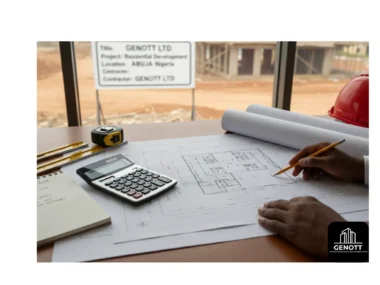
1. Project Scope Analysis
Contractors begin by reviewing:
-
Architectural drawings.
-
Structural design.
-
Site location.
-
Project timeline.
Clear scope reduces pricing uncertainty.
2. Bill of Quantities (BOQ) Preparation
The BOQ lists:
-
Quantity of materials.
-
Labour requirements.
-
Equipment needs.
This forms the backbone of building project cost estimation Nigeria professionals use.
3. Material Cost Calculation
Materials often represent 50–60% of project cost.
Examples:
-
Cement.
-
Reinforcement steel.
-
Blocks.
-
Roofing sheets.
Contractors track market prices carefully.
4. Labour Cost Assessment
Labour cost varies based on:
-
Skilled vs unskilled workers.
-
Urban vs rural locations.
-
Project complexity.
Labour cost estimation is crucial in contractor pricing structure Nigeria.
5. Equipment and Logistics Cost
Includes:
-
Machinery rental.
-
Transportation.
-
Fuel expenses.
Sites with poor road access increase cost.
6. Overheads and Profit Margin
Contractors include:
-
Office expenses.
-
Staff salaries.
-
Risk buffer.
-
Profit margin.
Typical margin: 10–20%.
7. Risk and Contingency Allowance
Construction tender pricing Nigeria projects usually include risk factors such as:
-
Inflation.
-
Project delays.
-
Weather conditions.
Cost Analysis and Investment Insights
Sample pricing structure:
| Cost Category | Percentage of Total |
|---|---|
| Materials | 50–60% |
| Labour | 20–30% |
| Equipment & Logistics | 5–10% |
| Overhead | 5–10% |
| Profit Margin | 10–20% |
Investment insight:
Understanding this breakdown helps clients negotiate intelligently.
Pricing Methods Compared
| Method | Advantages | Disadvantages |
|---|---|---|
| Cost per Square Meter | Quick estimate | Less precise |
| BOQ Pricing | Detailed accuracy | Requires expert preparation |
| Lump Sum Contract | Predictable cost | Less flexibility |
Common Mistakes Nigerians Make
-
Comparing contractor prices without reviewing scope.
-
Choosing lowest bid without cost breakdown.
-
Ignoring contingency allowance.
-
Not verifying material quality assumptions.
-
Skipping professional quantity surveyor review.
Expert Recommendations
-
Request detailed BOQ before approving price.
-
Compare scope, not just final amount.
-
Understand contractor margin structure.
-
Monitor market prices regularly.
-
Engage professional project managers.
Future Trends in Construction Pricing
-
Digital cost estimation software.
-
Prefabrication reducing labour dependency.
-
Sustainable materials impacting pricing models.
-
Increased compliance costs in major cities.
FAQs
1. How do contractors calculate building cost in Nigeria?
Using material quantities, labour estimation, equipment costs, overhead, and profit margin.
2. Why are Abuja projects sometimes more expensive?
Higher regulatory requirements and land cost.
3. Is lump sum pricing safe?
Yes, if scope is clearly defined.
4. Should I hire a quantity surveyor?
Highly recommended for accurate pricing.
5. How can I avoid overpricing?
Request detailed cost breakdown and compare multiple quotes.
6. Why do contractor quotes vary so much?
Different assumptions on materials, labour, and profit margin.
7. What is cost per square meter pricing?
A simplified method using building size to estimate cost.
8. Can I negotiate contractor pricing?
Yes — by reviewing cost breakdown and scope details.
9. What affects construction pricing most?
Material prices and labour cost.
CONCLUSION
Understanding how construction companies price projects in Nigeria empowers clients to make informed decisions, negotiate effectively, and avoid costly misunderstandings. By learning how pricing structures work — from BOQ preparation to labour cost estimation and risk allowances — builders and investors can approach construction projects with confidence and financial clarity.
For professional architecture, construction cost estimation, and integrated project planning tailored to Nigerian conditions, GENOTT LTD provides expert guidance throughout every stage of your project.

 GENOTT LTD Editorial Team